Table of Contents
- Key Takeaways
- What is clash detection?
- Why rework happens in steel detailing projects?
- How does this reduce rework?
- Key benefits of early clash detection
- BIM-based coordination in modern projects
- Real project example
- Final thoughts
- Frequently asked questions
Key Takeaways
- Clash detection determines design clashes prior to the start of fabrication and construction.
- Coordinating BIM contributes to minimising rework, delays, and material waste.
- Preparing accurate details to help acknowledge this boosts the standard of the project and the construction efficiency.
- 12 Meter Engineering operates using cutting-edge BIM and detailing processes to ensure successful projects.
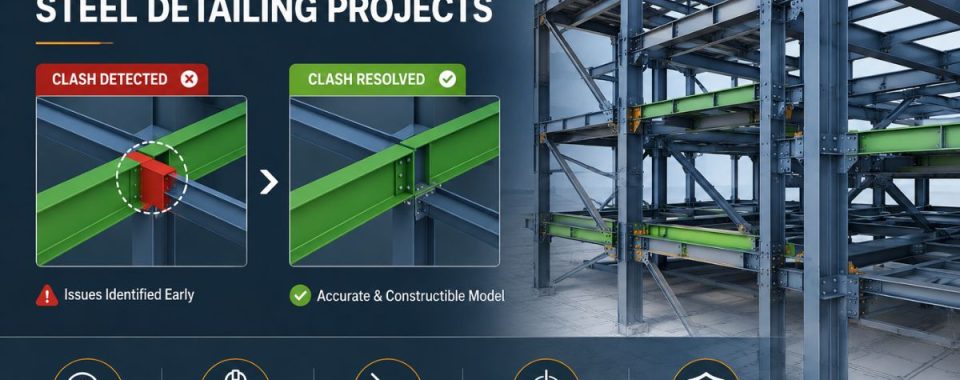
Through clash detection, steel detailing projects minimise rework by detecting conflicts between structural steel, MEP and architecture before construction. By detecting issues early, project teams can avoid costly site modifications, delays, material wastage, and fabrication errors.
With the complexity of construction projects, companies with structural steel detailing USA services are turning to BIM clash detection to enhance project coordination and accuracy. This proactive solution prevents problems with designs while they are still being planned, not as they’re being built or installed.
What is clash detection?
Clash detection is a digital method to detect clashes between different building systems in a 3D model.
Under the advanced BIM services in the USA, project teams can look at the structural, architectural, mechanical, electrical and plumbing models simultaneously to detect clashes ahead of construction.
Common Types of Clashes
| Clash Type | Description |
| Hard Clash | Two physical components occupy the same space |
| Soft Clash | Required clearance or maintenance space is violated |
| Workflow Clash | Construction sequencing or access issues occur |
Furthermore, this is a way for detailers, engineers, fabricators, and contractors to avoid costly issues before they start.
Why rework happens in steel detailing projects?
Rework is one of the major cost drivers for construction projects.
Common causes include:
- Incomplete design coordination
- Conflicting project drawings
- Errors in steel connections
- Misaligned structural elements
- Late design revisions
- Poor communication among stakeholders
When not coordinated, even a small detail error can cause delays in fabrication, site changes and budget overruns.
That’s why the steel detailing services in the USA industry are increasingly adopting clash detection as part of their processes.
How does this reduce rework?
1. Identifies Conflicts Before Fabrication
Steel parts are made from approved drawings. If a clash is identified early, it can be adjusted on the models prior to the creation of the steel members. This helps to avoid fabrication mistakes and material waste.
2. Improves Drawing Accuracy
Project information needs to be coordinated for accurate detailing. Clash detection is a way of making sure that production drawings such as fabrication drawings, erection drawings and steel fabrication drawings services in USA align with architectural and MEP requirements. This means that there are fewer revisions to come later.
3. Enhances Team Collaboration
Today, BIM software enables different design professions to collaborate on the same design model.
This enhances the communication between the following:
- Structural engineers
- Steel detailers
- Architects
- Fabricators
- Contractors
However, project risks also drop considerably when all work is done in conjunction with coordinated information.
4. Reduces Construction Delays
When unexpected conflicts are found during installation work, the project is halted. Smoother construction schedules and cost-saving downtime are eliminated by resolving issues in the design phase.
5. Minimises Material Waste
Often steel parts are incorrectly manufactured and must be replaced or modified. Clash detection early helps to reduce waste of materials and enables better project delivery.
Key benefits of early clash detection
Clash detection benefits in several ways for organisations that do so as part of their detailing process.
- Better Cost Control
It is much cheaper to fix the problems manually than to fix them digitally.
- Higher Project Quality
Models that are coordinated result in more accurate drawings and improved installation results.
- Faster Project Delivery
Fewer design conflicts mean fewer delays and change orders.
- Improved Safety
Conflict resolution prior to construction helps to minimise site risks and plan for installation.
- Greater Client Satisfaction
On-time and under-budget projects build trust and sustainability with clients.
BIM-based coordination in modern projects
Clash detection is a fundamental component of high-end BIM services now in the USA.
The best firms employ BIM technology to develop extremely coordinated 3D models which facilitate the following:
- Design validation
- Fabrication planning
- Construction sequencing
- Quantity estimation
- Facility management
Moreover, the use of BIM in coordinating problems makes it easier for project teams to spot issues early on and stay accurate throughout the project life cycle at 12 Meter Engineering.
For heavy industrial, commercial and infrastructure projects, BIM has become a key piece to the steel detailing puzzle.
Real project example
The challenge of a multi-level commercial building with structural steel beams running in the path of HVAC duct routing is a situation to consider.
If there was no clash detection, it wouldn’t be found until the project was installed, involving alterations to the beam, fabrication changes, and project delays.
Therefore, the conflict was identified in the detailing stage by using BIM co-ordination and clash detection. Engineers made ductwork changes while still meeting structural specifications.
The result included:
- Zero fabrication rework
- Faster installation
- Reduced project costs
- Better coordination amongst stakeholders
That’s what makes companies like 12 Meter Engineering invest in advanced detailing and co-ordination technology, and it’s a proactive problem-solving approach that will keep them in business.
Final thoughts
With the rise of modern steel detailing, clash detection is an important aspect of the process, as it helps in avoiding expensive errors that would affect the fabrication and construction process. Early detection of conflict can increase project team coordination, decrease delays, lower onsite material waste and increase project quality.
The complexity of the project always keeps growing; thus, it is essential to work with experienced service providers in structural steel detailing services in USA. Advanced BIM processes and clash detection features, such as those offered by 12 Meter Engineering, enable companies to deliver projects accurately, efficiently, and cost-effectively.
By opting for professional steel detailing services and BIM coordination, you can boost accuracy in your detailing, minimise rework, and ensure smoother project execution in the long run.
Frequently asked questions
In the clash detection process, engineers analyse conflicts that occur between steel components and other building systems in the 3D BIM model before work starts, avoiding conflicts after construction.
It helps minimise fabrication error, reduce rework, minimise delay, and increase overall project accuracy.
BIM integrates all kinds of discipline models within a single environment, enabling teams to identify and resolve conflicts before construction.
Yes. It is much more cost-effective to uncover problems at the design stage than during the fabrication or installation process.
The benefits are most beneficial to large commercial buildings; industrial, healthcare, infrastructure, and complex buildings