Table of Contents
- Key takeaways
- What makes precast detailing important in modern modular construction?
- How does precast detailing improve design accuracy and planning?
- Why does precast detailing reduce construction time and cost?
- How does precast detailing support better quality and safety?
- Why is precast detailing ideal for large-scale modular projects?
- How does digital precast detailing support future-ready construction?
- Conclusion
- Frequently asked questions
Key takeaways
- Precast detailing enhances accuracy and eliminates site mistakes
- It saves time and cost involvement in Modular Construction Projects
- Quality and safety are improved by detailed precast planning
- Large modular projects benefit the most from structured detailing
Precast detailing assists in making modular construction quicker, precise, and dependable. It produces transparent shop drawings and digital models before the start of manufacturing, which minimizes mistakes on site. In the case of companies that provide precast detailing services in USA, this method has been critical in providing quality modular projects with reduced delays and cost management.
Contemporary modular building depends on accuracy. Thus, precast detailing is important in bridging the gap between design and real construction. At 12 Meter Engineering, practical experience in the real project has demonstrated that good detailing is not just technical work but the key to successful modular buildings.
What makes precast detailing important in modern modular construction?
Modular construction is founded on repeatable off-site units. Nonetheless, minor design errors may impact hundreds of modules. Precast detailing is the solution to this issue because it clarifies all the elements before the production begins.
Precast detailing is concerned with:
- Proper sizes of walls, slabs, beams, and columns.
- Correct positioning of reinforcement and embedded objects.
- Integration of architectural, structural, and MEP systems.
Additionally, the process guarantees that the design can be manufactured and assembled. Consequently, it minimizes site confusion and streamlines construction. 12 Meter Engineering has realistic detailing workflows that mirror actual site circumstances, which creates confidence in contractors and developers.
How does precast detailing improve design accuracy and planning?
One of the largest benefits of precast detailing is design accuracy. Detailed shop drawings and 3D models are developed early on instead of using general drawings.
This enhances the planning in a number of ways:
- Structural and service conflicts are detected at an early stage.
- Connection and load paths are well established.
- Material quantities are calculated accurately
Moreover, proper detailing enables teams to schedule transportation, lifting points, and installation sequences. Therefore, the whole project is predictable. Design can consume a little more time at the beginning, but it will save a lot of time in implementation.
This degree of accuracy is not a choice but rather normal in international markets, even in projects financed by precast detailing services in Australia.
Why does precast detailing reduce construction time and cost?
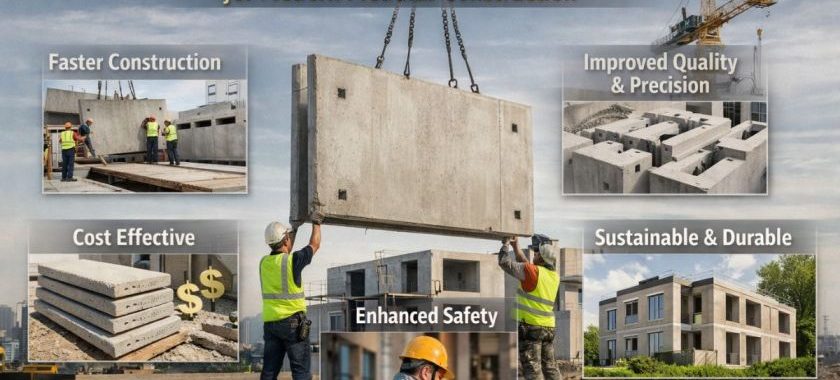
One of the reasons why modular construction is on the increase is time and cost control. Precast detailing directly supports either.
Here is how it reduces time:
- Components are manufactured correctly the first time.
- Minimal on-site rework and corrections are avoided.
- The clear assembly instructions make installation quicker.
Cost savings come from:
- Reduced material waste
- Lower labor costs on site
- Reduced design error delays.
Furthermore, when the problem is solved on-site, it is much more expensive, whereas with precast projects, which are well-documented and are not dependent on the physical location, the project tends to remain within the original budget.
A reputable firm has found that well-documented precast projects tend to remain within their original budgets, unlike the traditional construction methods.
How does precast detailing support better quality and safety?
Construction is closely associated with quality and safety. Improvisation on-site is unsafe because of poor detailing. This is prevented by precast detailing, which gives clear and approved instructions.
Quality benefits include:
- Regular manufacturing of parts in regulated settings.
- Improved surface finish and dimensional accuracy.
- Distinct quality inspection points.
The safety enhancements are
- Less cutting, drilling, and on-site modifications.
- Improved scheduling of lifting and installation procedures.
- Reduced chances of structural errors during construction.
Moreover, when employees are guided by the prepared drawings, they are more confident. This trust results in more effective and safer working practices. Therefore, precast detailing promotes technical quality and human safety.
Why is precast detailing ideal for large-scale modular projects?
Modular projects entail repetition on a large scale. Repetition may increase errors without good detailing. Precast detailing is used to make sure that after perfecting a certain module, it can be repeated safely and accurately.
The major benefits of large projects include:
- Standardized elements in various buildings.
- Quickened approval processes once initially validated.
- More convenient communication between various teams.
However, big projects tend to have several stakeholders. Detailed precast drawings serve as a single source of truth. Experienced teams regularly collaborate with architects, engineers, and contractors to make sure that all parties are using the same detailed information to avoid misunderstandings.
How does digital precast detailing support future-ready construction?
Contemporary precast detailing is intimately connected with the digital workflow. These processes facilitate sustainability and long-term performance.
Digital precast detailing is useful because:
- Facilitating the identification of clashes prior to construction.
- Favoring evidence-based decision-making.
- Enabling more convenient updates and revisions.
Additionally, digital models can be repurposed to maintain and make modifications in the future. Asset owners are concerned with this long-term value. Furthermore, precast detailing is not only construction-related but also helps with the entire building cycle.
Conclusion
The precast detailing has been an essential need of current modular construction. It enhances precision, time-saving, cost management, and quality and safety. Companies such as 12 Meter Engineering use real-world experience and technical know-how to provide detailing that is functional on the real sites and not on paper.
Furthermore, With the growing digitalization and modularity of construction, the combination of detailed planning and BIM services in USA is further enhancing the results of projects and building practices that are future-proof.
Frequently asked questions
It is the process of creating detailed drawings for precast concrete components before manufacturing.
No, even minor modular projects will be more accurate and planned.
Slightly, but it will greatly decrease construction delays and rework in the future.