Table of Contents
- Key Takeaways
- Why does rebar detailing matter for structural safety?
- What are the most common rebar detailing mistakes?
- How do poor drawings lead to site-level errors?
- Why is lack of coordination a hidden risk?
- How can wrong bar placement weaken a structure?
- What happens when codes and standards are ignored?
- How can these mistakes be prevented effectively?
- Conclusion
- Frequently asked questions
Key Takeaways
- Small detailing errors in rebar can lead to major structural failures
- Clear drawings prevent site-level confusion
- Coordination is just as important as calculation
- Expert review helps prevent costly repairs
The errors in rebar detailing are the frequent causes of cracks, load failure, and unsafe buildings. These mistakes are normally caused by lack of proper planning, sketching, or coordination. Consequently, it is necessary to learn about the frequent errors and how to avoid them to have long-term and safe buildings. Here rebar detailing services in USA are very significant.
At 12 Meter Engineering, they have experienced enough to prove that one small mistake can lead to major structural risks if ignored.
Why does rebar detailing matter for structural safety?
Rebar detailing is the connection between the design and the construction. It informs the site teams on the location, quantity, and method of the required steel. Concrete is not safe when it is not under pressure, but when steel bars are installed in the right manner, it becomes safe.
Additionally, rebar detailing guarantees the following:
- Proper load transfer
- Crack control
- Long-term durability
- Follow the safety codes.
However, even the best materials are not able to rescue the structure when the detailing is wrong. According to the experience in the industry, 12 Meter Engineering has observed that most failures begin on paper, rather than on the ground.
What are the most common rebar detailing mistakes?
The majority of rebar problems are due to recurrent and preventable mistakes. These errors can be minor, but they undermine the whole structure gradually.
The most common errors are:
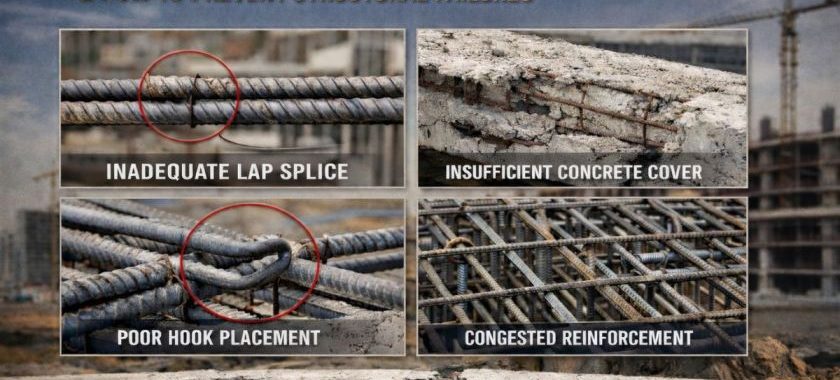
- Lacking bar sizes or spacing information.
- Incorrect lap length
- Poor anchorage details
- Excessive reinforcement areas.
- Confusing bar marks
Moreover, in cases where drawings are done in a hurry, mistakes are more frequent. That is why rebar detailing services in Australia pay much attention to accuracy and clarity.
How do poor drawings lead to site-level errors?
Poor drawings mislead workers and engineers at the site. Consequently, the steel is put in the wrong position or altered without permission.
Common drawing problems:
- Lap bars without a clear spacing.
- Missing section views
- Inconsistent dimensions
- No clear bending schedules
Nevertheless, simple drawings are easy to comprehend, which minimizes guesses. At 12 Meter Engineering, teams always place a premium on easy-to-read detailing, since site teams operate under time constraints and pressure.
Therefore, elaborated drawings minimize the wastage of materials and reworking expenses.
Why is lack of coordination a hidden risk?
Rebar detailing is not a one-man task. It should be in coordinate with architectural and structural plans. In case of poor coordination, conflicts emerge in the course of construction.
The coordination problems normally occur between the following:
- Building and planning designs.
- Rebar and MEP services
- Intersections between columns and beams.
Furthermore, most companies are currently consulting a BIM services provider in the USA to identify clashes at an early stage. BIM enables the teams to visualize reinforcement prior to construction.
Even though BIM is not compulsory in all places, it reduces risk to a significant extent when applied appropriately.
How can wrong bar placement weaken a structure?
Correct placement is as important as correct design. Even the best drawing cannot work when bars are not correctly put on the site.
Placement errors include the following:
- Bars shifted from the center.
- Lack of concrete cover.
- Incorrect bar bending
- Missing ties or stirrups
These mistakes decrease the carrying capacity and accelerate corrosion. Additionally, bar problems are usually overlooked in inspection reports after the concrete has been poured.
This is the reason why detailed teams who have experience incorporate site-friendly notes to ensure that they know where to place them.
What happens when codes and standards are ignored?
All countries have stringent structural codes. It is dangerous to disregard them.
Typical errors in code:
- Wrong lap lengths
- Inadequate anchorage
- Improper bar grade usage.
- Non-standard spacing
Whereas there are teams that attempt to reduce costs, disregard of codes adds to the repair costs in the long run. Moreover, reputable companies adhere to the international and local standards.
At 12-meter engineering, all drawings are verified by code requirement prior to delivery.
How can these mistakes be prevented effectively?
It is not hard to prevent rebar detailing errors, but it takes discipline, experience, and review.
Best prevention practices:
- Apply simple and clear detailing.
- Double-check bar schedules.
- Conduct peer reviews.
- Arrange with architectural drafting services teams.
- Only follow the accepted standards.
Moreover, the communication between the designers and the site engineers should be open. When queries are addressed at the initial stages, mistakes diminish automatically.
Besides, the trained detailing teams carry the experience of the previous projects, which enhances the accuracy in the future.
Conclusion
Mistakes in rebar details are frequent, but they can be avoided. Structural failures can be prevented with the right planning, drawings, and professional examination. However, the selection of skilled partners such as 12 Meter Engineering will guarantee precision, security, and durability. In addition, rebar detailing services in the USA with trust in them can assist in providing reliable structures that satisfy the safety and performance expectations.
Frequently asked questions
It makes sure that the steel is installed in the right position to hold the loads and prevent structural damages.
Yes, neglecting the detailing of errors over a long period can make the structures weak.
Through detailed experience, reviews, and proper coordination.
Yes, it aids in the early detection of clashes and placement problems