Table of Contents
- Key Takeaways
- What are the most common precast detailing errors?
- How can connection detailing errors be fixed early?
- Why do dimensional mistakes create major site problems?
- How does poor coordination affect precast projects?
- What happens when reinforcement detailing is incorrect?
- How can drawing clarity reduce fabrication errors?
- What role does quality checking play in error reduction?
- How experienced teams prevent repeat mistakes?
- Conclusion
- Frequently asked questions
Key Takeaways
- Most precast detailing errors are preventable with early review
- Connection and dimensional errors are the leading causes of site delays.
- Coordination using BIM drastically reduces clashes.
- Clear drawings and quality checks improve project success
Precast detailing mistakes are normally caused by rushed drawings, lack of coordination, and experience. Even minor errors in precast detailing services in USA may slow down the fabrication process, increase cost, and lead to site rework. Therefore, it is important to detect typical mistakes at the initial stage and correct them appropriately to ensure the project is carried out smoothly.
At 12 Meter Engineering, years of practical experience in precast detailing have demonstrated that most problems can be avoided through the appropriate process.
What are the most common precast detailing errors?
Even though each project is unique, the majority of precast issues can be grouped into several patterns. Additionally, such mistakes are usually not realized until production or construction commences.
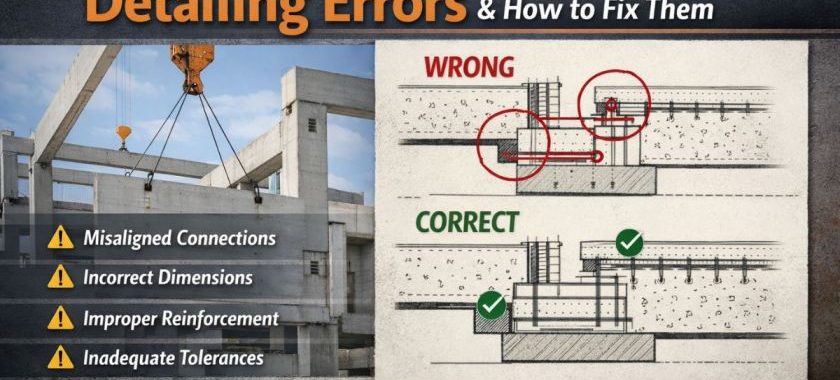
The most common mistakes are:
- Incorrect panel dimensions
- Lacking or incomplete connection information.
- Clash conflicts with structural or MEP items.
- Inappropriate reinforcement location.
- Unfinished or incoherent shop drawings.
These might be tiny on paper, but they cause severe delays on the field. Furthermore, it is significant to learn the details of every mistake.
How can connection detailing errors be fixed early?
Connection detailing errors are among the largest causes of precast failure. Installation is dangerous or impossible when inserts, embeds, or lifting points are not correctly depicted.
Common connection problems:
- Embed plates too near edges.
- Lack of tolerance allowances.
- Disagreement between panel and structure connections.
How to fix them:
- Connection loads should always be checked with structural purpose.
- Where possible, use standardized connection details.
- Include detailed notes and section views on complicated areas.
12 Meter Engineering makes sure that connection details are not only cross-checked with drawings but also with erection logic. This leads to fewer surprises in site teams.
Why do dimensional mistakes create major site problems?
The dimensional errors are expensive since the precast elements are produced elsewhere. Once cast, it is hard and costly to change.
Common dimensional issues:
- Incorrect panel thickness
- Inappropriate door and window size.
- Lack of alignment between the architectural and structural grid.
These problems usually occur in case architectural drafting services are not properly coordinated with precast drawings.
Practical fixes:
- Architectural drawings of locks must be locked down prior to elaboration.
- Check dimensions with grid lines, not only scaled drawings.
- Do internal dimension audits prior to the final issue.
However, dimensional accuracy should be considered as a priority rather than a checklist item.
How does poor coordination affect precast projects?
Precast detailing is not an isolated process. It is very reliant on architectural, structural, and MEP inputs. Nevertheless, lack of coordination is one of the major causes of rework.
In precast detailing services in Australia, there are usually gaps in coordination that arise due to failure to share updated drawings in time.
Types of coordination failures are the following:
- Clashes with HVAC ducts or sleeves
- Interactions between facade panels and structural beams.
- Lacking electrical parts recesses.
The way to prevent coordination problems:
- Clash detection Use coordinated BIM models.
- Arrange frequent coordination meetings.
- Revise the track drawing effectively.
Moreover, these coordination risks are minimized when one has a trusted BIM services provider in Australia.
What happens when reinforcement detailing is incorrect?
The wrong reinforcement description influences the safety and durability. Additionally, errors in reinforcement may lead to rejection at quality checks.
Common reinforcement errors:
- Incorrect bar spacing
- Lack of corner reinforcement.
- Wrong lap lengths
- Congestion at connection zones
How to correct reinforcement errors:
- Follow project-related reinforcement standards.
- Include definite bar-bending schedules.
- Enlarge views when there is congestion.
At 12 Meter Engineering, the reinforcement detailing is checked in terms of structural safety and constructability. This will enhance trust and reliability.
How can drawing clarity reduce fabrication errors?
Correct details may not work even when there are drawings that are not clear. Fabrication teams are not based on assumptions but on shop drawings.
Common clarity issues:
- Overcrowded drawings
- Missing legends or notes
- Confusing callouts
Easy methods of making things clearer:
- Restrict the amount of information per drawing sheet.
- Apply standard symbols and terminology.
- Emphasize important dimensions and tolerances.
Understandable drawings minimize queries, rework, and time wastage. Hence, simplicity is an advantage, rather than a drawback.
What role does quality checking play in error reduction?
Most of the errors are not design problems, but review failures. In the absence of an effective quality check procedure, errors creep in.
Proper quality checking involves:
- Internal reviews that are independent.
- Cross-discipline verification
- Checklist-based approvals
Additionally, it is possible to check drawings through the eyes of a fabricator and an erector in order to detect concealed risks.
One of the reasons why experienced firms always provide correct precast detailing is a structured review system.
How experienced teams prevent repeat mistakes?
Experience contributes significantly to the minimization of errors. The teams that comprehend the challenges encountered in the real-world sites can anticipate issues at an early stage.
What experienced teams do differently:
- Use the experience of previous projects.
- Standardize effective practices in detailing.
- Speak directly with clients and contractors.
12 Meter Engineering is a process-driven company that is not based on assumptions. Consequently, errors are reduced in the form of repeat errors in projects.
Conclusion
To prevent the errors of precast detailing, it is necessary to have experience, coordination, and disciplined quality checks. Even minor mistakes can cause massive delays in complex projects, particularly in projects that require architectural drafting services. However, it is certain that working with such an experienced partner as 12 Meter Engineering, the accuracy, constructability, and easier project delivery between detailing and installation will be guaranteed.
Frequently asked questions
Connections that describe errors result in the greatest site and safety problems.
Once architectural and structural drawings are complete.
Yes, BIM can be used to identify clashes prior to fabrication.