
Table of Contents
- Key Takeaways
- What are precast concrete shop drawings and why are they needed?
- Who uses precast shop drawings in real projects?
- Step 1: How do you study design and contract drawings?
- Step 2: How do you plan panels, connections, and layouts?
- Step 3: How do you add dimensions, levels, and tolerances?
- Step 4: How is reinforcement detailed clearly?
- Step 5: How are embeds, inserts, and openings shown?
- Step 6: How do you check constructability and clashes?
- Step 7: How are shop drawings reviewed and approved?
- Common mistakes to avoid while preparing precast shop drawings
- Conclusion
- Frequently asked questions
Key Takeaways
- Precast shop drawings convert concepts into workable instructions for construction
- Well defined reinforcement and embed detailing eliminates site errors
- Professional teams 12 Meter Engineering provide a level of trust and reliability to precast projects
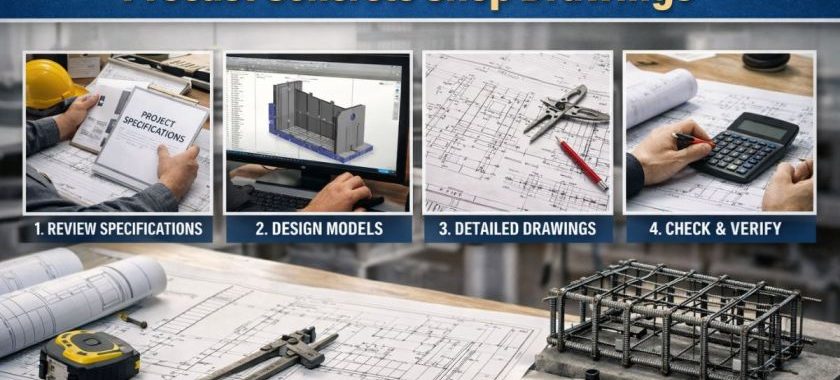
Precast concrete shop drawings describe the process of making, lifting, and placing each precast element on site. The step-by-step process provides a clear procedure to make correct, approval-ready drawings, which are usually helped by precast detailing services in USA, to reduce the number of errors, and the construction process is smooth throughout.
At 12 Meter Engineering, experienced detailers follow this exact process to provide clear, practical, and reliable precast shop drawings for actual projects.
What are precast concrete shop drawings and why are they needed?
Precast concrete shop drawings are elaborate technical drawings that are made after the approval of the design. They convert design intent to precise manufacturing and installation instructions.
These drawings often comprise
- Panel sizes and thickness
- Reinforcement details
- Lifting points and inserts
- Connections to other elements
- Door, window, and service opening.
Therefore, precast elements might not fit, align, and work as intended without proper shop drawings. Furthermore, the clear drawings will minimize site confusion, delays, and expensive rework.
Who uses precast shop drawings in real projects?
Precast shop drawings are not prepared by a single individual. Rather, they sponsor the entire construction team.
They are used by:
- Casting element precast manufacturers.
- Installation planning site engineers.
- Design engineers to verify structures.
- Architects to check the visual and alignment.
All these users are taken into consideration in the preparation of the drawings at 12 Meter Engineering, which makes them easy to read and apply on-site.
Step 1: How do you study design and contract drawings?
The initial one is thorough research. You have to be well versed with the project documents before you make any drawing.
This includes:
- Structural drawings
- Architectural layouts
- Specifications and notes
- Contract requirements
But here lots of mistakes begin as some details are neglected. Moreover, it is important to check load paths, panel locations, and design assumptions.
In case of any confusion, it must be clarified at the initial stage with the design team. This will save time in the future in approval and production.
Step 2: How do you plan panels, connections, and layouts?
Planning is the second step after design intent.
This stage focuses on:
- Breakdown of panels according to transport limits.
- Combined positions of simple installation.
- Types of connection between panels and structure.
Additionally, lifting capacity, crane reach, and site access should be taken into consideration during the planning. A proper layout ensures that production is quicker and site work is easier.
Precast detailing services in Australia are also used in many international projects at this stage to conform to local codes and site practices.
Step 3: How do you add dimensions, levels, and tolerances?
Shop drawings are based on accurate dimensions.
Each precast element must clearly show:
- Total length, width, and thickness.
- Levels and elevations
- Fabrication and erection tolerances.
Even though tolerances might appear insignificant on paper, they can be very important in the field. Therefore, they ought to be presented in an understandable and consistent manner.
Moreover, views should never have conflicting dimensions. It is necessary to cross-check plans, sections, and elevations.
Step 4: How is reinforcement detailed clearly?
The reinforcement detailing specifies the strength of the precast element.
This includes:
- Bar size and spacing
- Mesh details
- Cover requirements
- Additional reinforcement around openings.
Furthermore, reinforcement drawings should be equal to structural calculations. Any discrepancy may be rejected in the course of review.
At 12 Meter Engineering, reinforcement is also elaborated with clear callouts and simple notes, which the factory teams can follow without any confusion.
Step 5: How are embeds, inserts, and openings shown?
Ready-made components can have numerous inbuilt components.
These may include:
- Lifting anchors
- Connection plates
- Electrical conduits
- Window and door openings
However, the location of every embed and opening should be found accurately with respect to fixed reference points.
Additionally, the coordination with architectural drafting services is used to make sure that the openings are perfectly matched with the finishes, facades, and interior layouts.
Step 6: How do you check constructability and clashes?
Drawings should be checked in terms of constructability prior to submission.
The step will respond to questions such as
- Is it safe to lift this panel?
- Will it conflict with beams, columns, or services?
- Is the sequence of installation practical?
Additionally, the comparison of drawings with 3D models or coordination drawings can be used to detect problems at an early stage. It is much easier to fix the problems at this stage than on-site.
Step 7: How are shop drawings reviewed and approved?
Shop drawings are presented after internal reviews.
The approval process generally entails:
- Structural safety engineer review.
- Architect inspection of alignment and appearance.
- Remarks by clients or consultants.
Nevertheless, remarks are not to be regarded as rejection. On the contrary, they enhance transparency and security.
Common mistakes to avoid while preparing precast shop drawings
Even the more experienced teams may make errors. Being aware of the pitfalls prevents them.
Typical issues include:
- Lack of dimensions or references.
- Improper placement of reinforcement.
- Beyond lifting limits, overloaded panels.
- Lack of coordination with architectural layouts.
Moreover, a well-organized process and a careful examination of drawings minimize the risk and enhance trust.
Conclusion
Design, manufacturing, and construction are interlinked, and precast concrete shop drawings are a complex process. Through simple steps, teams are able to minimize mistakes and wastage of time and construct with confidence. Through the masterful assistance of 12 Meter Engineering and the appropriate application of precast detailing services in the USA, the projects are completed with accuracy, safety, and easy construction between the factory and the site.
Frequently asked questions
They control the manufacturing, lifting, and installation using precise technical specifications.
Well-trained precast detailers who are well versed in structural and construction knowledge.
Once the design is approved and precast manufacturing has not begun.