
Table of Contents
- Key Takeaways
- What is precast erection in construction?
- Why is precast erection important?
- Step-by-step process of precast erection
- What methods are used in precast erection?
- What are the key benefits of precast erection?
- Role of detailing in successful erection
- Common challenges during precast erection
- Conclusion
- Frequently asked questions
Key Takeaways
- Precast erection is the process of installing concrete elements that are manufactured in factories at the construction sites.
- Safe installation requires proper detailing and planning.
- Precasts save much time and labor during construction.
Precast erection involves the construction of factory-manufactured concrete elements at the construction sites by using cranes and equipment. It enhances speed and accuracy. Therefore, companies such as 12 Meter Engineering assist in the development of projects by drawing accurate drawings and technical specifications to make construction safe and efficient.
What is precast erection in construction?
Precast erection entails the construction of factory-produced concrete components like walls, beams, and slabs in the field. They are placed by cranes as per engineering drawings.
Moreover, correct precast connection details provides correct alignment and good structural connection as well as minimizes installation mistakes in the course of construction.
Why is precast erection important?
Precast erection is a very important aspect in contemporary construction since it enhances efficiency and the quality of the structure. Traditional buildings may take more time to cure and more labor on the site. Precast systems, however, minimize these challenges.
Precast erection is extensively used due to some of the following reasons:
- Reduced construction schedules.
- Greater quality control in factory manufacturing.
- Less site labor is needed.
- Better safety in the construction.
- Regular structural performance.
Moreover, infrastructure works and major commercial constructions also depend on the service of specialized erection drawings services in Australia so that all the precast elements are accurately placed and fitted in an ideal manner.
Furthermore, companies such as 12 Meter Engineering assist project teams to come up with elaborate erection plans such that construction teams have clear guidelines to follow when installing.
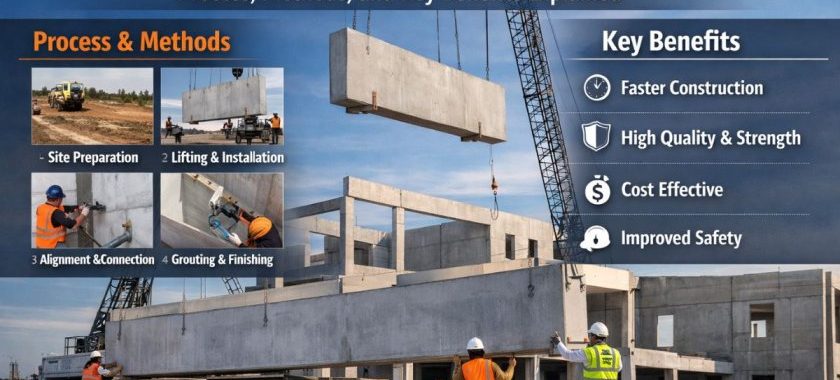
Step-by-step process of precast erection
The precast erection is a structured workflow in order to be safe and accurate. Every phase should be well thought out before it is installed.
1. Planning and design
Structural drawings and installation plans are made by engineers and detailing specialists. These are documents that are used to direct the whole erection process.
2. Fabrication of precast components
Elements made of concrete are produced under controlled factory conditions. This is done to guarantee consistency in strength and quality.
3. Transportation to site
Once the production is done, the precast elements are then moved to the construction site with special vehicles.
4. Site preparation
The base and the pillars should be prepared prior to the construction.
5. Lifting and positioning
Cranes pick up precast elements and lay them in the manner of installation drawings.
6. Alignment and fixing
Employees verify that everything is in place and fasten the parts with connectors and structural supports.
However, projects tend to rely on precast fabrication drawings services in Australia to make sure that all the components are manufactured and installed correctly.
What methods are used in precast erection?
Various erection techniques are applied based on the type of building, size of the component, and the project needs. The selection of the appropriate method contributes to the enhancement of safety and efficiency in the course of installation.
The precast erection methods that are commonly used include:
- Crane-Based Installation
It is the most commonly used method. Heavy precast components are picked by large cranes and fitted at their exact positions.
- Modular Assembly Method
In this approach, several precast units are put together and then installed. This decreases the time of erection and accelerates construction.
- Sequential Erection Method
Elements are fitted in a premeditated order. This is applicable to intricate structures in which alignment is of paramount importance.
Additionally, the projects may be based on precast panel detailing services in Australia to create proper panel layouts and installation instructions.
Therefore, the choice of the appropriate erection method contributes to the structural safety and enhances the productivity of the construction.
What are the key benefits of precast erection?
Precast erection has a number of benefits that have made it a choice of construction technique in most of the current projects.
- Faster Construction
Components are produced in advance, and hence the construction process is significantly faster.
- Better Quality Control
The production in factories guarantees the uniformity of quality of concrete and its correct dimensions.
- Reduced Labor Costs
Reduced on-site work will result in reduced labor needs and efficiency.
- Improved Safety
The risks involved in the traditional concrete pouring are minimized by controlled installation procedures.
- Environmentally Efficient
Precast production produces less construction waste and consumes more efficiently.
In Australia, many builders take the services of precast detailing, and 12 Meter Engineering offers detailing support and technical advice to install the details correctly.
Role of detailing in successful erection
Without detailing and engineering documentation, precast erection is not possible. Specific drawings provide instructions to the contractors during the installation process and avoid expensive errors.
Significant elements of detailing are the following:
- Dimensions of structural components.
- Reinforcement placement
- Lifting points for cranes
- Installation sequence
- Structural connections
With accurate detailing, contractors are able to do erection work more quickly and with fewer errors. Therefore, professional detailing companies like 12 Meter Engineering are significant in ensuring that the precast construction project is of quality and that it is structurally correct.Additionally, appropriate detailing enhances the coordination of architects, engineers, fabricators, and construction crews.
Common challenges during precast erection
Despite the numerous advantages of precast erection, some challenges might arise when the process is not handled in the right way.
Some common issues include:
- Misalignment of precast parts.
- Damage in delivery transportation.
- Low crane access at congested locations.
- Lack of coordination between design and installation teams.
- Unfinished or incorrect drawings of erections.
Nonetheless, these issues can be prevented by planning, effective project management, and elaborate engineering documentation.
Moreover , collaboration with the experienced engineering partners is beneficial to guarantee that the erection processes are carried out in accordance with the industry standards and safety precautions.
Conclusion
Precast construction accelerates the construction process and enhances safety and precision. Through adequate planning and description by 12 Meter Engineering, such solutions as precast detailing services in Australia are used to provide accurate installation and stable structural performance.
Frequently asked questions
Precast erection involves placement of manufactured concrete elements at the site with the help of cranes and engineered connection systems.
Precast elements are produced in advance, and they can be installed without having to wait until the concrete on site has cured.
Commonly used are cranes, lifting anchors, alignment tools, temporary supports, and safety systems.