Table of Contents
- Key Takeaways
- What is BIM in rebar detailing?
- How does BIM improve rebar detailing?
- How does BIM support clash coordination?
- How does BIM improve construction workflow?
- Conclusion
- Frequently asked questions
Key Takeaways
- BIM enhances precision in rebar detailing.
- Early detection of clashes minimizes rework at the site.
- Coordinated 3D models enhance team communication.
- The speed and organization of construction workflow are improved.
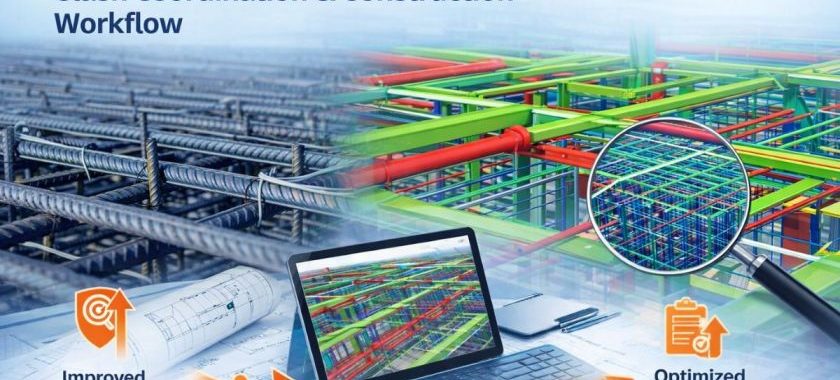
BIM enhances rebar detailing, clash coordination, and construction workflow through the creation of a clear 3D model prior to site work. It minimizes mistakes and time wastage and enhances coordination. This method is used by many firms that provide BIM services in Australia. However, BIM assists teams in solving problems at an early stage. 12 Meter Engineering provides well-coordinated solutions that are reliable with the help of BIM.
What is BIM in rebar detailing?
Rebar detailing using BIM refers to the development of a detailed 3D representation of the precise size, shape, spacing, and location of steel reinforcement bars within concrete buildings. Engineers do not work with 2D drawings only, but they use intelligent models.
Rebar detailing is a very sensitive part of construction because:
- A little error will lead to structural issues.
- Bar placement can slow down construction because of wrong placement.
- Wastage of materials raises the cost of the project.
Under BIM, rebar is represented as it will be laid on the ground. This enhances understanding among designers, structural engineers, and site teams. Being a reliable BIM services provider in Australia, 12 meter engineering is concerned with proper modeling in order to minimize confusion at the site.
Additionally, BIM models include bar bending schedules, quantities, and fabrication details. Therefore, the contractors will be able to plan the procurement and installation more effectively.
How does BIM improve rebar detailing?
BIM enhances rebar detailing by rendering it accurate, graphic, and aligned to other building components. This minimizes mistakes and enhances quality management.
Here’s how BIM helps:
- 3D Visualization- The engineers are able to view the reinforcement in actual form.
- Automatic Quantity Calculation- Accurate steel quantity minimizes wastage.
- Bar Bending Schedules- Generated directly out of the model.
- Simple Design Modifications- The changes in design reflect automatically in all the drawings.
In offering rebar detailing services in Australia, the experienced teams apply BIM tools to identify the congestion points in beams, columns, and slabs. This is quite crucial since excessive reinforcement may cause issues during the pouring of concrete.
BIM also enables the improved communication between site engineers and structural designers. In the case of a design change, it is updated in the model immediately. However, the possibility of the outdated drawings being applied on the site is reduced.
At 12 Meter Engineering, fieldwork experience in projects will be used to make sure that detailing is not only correct on the screen but also feasible in the field.
How does BIM support clash coordination?
Clash coordination refers to the detection and resolution of conflicts among various building systems such as structure, plumbing, HVAC, and electrical prior to construction.
In the absence of BIM, clashes are usually realized in the course of construction. This causes:
- Costly rework
- Project delays
- Material wastage
- Team conflicts
Nonetheless, BIM software identifies clashes automatically within the digital model. For example:
- Rebar clashing with pipes
- Beams that are in conflict with ducts.
- Columns that cause disruption of service lines.
Teams prevent site-level problems by resolving them during the design phase. Moreover, clash detection meetings are more constructive as teams do not have to talk about paper drawings but discuss visual models.
BIM coordination enhances the cooperation among the following:
- Structural engineers
- MEP engineers
- Architects
- Contractors
Moreover, fewer surprises occur in projects. This is a coordination method that makes this type of coordination one of the reasons why such companies as 12 Meter Engineering focus on BIM-based planning.
How does BIM improve construction workflow?
The flow of information between the design and the execution of construction work enhances the construction process. BIM links together the entire phases of a project into a single digital system.
This is how workflow can be improved:
- Better Planning
The fact that the whole structure is modeled in detail allows the project managers to plan timelines more accurately. Moreover, the schedules of the material delivery are better organized.
- Reduced Rework
Due to the early resolution of clashes, site teams do not spend much time correcting errors.
- Faster Decision-Making
Visual models enable the stakeholders to learn about issues in a short time. Therefore, the approvals become quicker.
- Improved Site Execution
The layouts of rebar are clear, coordinated drawings that minimize confusion to the site workers.
Below is a simple comparison:
| Without BIM | With BIM |
| 2D drawings only | 3D coordinated model |
| Frequent site clashes | Early clash detection |
| Manual quantity errors | Automated quantity take-off |
| Delays and rework | Smooth workflow |
Besides, BIM facilitates improved communication between the office and field teams. When all people are operating on the same updated model, there is more trust and less misunderstanding.
Furthermore, having a practical experience in various projects, 12 Meter Engineering can be sure that BIM models are realistic, constructible, and consistent with the actual construction environment.
Conclusion
BIM enhances rebar detailing, clash coordination, and construction workflow with a clear buildable 3D model that is developed prior to the commencement of site work. It reduces errors and delays.
Additionally, this is the method that is used by many firms that provide BIM services in Australia. 12 Meter Engineering utilizes BIM to provide accurate, efficient, and reliable project outcomes.
Frequently asked questions
BIM is a three-dimensional computer-aided design that is employed prior to the commencement of construction.
It enhances precision and synchronization and decreases the wastage of steel.
It eliminates expensive rework and construction delays.