Table of Contents
- Key Takeaways
- What is BIM coordination?
- Why does BIM coordination matter in steel fabrication?
- How does BIM support steel fabrication?
- Key benefits of BIM coordination
- Real-world project example
- Common challenges solved by BIM coordination
- Final thoughts
- Frequently asked questions
Key Takeaways
- BIM coordination helps to detect and resolve project conflicts before fabrication.
- It enhances the accuracy of detailing, efficiency of fabrication and erection planning.
- The application of BIM helps in minimizing rework and material wastage, minimizing project delays, and reducing construction costs.
- Digital models are more coordinated, and they allow for better collaboration between all project stakeholders.
By enhancing design accuracy, minimizing clashes and improving communication and streamlining project execution, BIM coordination is playing a vital role in structural steel fabrication. For companies that provide structural steel detailing in the USA, BIM serves as a way to bring architects, engineers, fabricators, and contractors together on a single coordinated model, eliminating costly mistakes before construction starts.
Construction projects are becoming increasingly complex, and steel fabricators must have accurate information to avoid rework, material loss, and delays. This is where BIM coordination becomes valuable. These advanced BIM workflows are beneficial for efficient fabrication, detailing, and erection planning of modern construction projects, as seen at industry leaders such as 12 Meter Engineering.
What is BIM coordination?
BIM (Building Information Modeling) coordination is the activity of merging the architectural, structural, MEP, and fabrication models into one and the same coordinated digital environment.
Key Objective
BIM coordination is mainly used to eliminate design clashes before the fabrication and construction process starts.
This process assists teams to:
- Detect clashes early
- Improve collaboration
- Reduce fabrication errors
- Streamline project workflows
- Enhance construction accuracy
Therefore, coordination is one of the most valuable stages in the successful delivery of projects for the organizations that offer BIM services in USA.
Why does BIM coordination matter in steel fabrication?
There is no room for error in structural steel fabrication. Any minor design differences can result in significant delays and loss of materials.
Without BIM Coordination
| Challenge | Impact |
| Design conflicts | Fabrication errors |
| Inaccurate dimensions | Material wastage |
| Poor communication | Project delays |
| Rework on-site | Increased costs |
| Installation issues | Schedule overruns |
With BIM Coordination
- Better fabrication accuracy
- Faster project delivery
- Reduced rework
- Improved quality control
- Enhanced site safety
That’s why BIM is now a must in the steel fabrication drawings services in USA.
How does BIM support steel fabrication?
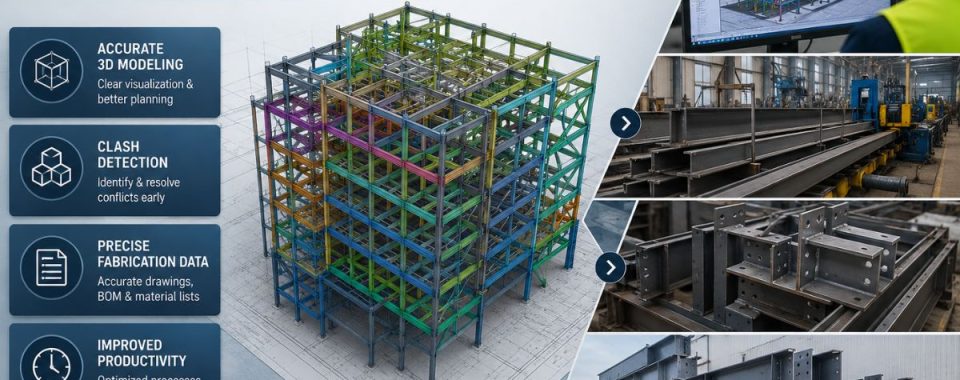
1. Clash Detection
The most significant benefit of BIM is the automated clash detection.
The system generates conflicts between:
- Structural steel members
- Mechanical systems
- Electrical systems
- Plumbing networks
- Architectural elements
These issues are resolved in the digitized version, saving on later field modifications that are costly.
2. Improved Steel Detailing
BIM models give accurate information to the steel detailers.
This improves:
- Shop drawings
- Assembly drawings
- Connection details
- Material lists
- Fabrication documentation
Consequently, structural steel detailing companies in the USA can provide more accurate and reliable results.
3. Better Fabrication Planning
BIM models can be used by fabricators to have a view of all components before they go into production.
Benefits include:
- Improved material management
- Accurate quantity take-offs
- Reduced waste
- Better scheduling
- Faster fabrication processes
4. Enhanced Erection Coordination
Similarly, BIM can help the contract companies of steel structure erection drawing service in USA understand the process of steel structure erection, understand the process of steel structure erection, and know how to install it.
Teams can:
- Visualize erection stages.
- Plan crane operations.
- Improve site logistics
- Reduce installation risks
Moreover, this means that project execution is smoother, and there are fewer problems in the field.
Key benefits of BIM coordination
- Higher Accuracy
With coordinated models, many of the common drafting mistakes are eliminated.
- Reduced Rework
Issues are discovered at the design phase, not during construction.
- Faster Project Delivery
Better teamwork ensures projects are completed on time.
- Cost Savings
Less waste, fewer fallouts, and less rework reduce the total project costs.
- Better Communication
The same model is used for all stakeholders, with consistent project information.
For 12 Meter Engineering, BIM coordination has been a key solution in supporting their clients to gain more efficiency in the fabrication and construction process.
Real-world project example
The demand for thousands of steel components in a commercial building project, spanning several floors. When the BIM team was involved in coordination, the clash detection report identified a few clashes between the HVAC systems and structural beam elements.
Moreover, engineers were able to mitigate these conflicts in the BIM model prior to fabrication, as opposed to discovering them during installation.
Results Achieved
- Reduced fabrication revisions
- Improved production efficiency
- Faster steel installation
- Lower project costs
- Improved coordination of teams.
As shown in this example, BIM has become a standard practice for advanced BIM services in the USA, and that is why it is in demand.
Common challenges solved by BIM coordination
- Design Changes
BIM updates across models that are coordinated to minimize confusion.
- Material Waste
When accuracy is the key, unnecessary steel procurement is reduced.
- Communication Gaps
A centralized model keeps all stakeholders aligned.
- Schedule Delays
It is important to resolve conflict early so that project timelines are not adversely affected.
- Site Installation Issues
Detailed coordination enhances constructability and erection planning.
Therefore, by having experienced partners such as 12 Meter Engineering to support the project teams, project risks are reduced and overall project performance is enhanced.
Final thoughts
BIM coordination has revolutionized the design, manufacturing, and installation of structural steel projects. BIM can provide measurable benefits across all phases of a project, from clash detection to detection of detail accuracy, from fabrication planning to support erection.
Over the years, construction projects have become more and more complex and complicated. Additionally, hiring structural steel detailing services in USA, steel fabrication drawings, BIM services, or steel structure erection drawing services in the USA has become a necessity to ensure quality, efficiency, and cost management.
With expert BIM-based solutions, 12 Meter Engineering enhances coordination, mitigates risk, and guarantees the achievement of successful structural steel projects with confidence.
Frequently asked questions
BIM coordination is a process in which several project disciplines are combined into the same coordinated digital model, and conflicts are identified and solved before fabrication and construction.
BIM increases drawing precision, lowers errors, helps to collaborate better, and helps to take advantage of efficient fabrication processes.
Through early identification of clashes, rework reduction, material waste minimization, and accurate planning.
BIM assists in generating precise erection plans, sequences of installation, and coordination drawings for efficient on-site assembly.
Yes. BIM coordination also helps teams to identify problems at an early stage, limiting delays and speeding up fabrication and building activity.