Table of Contents
- Key takeaways
- What is BIM coordination and why does it matter?
- Common BIM coordination problems
- The real cost of coordination failures
- How can project teams prevent these problems?
- The role of structural steel detailing in reducing coordination risk
- Choosing the right BIM partner in Australia
- Wrapping up
- Frequently asked questions
BIM coordination problems occur when teams in design and construction use incompatible models, resulting in conflicts, delays, and rework as construction gets underway. This problem is common on complex construction projects where architecture, structure, and MEP models are created separately and only integrated later in the project.
Most of these problems can be solved. A clear execution plan, common modelling standards, and early collaboration between disciplines allow teams to resolve several issues remotely instead of experiencing them at the construction site. This is why contractors working on multi-discipline projects in Australia are starting to take structured BIM services into account well in advance.
Key takeaways
- The majority of issues related to BIM coordination arise due to communication gaps between teams on a project rather than issues related to software itself.
- In order to detect conflicts earlier, models need to be updated and checked regularly.
- Late involvement of detailing often makes rework unavoidable when steel arrives at the construction site.
- Properly developed BIM execution plans and modeling standards help to avoid coordination issues.
What is BIM coordination and why does it matter?
BIM coordination involves the process of combining the architectural, structural and building services models into one federated model where conflicts are detected prior to the commencement of construction activities. This makes it possible to avoid manually comparing each 2D plan as you have everything in one virtual environment whereby all parties participating in the process know how their field of expertise affects everyone else’s.
When executed correctly, it can help detect spatial issues, scheduling difficulties, and design shortcomings early, when they are still inexpensive to address. In contrast, if poorly done, it may lead to issues being revealed at the construction site where socioeconomic costs are substantially raised.
However, the numbers back this up. Rework linked to design conflicts can account for 5 to 12 percent of total project costs, which on a large commercial build means millions of dollars lost to avoidable waste. A widely cited industry report found that BIM-enabled coordination can cut design duration by over 30 percent and bring infrastructure project costs down by close to a quarter. The pattern holds across markets, and it’s one reason BIM services in Australia have become standard practice on multi-disciplinary projects with tight schedules.
Common BIM coordination problems
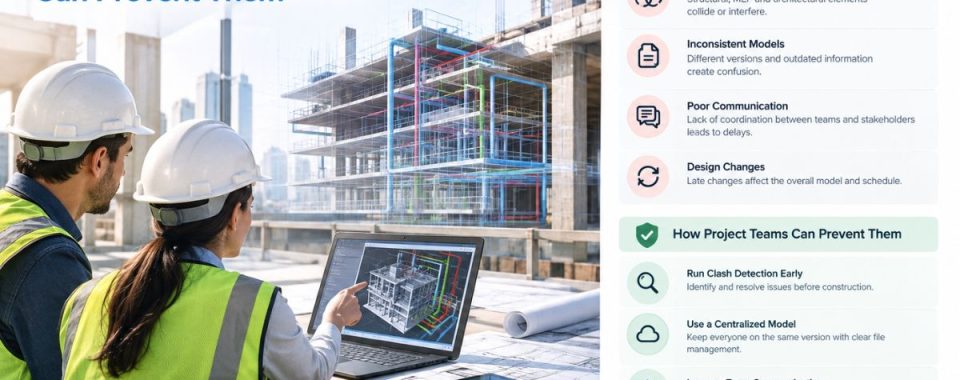
- Clash Detection Failures Between Disciplines
The clash everyone knows about is a physical one, a structural beam running through a ductwork path, or a plumbing riser fighting a steel connection. These happen when models aren’t checked against each other often enough, or when clash rules are too narrow to pick up soft clashes like clearance and access issues.
Therefore, left unchecked, these usually aren’t found until steel is already fabricated or ducts are already in, at which point a model fix turns into a site rework problem.
- Poor Communication Between Stakeholders
Coordination isn’t purely a modelling exercise. It depends on architects, engineers, fabricators, and site teams actually talking to each other regularly. When updates get shared inconsistently, or one discipline changes a design without telling anyone, the federated model goes stale fast.
This is easy to overlook because nothing is technically broken. The models work fine. The process feeding them doesn’t.
- Inconsistent Modelling Standards and LOD
When advisors work at varying standards of levels of development (LOD), naming conventions or settings of units, the federated model becomes difficult to interpret properly. The existence of the structural model resulting from LOD 300 together with the MEP model with LOD 200 might provoke some inconsistencies between them which may give the wrong impression of actual clashes.
Additionally, absence of pre-agreed standards makes teams devote time to differentiating real problems from mismatches instead of concentrating on resolution of actual issues.
- Late Involvement of Detailing Teams
On a lot of projects, detailing doesn’t start until the design is considered locked. By then, changes cost far more, and connections that looked fine on paper might not be practical to fabricate or erect on site.
This matters a lot for structural steel detailing services in Australia, where fabrication tolerances, transport limits, and site access all need to be worked through before shop drawings are finalised. Getting detailers involved earlier means these constraints get handled during design, not discovered during construction.
- Version Control and Model Federation Issues
When teams work off outdated model versions, or federation happens too rarely, coordination reviews end up running on stale data. Decisions get made on a design that’s already moved on, and clashes that were already resolved have a habit of quietly reappearing.
- Inadequate BIM Execution Planning
A BIM Execution Plan (BEP) sets out how models get developed, shared, and reviewed through the project. Skip this step, or treat it as a box to tick, and teams are left without clear rules on review frequency, ownership, and who signs off on clash resolution. Coordination ends up happening reactively instead of on a schedule.
The real cost of coordination failures
Field-discovered clashes cost far more to fix than the same issue caught during design, since site rework means demolition, re-fabrication, labour downtime, and schedule slippage stacked on top of each other.
Moreover, on a large commercial project, an unmanaged build can run into hundreds of site-discovered clashes, each costing anywhere from a few hundred to several thousand dollars to sort out once construction is underway. Across a full project timeline, that adds up to one of the largest preventable cost categories on the job.
Beyond the direct cost, poor coordination also puts pressure on:
- Project schedules, through delays waiting on redesign or re-fabrication
- Subcontractor relationships, when late changes throw out sequencing
- Client confidence, when budgets blow out over avoidable rework
- Site safety, when fixes get rushed under time pressure
How can project teams prevent these problems?
Most coordination problems share the same root cause: they get addressed too late. Prevention is mostly about building structure into the process from day one.
- Agree on LOD requirements, naming conventions, and file formats before modelling starts, not after the first clash report comes back confusing. Run clash detection on a fixed schedule, ideally weekly or fortnightly, so conflicts get caught while they’re still cheap to resolve rather than surfacing in a single review near handover.
- Bringing detailing and fabrication input in during design development, rather than after design sign-off, means fabrication and site constraints get considered before drawings are locked in. It also helps to settle on one clear source of truth for the model, so every discipline is reviewing the current version and not a file from two weeks ago.
- Every clash needs an owner and a deadline, or it gets logged and forgotten rather than actually closed out. And the BEP shouldn’t sit static once it’s written. Keeping it updated as the project evolves is what keeps coordination rules consistent even when the design team or scope changes.
Therefore, teams that build these habits into their workflow tend to see fewer surprises on site. It’s a large part of why contractors lean on an experienced BIM services provider in Australia to run this process rather than handling it ad hoc in-house.
The role of structural steel detailing in reducing coordination risk
Structural steel takes the hardest hit from poor coordination, because fabrication happens off-site on a lead time. Find a clash after steel has been fabricated, and there’s often no quick fix. That makes early, accurate detailing one of the strongest defences against coordination failure.
Good steel detailing services in Australia go well beyond producing shop drawings. Detailers involved from the coordination stage can flag connection issues, transport and lifting constraints, and clashes with other trades before fabrication locks anything in, which cuts down the number of clashes that ever reach the field.
12 Meter Engineering works this way, sitting alongside design and construction teams to keep steel detailing aligned with the wider federated model instead of treating it as something that happens after everyone else is finished.
For projects with real structural scope, bringing in structural steel detailing services in Australia early in design development is one of the more practical steps a project team can take to reduce coordination risk before it turns into a site problem.
Choosing the right BIM partner in Australia
Process alone doesn’t solve every coordination problem. Who you work with matters too. When sizing up a BIM services provider in Australia, look for:
- A real, demonstrated coordination process, not just modelling capability
- Experience across multiple disciplines on comparable project types
- Willingness to get involved during design development, not just at documentation stage
- Clear practices for reporting and tracking clash resolution
- A track record with steel detailing services in Australia where the project has significant steel scope
How well a partner integrates with the rest of the project team tends to matter more than how advanced their modelling tools are.
Wrapping up
BIM coordination problems are rarely a technology issue. They come down to gaps in process: standards never agreed on, teams brought in too late, models reviewed too infrequently to catch conflicts while they’re still cheap to fix. Project teams that build clear coordination habits, supported by solid BIM services in Australia and early input from experienced detailing partners, tend to avoid the costly surprises that throw out budgets and schedules.
If your project is heading into design development and you want structural steel detailing built into the coordination process from the start, 12 Meter Engineering can work alongside your design and construction teams to help keep your model, and your build, clash-free from the outset.
Frequently asked questions
Communication gaps, inconsistent modelling standards, and detailing teams joining too late cause most of it. The modelling process itself is rarely the actual problem.
Weekly or fortnightly works best on active projects. Frequent federation catches conflicts while design changes are still cheap to fix.
A hard clash is a physical overlap between elements. A soft clash is a clearance or access issue that makes construction or maintenance impractical without being a direct collision.
Because steel fabrication happens off-site with a long lead time. A clash found after fabrication is expensive to fix and often can’t be corrected without delaying the whole project.
It sets modelling standards, review frequency, and clash ownership before work starts. Without one, coordination tends to happen reactively instead of on a schedule.
It can. Fixes made under time pressure after a late-discovered clash carry more risk than changes worked through calmly during design.
Rework from unresolved clashes typically runs 5 to 12 percent of total project costs, depending on the size and complexity of the build.
A proven coordination process, experience across disciplines, early design-stage involvement, and clear clash reporting, not just familiarity with modelling software