Table of Contents
- Key takeaways
- Why are these drawings important?
- What basic elements should you check first?
- How to read layout and panel positions?
- How to understand precast connection details?
- What do symbols and notes mean?
- How to check dimensions and levels correctly?
- Common mistakes to avoid while reading drawings
- Conclusion
- Frequently asked questions
Key Takeaways
- The entire process of installation is guided by precast erection drawings.
- Always begin with title, scale, and notes.
- Panel numbers and layout are very important.
- Connection information should be well comprehended.
- Dimensions and levels should always be verified.
- Avoid rushing and double-check everything.
Precast erection drawings show how precast elements are placed, connected, and installed on-site. In simple words, they guide workers step-by-step during installation. Therefore, with the right understanding of these drawings, you can save time, prevent mistakes, and be safe.
These drawings are drawn out following thorough planning and coordination. Such companies as 12 Meter Engineering are concerned with accuracy since a little error can influence the whole construction.
Erection drawings in most projects contain panels, beams, columns, lifting points, and fixing methods. Besides, they assist site engineers and workers in having a clear idea of where everything goes and how everything is connected.
Why are these drawings important?
Erection drawings are not mere technical documents; they are the foundation of precast construction. In their absence, installation is complicated and dangerous.
The reason they are important is as follows:
- They indicate the precise location of all precast components.
- They minimize on-site errors and rework.
- They enhance team-to-team communication.
- They are safe in the course of installation.
- They speed up the construction process.
As an example, precast detailing services in Australia are conducted in a strict manner to ensure that drawings are clear and easily readable. This leads to smooth running of projects without delays.
What basic elements should you check first?
It is always best to begin with the fundamentals before getting down to the drawing. This will assist you in getting the general layout.
Pay attention to the following aspects:
- Drawing title and number- Identifies the sheet.
- Project name and location- Verifies the right project.
- Scale of drawing- Indicates proportion of size.
- Legend or symbols section- Describes markings.
- General notes –Gives important instructions
Additionally, never forget to check revision history. It informs you whether there were any changes. Failure to do this may result in grave errors on-site.
At 12 Meter Engineering, professionals never read past these basics without confirming them, which is a guarantee of accuracy.
How to read layout and panel positions?
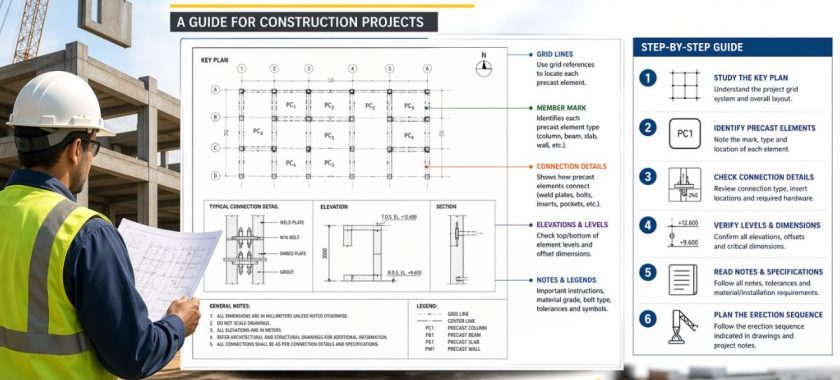
The next important step is to understand the layout. It indicates the location of each precast element in the structure.
Look for:
- Horizontal and vertical references (grid lines).
- Panel numbers (IDs of each unit)
- Direction of placement (orientation arrows).
- Section marks (cut views for clarity)
The panels are labeled well, and hence, you can identify the panel with the actual element. Always match panel numbers with delivery tags, therefore.
Precast panel detailing services in Australia put a lot of emphasis on clear labeling in many projects. This will minimize confusion and enable teams to install panels in the right way without wasting time.
How to understand precast connection details?
One of the most important components of any precast structure is connections. When the connections are incorrect, the structure can collapse.
Precast connection details demonstrate the way various elements are connected. These include:
- Bolted connections
- Welded joints
- Grouted connections
- Embedded plates
Check when reading connection drawings:
- Type of connection used
- Size and spacing of bolts or welds
- Materials required
- Installation sequence
Moreover, always follow the notes carefully. Safety can be affected even by a minor detail such as the order of tightening bolts.
What do symbols and notes mean?
Drawing is a way of saving space and keeping things simple with the help of numerous symbols. But when you do not comprehend them, the drawing will be confusing.
Common symbols include:
- Arrows (direction or movement)
- Circles (connection points)
- Dashed lines (hidden elements)
- Section cuts (internal view)
Notes are also essential. They give instructions that are not presented visually. So, do not forget to read them.
For example, erection drawings services in Australia have detailed notes so that the site teams can adhere to proper installation procedures. This enhances quality and minimizes risk.
How to check dimensions and levels correctly?
Dimensions and levels ensure everything fits perfectly. Even a minor incongruity can cause significant issues.
Always verify:
- Element length, width, and height.
- Distance between panels
- Floors and points of elevation.
- Tolerance limits
Measure with measuring tools and compare with drawings prior to installation. However , verify dimensions against other drawings such as architectural or structural plans.
Steel erection drawings in Australia are also part of many projects, where correct measurements are even more important with structural load requirements.
Common mistakes to avoid while reading drawings
Even professionals who have been in the field long enough make errors when they are in a hurry. So, one should be cautious.
These are some of the mistakes to avoid:
- Skipping general notes
- Ignoring revision updates
- Ignoring scale or dimensions.
- Not checking connection details
- Confusing panel numbers
Furthermore , do not make any assumptions. Always check with the drawing or refer to the design team.
Teams that collaborate with professionals such as 12 Meter Engineering tend to shun such errors since they have a systematic method of reading drawings.
Conclusion
When you have a step-by-step approach to it, it becomes easy to read erection drawings. Begin with such basics as title, scale, and notes. Then, familiarize yourself with the layout, panel locations, and connection information. Then, be careful to check all dimensions and levels to prevent mistakes. This method assists in making sure that construction work is safe, smooth, and correct.
Moreover, collaboration with specialists such as 12 Meter Engineering enhances precision and minimizes errors in the field. Their experience will make teams more familiar with drawings and implement projects effectively. This becomes particularly handy in the projects where precast detailing services in Australia are applied, and the accuracy and clarity are highly valued to make the installation successful and ensure long-term performance.
Frequently asked questions
They direct the right positioning and installation of precast components on-site.
They guarantee structural safety and adequate joining of elements.
Always verify notes, revisions, and dimensions before installation.
They are designed by experienced engineers and detailing experts with design standards.