Table of Contents
- Key takeaways
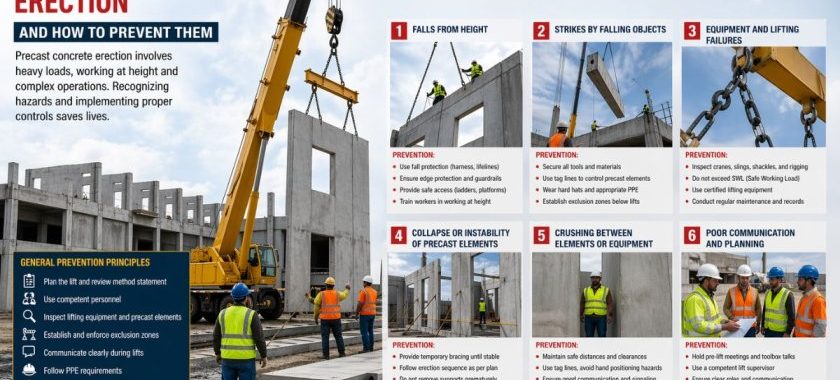
- What are the main risks in precast erection?
- Why do lifting and rigging accidents happen?
- How can workers avoid fall-related hazards?
- What causes structural instability on site?
- How to manage equipment and crane risks?
- Why do communication failures create danger?
- What role does planning and detailing play?
- Bottom line
- Frequently asked questions
Key Takeaways
- With planning and training, risks associated with precast erection can be minimized.
- Safety of lifting and rigging is essential in preventing major accidents.
- Fall protection should be a priority at all times.
- Proper sequencing and support are essential to structural stability.
- Safety of equipment involves frequent checks and competent operators.
- Effective communication enhances safety and efficiency at the site.
Precast concrete erection can be dangerous if safety steps are ignored. The largest risks are falling panels, crane accidents, ineffective planning, and falls of workers. Nevertheless, these risks can be minimized and managed with the right training, excellent planning, and professional assistance such as 12 Meter Engineering.
What are the main risks in precast erection?
Precast erection entails heavy elements, intricate lifting, and strict schedules. Therefore, the risks of accidents are higher when safety is not addressed appropriately.
Common hazards include:
- Falling precast panels
- Failure of cranes or lifts.
- The height of the worker.
- Poor site coordination
- Structural collapse during placement
Additionally, there are risks associated with every step of erection. For example, lifting entails precision, whereas installation entails stability. Any little error can cause severe accidents.
In order to minimize these risks:
- Adhere to a definite erection plan.
- Only use trained workers.
- Inspect equipment prior to use.
- Maintain site discipline.
Companies such as 12 Meter Engineering are concerned with safety-first processes, which can mitigate such risks to a great extent.
Why do lifting and rigging accidents happen?
One of the most dangerous jobs is the lifting of heavy precast elements. Unless rigged properly, panels may slip, tilt, or fall.
Common causes include:
- Wrong lifting points
- Poor or broken slings.
- Overloading cranes
- Lifting with poor balance.
However, these issues can be prevented with proper planning and inspection.
Prevention steps:
- Always use recommended lifting anchors.
- Check rigging equipment every day.
- Adhere to load capacity limits.
- Guarantee trained rigging crews.
Moreover, proper precast panel detailing services in USA can be used to establish proper lifting points and distribution of loads, which enhances safety.
How can workers avoid fall-related hazards?
One of the most common causes of construction injuries is falls. This risk is further increased during precast erection, where workers are usually working at heights.
Common fall risks are:
- Working on rough edges.
- Climbing without protection
- Slippery surfaces
- Lack of guardrails
Therefore, fall protection should be a priority at all sites.
Safety measures:
- Always use safety harnesses.
- Install guardrails and safety nets.
- Provide proper scaffolding.
- Train workers on fall safety
Additionally, frequent safety inspections can be used to make sure that everything is operating correctly. 12 Meter Engineering makes sure that the fall protection standards are followed to the letter, minimizing accidents at the workplace.
What causes structural instability on site?
Structural instability occurs when the precast elements are not supported correctly in the process of installation. This may cause abrupt collapse, which is very risky.
Key reasons include:
- Improper alignment
- Weak temporary supports
- Incorrect sequencing
- Poor connection design
Moreover, this risk can be controlled with better planning and execution.
How to prevent instability:
- Brace correctly.
- Follow erection sequence strictly
- Check alignment prior to repair.
- Make sure of good temporary support.
However, trusted precast detailing services in USA will assist in proper design and placement, which will minimize the risk of instability.
How to manage equipment and crane risks?
Precast erection requires cranes and heavy equipment. Nevertheless, they may prove to be hazardous unless handled appropriately.
Common equipment risks:
- Crane collapse
- Mechanical failure
- Poor maintenance
- Operator error
Thus, the safety of equipment cannot be overlooked.
Best practices:
- Conduct regular maintenance checks.
- Hire qualified crane operators.
- Monitor weather conditions.
- Avoid overloading
Moreover, safe crane use and a seamless working process are guaranteed by appropriate planning of lifting operations with precast erection services USA.
Why do communication failures create danger?
Good communication is critical on construction sites. In its absence, even the most basic things can be dangerous.
Issues due to ineffective communication:
- Misunderstood instructions
- Delayed reactions
- Unsafe movements
- Confusion during lifting
These problems can be addressed, however, with good communication systems.
Communication can be enhanced through the following ways:
- Make use of hand signals.
- Assign a signal person
- Carry out safety briefings on a daily basis.
- Coordinate using radios.
Furthermore, effective communication teams perform safer and more efficiently. At 12 Meter Engineering, effective communication systems are encouraged at all project sites.
What role does planning and detailing play?
Safe precast erection relies on planning. In its absence, risks are escalated at each level.
Lack of planning may result in:
- Delays and confusion
- Unsafe lifting practices
- Structural issues
- Increased accidents
Most of these problems can, however, be avoided by proper detailing and planning.
Key planning steps:
- Draw elaborate erection drawings.
- Specify lifting techniques.
- Prepare the plan site layout.
- Coordinate all teams.
Additionally, precast concrete detailing services in USA guarantee correct designs, which positively affect safety and error reduction.
Bottom line
The erection of precast concrete is a serious risk, yet the majority of them can be managed with the appropriate safety strategy. From safe lifting practices to appropriate planning, all these are important in avoiding accidents. Well-trained teams, frequent inspections, and effective communication are also important. Company such as 12 Meter Engineering are oriented towards safety-based operations, trained employees, and effective performance to minimize hazards on-site.
Moreover, expert precast detailing services in the USA enhance accuracy, proper coordination of design, and safer installation. Therefore, precast projects can be safely and efficiently accomplished without significant risks with the correct planning and professional assistance.
Frequently asked questions
The most dangerous risks during precast erection are falling panels and crane failures.
Through appropriate rigging, skilled laborers, and appropriate lifting points at all times.
Since employees work at a height, which increases the risk of severe injuries.
It minimizes mistakes, enhances coordination, and ensures safe execution at all levels.