Table of Contents
- Key Takeaways
- What are shop drawings in structural steel?
- What information is needed before starting?
- Step 1: Review structural design drawings
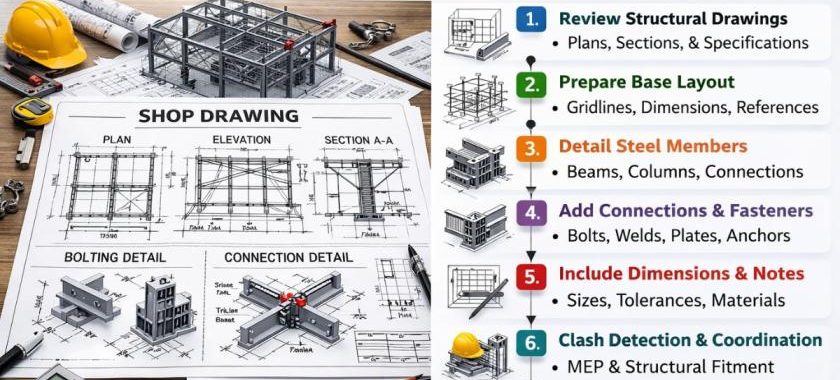
- Step 2: Create general arrangement drawings
- Step 3: Prepare detailed fabrication drawings
- Step 4: Add connections and bolt details
- Step 5: Include erection information
- Step 6: Check with BIM and coordination
- Step 7: Quality review and submission
- Conclusion
- Frequently asked questions
Key Takeaways
- Shop drawings lead to fabrication and erection.
- Proper detailing minimizes site delays and rework.
- Connection detailing is essential to safety.
- BIM coordination eliminates clashes and design conflicts.
The structural steel shop drawings provide instructions to fabricators and site teams to manufacture and install correctly. They display sizes, relationships, and details. Safety and efficiency are enhanced by professional structural steel detailing services. At 12 Meter Engineering, accurate drawings decrease delays and allow a seamless project execution.
What are shop drawings in structural steel?
Shop drawings are elaborate working drawings, which are drawn after approval of the structural design. Whereas design drawings indicate the general structure, shop drawings indicate how each steel member will be made and assembled.
They include:
- Beam and column sizes
- Plate dimensions
- Bolt and weld details
- Section views
- Material specifications
- Member marks and numbering
These drawings are used by:
- Fabrication workshops
- Quality inspectors
- Site erection teams
Fabrication errors can occur without appropriate shop drawings. Therefore, proper detailing will guarantee that steel members are fitted on the site.
What information is needed before starting?
There are some inputs required before making shop drawings. It is possible to make mistakes and do the work again because of starting without proper data.
Important inputs include:
Structural design drawings, which are approved.
- Architectural drawings
- Project specifications
- Connection design details
- Material grade information
- Relevant standards and codes.
Additionally, the communication between the design and detailing teams is highly significant. 12 Meter Engineering has a well-organized review process before proceeding with drafting. This is to enhance precision and save time in the future.
Step 1: Review structural design drawings
The initial one is the close examination of structural design drawings. This assists the detailers to be familiar with the structural system.
During review:
- Check beam and column sizes.
- Confirm steel grades.
- Identify connection types.
- Understand load conditions
- Note special instructions.
However, the analysis of drawings profoundly prevents misjudgments. The structural engineer should be consulted to explain any information that is missing before proceeding.
Professional teams that provide shop drawing services in USA usually start with an elaborate checklist review to make sure that nothing is deleted.
Step 2: Create general arrangement drawings
Once the design is reviewed, one is to prepare General Arrangement (GA) drawings.
GA drawings show:
- Overall framing layout
- Grid references
- Member locations
- Elevations and sections
- Steel member orientation.
Moreover, these drawings serve as a foundation of elaborate fabrication drawings.
Additionally, GA drawings assist fabricators to know how various members are related in the entire structure. This is a critical stage that requires accuracy since any error will impact all the detailed drawings that will be made in the future.
Step 3: Prepare detailed fabrication drawings
This is the most significant step. The steel members are fabricated individually.
Fabrication drawings consist of the following:
- Exact length of members
- Cutting dimensions
- Hole sizes and spacing
- Plate thickness
- Weld symbols
- Edge preparation
Part numbers and material lists are also included to make the workshop understandable. Companies that offer steel fabrication drawings services in the USA are very keen on clarity. Fabricators rely entirely on such drawings. Therefore, dimensions should be accurate, legible, and full.
Even a minor mistake in the spacing of bolts can postpone the whole project. Therefore, approval should be done with detailed checking.
Step 4: Add connections and bolt details
Structural steel requires connections. Poor or vague connection descriptions can lead to severe problems in the installation process.
Connection information should indicate:
- Bolt diameter and grade
- Bolt spacing
- Weld size and type
- Gusset plates
- Stiffeners
- Base plates
Moreover, connection drawings must be in agreement with structural calculations.
The 12 Meter Engineering has experienced detailers who make sure that connection drawings are viable and can be easily made. Symbols and labeling make it clear in the workshop and on site.
Step 5: Include erection information
Once the fabrication details are added, erection information should be added. This assists in locating teams to put steel in place.
Erection drawings include:
- Assembly sequence
- Member marks
- Orientation arrows
- Level references
- Temporary aids (where necessary)
These drawings give the site team step-by-step guidance.
The professionals who provide the steel structure erection drawing service in USA are aware that the clarity of erection minimizes crane time and labor cost. Hence, marking and labeling should be easy and straightforward.
Furthermore, proper drawings of erections enhance the safety of the site and minimize errors during installation.
Step 6: Check with BIM and coordination
The contemporary projects demand the coordination of several disciplines. Therefore, it is relevant to combine drawings and 3D models.
Using BIM:
- The clash detection is carried out.
- MEP system conflicts are verified.
- Conformance with architectural features is checked.
- Quantities based on models are extracted.
A good BIM services provider in USA will make sure that the steel models are in accordance with the real site conditions.
Besides, BIM assists in visualizing connections and assembly prior to fabrication. This minimizes risk and enhances confidence among the project stakeholders.
Step 7: Quality review and submission
Drawings should undergo rigorous quality control before they are submitted.
Review checklist includes:
- Dimension accuracy
- Bolt and weld verification
- Material confirmation
- Member labeling
- Drawing numbering
- Follow project standards.
Multi-level reviews in 12 Meter Engineering provide correct drawings, easy approvals, fabrication preparedness, and client confidence.
Conclusion
Production of structural steel shop drawings requires technical expertise, precision, and a high level of coordination. Every step counts, starting with design review up to final checks. Quality structural steel detailing services facilitate easy fabrication and construction. In the case of 12 Meter Engineering, projects are developed safely, efficiently, and devoid of unnecessary delays.
Frequently asked questions
They control the fabrication and construction of steel structures precisely.
They are prepared by experienced structural steel detailers or detailing companies.
Connections guarantee strength, safety, and the transfer of proper loads.