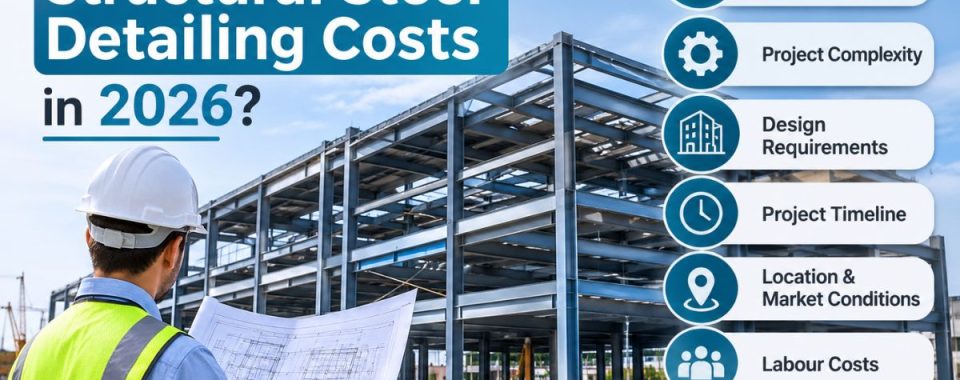
When it comes to structural steel detailing costs in 2026, there are only a handful of major drivers that typically come into play, including: tonnage of steel to be used; how complex the connections will be; scope of drawings involved; type of coordination required with other contractors; regulations and requirements to be followed; and pricing model chosen. Any of the drivers can push the price either up or down and even change it significantly. Being aware of how they function will help make a proper comparison and achieve a realistic budget at the very beginning.
When deciding to hire a provider of structural steel detailing services in Australia, knowing the price from the quote just won’t be enough. In fact, you should not be surprised when you find that a very low price signifies missing important deliverables, while a seemingly high quote includes a lot of checking, coordination, and modifications that can help save on fabrication costs. To clear the air around each cost driver, we have drafted this article with the goal of making it easier to keep costs under control during the entire process.
Key takeaways
- Tonnage gives an idea of how large the project size will be, but ultimately it is the intricacy of connections and content included within the drawings that determines the cost.
- Utilization of common member dimensions and repetitive connection models allows one to save a great deal of detailing and review time.
- While BIM coordination requires additional time for modeling, it helps avoid clashes and additional work which would be quite costly otherwise.
- Clearly stated inputs, a schedule of deliverables and a revision plan allow one to receive accurate quotes.
Explain factors that affect structural steel detailing costs?
The cost of structural steel detailing in 2026 varies based on several factors, including the quantity of steel involved, the number and complexity of connections, drawings and deliverables required, the coordination requirements for BIM, the pricing model applied, and the Australian compliance requirements. Heavy tonnage, lots of unique connections, and lots of coordination usually make projects more costly than simple and repetitive frames.
Each of the factors has a different effect. The number of hours per tonne for detailing depends on the complexity of the drawing and connections, and the size of the job. Coordination and compliance are an extra dimension on projects that have tight tolerances or multiple trades that are operating in the same space. These are all explained below, beginning with what detailing entails.
What is structural steel detailing and why does it shape cost?
Structural steel detailing is a process that transforms an engineer’s design into the exact shop drawing, model, cutting list, etc. that a fabricator requires. Each member, plate, bolt, and weld is marked by a detailer so that they can be cut, assembled, and erected without guesswork. The work lies between design and fabrication, and the detailer’s work directly impacts the smooth running that will be seen on the shop floor.
The types of drawings that these drawings are usually called ‘detailing’ include general arrangement drawings, single part drawings, assembly drawings, erection plans, and bills of material. Numerical Control files for cutting machines and 3D models for coordination are also requested in many projects. There’s a cost to each additional output, and that’s why the scope of deliverables is one of the most potent cost influencers in the entire quote.
Why does accuracy keep costs down?
In fact, the more time spent on detailing the project, the lower the overall project costs. Imperfections that make it to the fabrication floor result in rework, delays, and site costs. A detailer who can review the design basis and resolve connections before they cause any clashes saves you more money than just signing a low-priced bill that goes unchecked.
That’s why a professional detailer will put in the effort to perform internal checking and quality control. When shopping for quotes, ask about revisions and whether they include checking. Usually, if a process is transparent, there are no surprises later on in the project, and your site team knows that the steel will fit as soon as it arrives.
How does project size and steel tonnage affect pricing?
Most frequently, tonnage is the initial basis of pricing. The more steel, the more members, more connections, and more drawings to make and verify. The more detail the project requires, the more hours will be spent on the layout – even if the layout is simple, projects with more sections or longer spans will need more detailing time.
But it’s not just the tonnage. It is possible to detail a 200 tonne frame with simple beams and standard connections faster than a 120 tonne frame with irregular geometry. Therefore, many detailers will check the drawings before they give a quote, rather than using a flat rate for tonne-on-tonne. Several factors can lead to higher hours at the same tonnage:
- Irregular grids and non-orthogonal layouts that require custom geometry
- Heavy built-up areas requiring individual plate information
- Strict tolerances on machines, cranes, or precision equipment
- Many members with very odd shapes to model in long-span trusses.
Why does repetition lower the cost per member?
The simplest method to cut detailing expenses is to repeat the task. If the same column and beam types are employed in numerous bays within a building, then the detailer can only use connection templates and standard drawings. This decreases the number of hours spent modelling and the amount of checking time each member has to spend, due to the reduction in the total number of checks, thus lowering the final cost without affecting the structural performance.
Additionally, the standardised sizes of its members simplify fabrication. If the engineer is involved early, the owner may be able to request standard sections that will still accommodate the design requirements. Adopting a slight change like the spacing of bays or reducing certain thicknesses of plates can be significant savings over a large frame. If you have a larger product frame, our steel fabrication drawings services in Australia incorporate all the needs of the shop drawings and modeling results that you might require in such a project.
Which connection types add the most cost?
Most of the detailing work is focused on connections. Each joint is different and must be designed, modelled, and checked, and each type of joint has its own degree of complexity. The reasons why two projects with the same number of hours can have widely varying quotes are understood by understanding the differences.
Simple vs complex connections
Simple shear connections, like beam-to-column web cleats, are fast to manufacture, provided that a standard template has been developed. Moment connections, bracing gussets, and heavy splices are much longer to prepare because they have plates, stiffeners, bolt patterns, and such that need to be checked one by one. The table below shows a comparison of the most common types.
| Connection type | Typical detailing effort | Relative cost impact | Common examples |
| Simple shear | Low | Low | Beam-to-column web cleats, end plates |
| Moment | High | High | Bolted moment end plates, stiffened joints |
| Bracing | Medium to high | Medium to high | Gusset plates, brace-to-frame connections |
| Splices | Medium | Medium | Column splices, beam splices |
| Special or custom | Very high | Very high | Non-standard joints, seismic details |
Special details and site constraints
Even if the connection type is standard, special conditions may increase costs. Access for bolting, unusual sequences for erection, or structures that have to be matched with existing buildings all pose site constraints which have to be planned for. Other geological or wind load information requirements can require further engineering checks and documentation as well.
However, if you need to include these conditions in your project, communicate them early. Information at the beginning eliminates revisions and guarantees the accuracy of the quote. An understanding of the site can often allow a detailer to offer practical solutions, such as shop-bolted assemblies that limit the onsite work, which can help to decrease the total installed cost.
How does drawing scope change the final quote?
The number and nature of drawings you request will have as much influence on the price as will the steel itself. A fabricator may only require single part drawings, and a different fabricator may require erection sequences, bolt summaries and 3D models. Before asking for a quote, it’s one of the easiest ways to compare offers accurately by clarifying the deliverables.
Core deliverables
Most structural steel detailing packages will include core deliverables. They usually include:
- Plans for general arrangement and framing.
- Part and assembly drawings for a single part.
- Bills of material and material take-off reports
- Design drawings and bolt schedules
- Drawing exchange files for numerical control of production.
All of these require a certain amount of time to make and test. In general, the shorter the list of deliverables, the lower the initial quote, but you should verify that the list is still complete enough for your fabricator and erector to work safely and efficiently.
Optional outputs that add cost
There are some outputs that are helpful but not necessary, like detailed 3D models for clash detection, custom reports for quantity surveyors, or additional revision cycles. Every one has an expense associated with it, but every one could also lessen the risk. It will depend on the type of procurement you use, the level of coordination, and the level of certainty you require before the start of fabrication.
Our architectural drafting staff can create drawings that complement your project’s steel package, minimizing intertrade gaps if you need drawings other than steel.
What is the impact of BIM coordination on detailing costs?
On many of the commercial and industrial projects, building information modelling is now a walk-up order. A model-based approach connects steel detailing to architectural, mechanical, and civil information, resulting in everyone operating from the same source. This coordination is at the expense of modeling labor during the detailing process, but it also avoids expensive conflicts.
Model-Based Detailing
In a BIM environment, any member or connection of the steel is rendered in three dimensions. This allows the team to verify fit, access, and clearances prior to the manufacture of anything. The upside is that there is less upfront cost of modelling and clearer drawings, which helps to offset some of the disadvantages. Our BIM services enable model-based detailing and clash checking from the initial stages of a project when coordinated models are required.
Clash Detection and Revision Control
Clash Detection will determine where steel is going to work against ductwork, piping, or other structures. Every on-screen clash saves time that is otherwise spent on site for cutting, rework, or delayed installation. The number of clashes is dependent upon the level of design maturity, so it is important to schedule some of the initial design coordination meetings to minimise clashes as well as the cost of revisions that are likely to occur.
This goes for revision control, too. Constructing projects with frequent changes adds extra modelling and checking time which is not included in the initial quote. When a revision process is established prior to work starting, and the pricing of revisions is agreed, the budget is predictable for all involved.
How do compliance requirements affect costs in Australia?
Australian projects must comply with both the national and local council standards, and these influence the way in which the detailing is conducted. Generally, steel structures are designed to AS 4100, and manufacturing and installation work is addressed by AS/NZS 5131. Detailers must prove that members and connections meet these standards, involving expertise in the checking process and good record-keeping.
Specialist structural steel detailing services in Australia are already familiar with such expectations and will help projects across the country. These drawings are less likely to require repeated corrections during engineering approval because a team with knowledge of the relevant standards is at a lower risk of creating drawings that must be corrected.
Engineering Sign-off and Documentation
Before fabrication, many projects must be engineered (certified) or have a design verification report. Time and expense from supporting documentation (design basis report, connection calculations, engineer seals, etc.). If such documents are required, they should be clearly stated in the scope of the quote to avoid being considered an extra at the time of quotation.
Moreover, a question you may want to consider early is what types of documents your authority or principal will be looking for. Delays are frequently caused by missing documentation, and if it is discovered after the fabrication process has begun, it will cost a lot more to add it to the original scope.
Wind, Seismic, and Site-Specific Loads
Depending on the loads, the design of the connections can vary considerably from site to site. Heavier connections, bracing, and more detailed load paths may be necessary for wind exposure along the coast and seismic requirements in some areas. These details add to the detailing effort but will be critical for safety, long-term performance, and should not be value engineered without a proper engineering review.
How do pricing models compare in 2026?
The techniques used to charge for detailing work are generally one of three types: by the tonne, by the hour, or by a fixed fee. All of the models are applicable to specific projects, and none is always the lowest-priced choice. The correct selection will depend on the degree of the scope definition and the degree of risk each of the parties is willing to accept throughout the project.
Per Tonne and Fixed-Fee Packages
For projects involving a definite steel quantity and typical specifications, per tonne pricing is frequently used. Comparing from supplier to supplier is easy, but can be misleading if the connections are unusually heavy or there is extensive drawing. Fixed-fee packages offer clarity after the scope has been agreed, but they also come with a risk premium and a mechanism for managing scope changes.
Comparing Pricing Models
| Pricing model | Best suited for | Main advantage | Main risk |
| Per tonne | Repetitive, well-defined frames | Easy to compare quotes | May not reflect complex connections |
| Hourly | Uncertain or evolving scope | Flexible for design changes | Final cost is harder to predict |
| Fixed fee | Clearly defined packages | Budget certainty | Higher upfront price and change costs |
Regardless of your purchase, request a detailed list of what is included and excluded. An initial quote that appears low could mean that there is also a lack of checking, revision, or some of the deliverables, and when a project gets underway, that lack can undo the initial savings a lot.
How can you control structural steel detailing costs?
The first step to cost control is long before the first drawing is sent out. The majority of overruns are due to design changes, incomplete information, and ambiguous expectations of outputs, which are most common in late design changes. A few sound steps will help maintain stable costs without sacrificing the quality of the completed drawings.
Practical Steps to Follow
- Early freeze the structure design; do not make unnecessary changes for safety or compliance requirements.
- Before requesting any quote, give all inputs such as architectural drawings, load information, and site constraints, etc.
- Specify deliverables, including drawing type, file format, and number of revision cycles for each.
- Ensure that members are standardized in size and connection and are proven to be sufficient by the engineer.
- Plan coordination meetings at important stages to identify conflicts in advance, before the model is completed.
Choosing the Right Partner
A good detailing partner can be very forthright and transparent in their communication, record assumptions, and explain the process of revisions. Request examples of similar projects and determine if the team has a standard that it is required to adhere to in Australia. Aside from the rate on the page, the way the communication is responsive is often as important, as fast answers to inquiries help keep the project on track.
The steel detailing services in Australia and rebar detailing services in Australia pages outline the deliverables of these scopes and can be compared to your steel package in one place, if your project incorporates concrete elements.
Why work with a specialist detailing partner?
An experienced detailing partner such as 12 Meter Engineering Private Limited is an engineering firm engaged in drafting and detailing services for around 17 years now. They assist clients with their drafting services with respect to steel works, precast, rebar, pre-engineered buildings, building information modeling (BIM), and architectural drafting services, providing high-quality drawings within stipulated timelines. The fact that they operate in several regions adds variety to the projects handled by them.
Closing line
In 2026, the price of structural steel detailing varies according to tonnage, difficulty of connections, complexity of drawings, and any necessary compliances. In order to control costs, clear briefs about the structure, design approvals in a timely manner and clarity in pricing are the most essential factors. Relying on reliable structural steel detailing service providers in Australia helps in making the whole process of fabrication and erection easier.
Frequently asked questions
The cost depends on tonnage, connection complexity, and deliverables; therefore, get an estimate from us according to your specific drawings and requirements.
Not always. A low quote may not include checking, revision, or delivery items; hence, compare them well before making a choice.
Freeze your design early, provide complete input details, standardize member roles if applicable, and define deliverable specifications before quoting.
BIM increases modeling time but detects conflicts earlier to reduce rework and site modifications, which are usually more expensive than coordination costs.