Table of Contents
- Key Takeaways
- What materials are used in precast concrete?
- Why cement quality matters in precast?
- How aggregates affect strength and durability?
- Role of water in concrete mix quality
- Why is reinforcement steel important?
- How do admixtures improve concrete performance?
- What are connection details in the precast?
- How detailing services ensure material accuracy?
- Conclusion
- Frequently asked questions
Key Takeaways
- Precast concrete involves the use of cement, aggregates, water, steel, and admixtures.
- All materials play a certain part in strength and durability.
- The quality of cement has a direct impact on structural performance.
- Aggregates are the masses and enhance stability.
- Tensile strength is provided by steel reinforcement.
- Correct use of materials is achieved through proper detailing.
Precast concrete fabrication involves the use of a combination of major materials such as cement, aggregates, water, steel, and additives to produce strong and durable structures. All materials serve a particular purpose. As such, the knowledge of these materials assists in enhancing quality, safety, and long-term performance in construction projects.
What materials are used in precast concrete?
Pouring cement into molds is not all about precast concrete. It is a well-planned combination of materials that combine to form powerful structural elements. Firms such as 12 Meter Engineering are concerned with the choice of the appropriate materials to make them durable and precise.
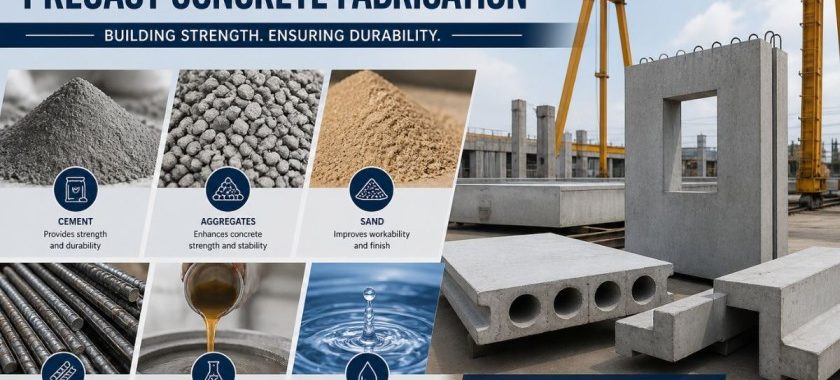
The primary materials are:
- Cement (binding material)
- Fine aggregates (sand)
- Coarse aggregates (gravel or crushed stone)
- Water
- Reinforcement steel
- Chemical admixtures
The purpose of each of these materials is evident. For example, cement holds it all together, and aggregates are the source of strength and volume. Load-bearing is enhanced by steel reinforcement. Additionally, the correct mix makes precast components uniform, crack-resistant, and durable.
Why cement quality matters in precast?
The core of precast concrete is cement. The whole structure may collapse with time without good quality cement. So, it is highly important to select the appropriate type of cement.
Important uses of cement:
- Unites all the materials.
- Gives strength following hardening.
- Controls setting time
In precast fabrication, the cement has to be of uniform quality. Even minor changes can influence the end product. Moreover, cement of high quality contributes to the smooth finishes and enhanced durability.
In designing precast panel detailing services in USA, engineers are keen to ensure that cement properties are matched with the design requirements. This makes sure that panels are robust and consistent.
How aggregates affect strength and durability?
Almost 60-70 % of concrete is made up of aggregates. Thus, their quality has a direct influence on strength and durability.
It is of two kinds:
- Fine aggregates (sand)
- Rough aggregates (stone or gravel)
Good aggregates must be
- Free of dust and clean.
- Strong and hard
- Graded in size appropriately.
Aggregates that are well graded minimize gaps in the mix. Concrete is consequently made stronger and denser. Therefore, they aid in decreasing shrinkage and cracking.
In precast fabrication drawings services in USA, the proper aggregate selection is defined in drawings. This assists manufacturers to be consistent in production.
Role of water in concrete mix quality
Water can be considered as being simple, yet it is a very important component of precast concrete. Adequate water is required to mix and hydrate cement.
Notable facts concerning water:
- Excessive water lowers strength.
- Inadequate water leads to a hard time mixing.
- Clean water is a necessity.
One of the factors is the water-cement ratio. Good strength and workability are guaranteed by a balanced ratio. Moreover, regulated water consumption enhances surface finish and life.
At 12 Meter Engineering, professionals make sure that the water content is measured properly when fabricating. This assists in ensuring quality in all precast components.
Why is reinforcement steel important?
Concrete is compressive but not tensile. Here, reinforcement steel is necessary.
Steel reinforcement functions:
- Improves tensile strength
- Prevents cracking
- Supports heavy loads
Molds are filled with steel bars or mesh, and concrete is poured into them. When hardened, the mixture is very strong.
In precast detailing services in USA, reinforcement will be placed accurately in detail. This is to provide safety and structural stability. Furthermore, effective reinforcement minimizes maintenance problems in the long run.
How do admixtures improve concrete performance?
Admixtures are special chemicals that are used in concrete to enhance the properties of concrete. They are used in small quantities, but they have a big impact.
Typical admixtures:
- Plasticizers (improve workability)
- Accelerators (speed up setting)
- Slow-down setting (retarders)
- Air-entraining agents (enhance durability)
These additives aid in regulating the behavior of concrete under various conditions. As an example, accelerators come in handy during cold weather. Retarders, on the other hand, assist during hot climates.
In the case of precast connection details, admixtures are useful in ensuring that joints are strong and durable. However, they play a significant role in contemporary precast fabrication.
What are connection details in the precast?
Connection details specify the way various precast elements are connected. These connections should be robust, secure, and simple to install.
Connection types are:
- Welded connections
- Bolted connections
- Grouted joints
A good connection design will guarantee:
- Structural stability
- Easy installation
- Long-term performance
Failure may occur due to poor connections, despite strong materials. Therefore, much attention is paid to the description of these joints by engineers.
How detailing services ensure material accuracy?
The services of detailing are important in precast fabrication. They make sure that all materials are utilized properly and effectively.
The main advantages of detailing:
- Accurate material specifications
- Fewer mistakes in the manufacturing process.
- Improved inter-team coordination.
In precast concrete detailing services in USA, drawings are very clear on the type of materials, sizes, and location. This eliminates confusion in the manufacturing process.
Furthermore, precast detailing services in the USA assist in quality maintenance by making sure that all materials are up to the design standards. This leads to faster and error-free completion of projects.
Conclusion
The strength, durability, and quality of structures are directly affected by materials used in precast concrete fabrication. Cement, steel, and admixtures all have their distinct roles. Therefore, it is necessary to select it carefully and detail it. By using skilled assistance such as 12 Meter Engineering and sophisticated precast detailing services in the USA, projects are more accurate, safer, and perform better in the long run.
Frequently asked questions
Primary materials used include cement, aggregates, water, steel reinforcement, and admixtures.
Reinforcement enhances tensile strength and averts cracks during heavy structural loads.
They enhance durability, strength, setting time, and workability of concrete structures.
Aggregates give bulk and strength and minimize shrinkage in concrete structures.
Clean water guarantees proper hydration of cement, enhancing strength, durability, and overall concrete performance.