Table of Contents
- Key Takeaways
- What are RFIs in steel detailing?
- Common causes of RFIs
- How to minimize RFIs in steel detailing?
- Benefits of reducing RFIs
- Real project insight
- Wrapping up
- Frequently asked questions
Key Takeaways
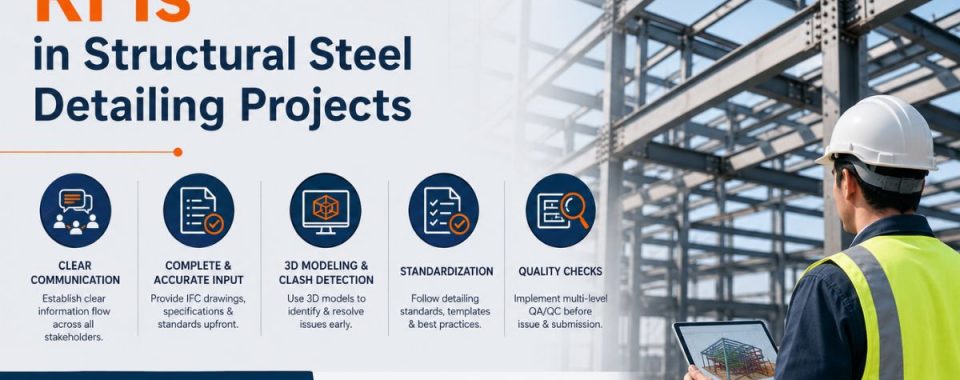
- Detailing correctly allows for fewer RFIs and project delays.
- BIM coordination allows to identify clashes in an early stage
- The shop drawings are more useful in explaining what to fabricate.
- Efficient communication is essential for steel projects to run smoothly.
The first step to minimizing RFIs in structural steel projects is to ensure accurate drawings and improved coordination and communication among engineers, fabricators, and contractors. The typical causes of RFIs are missing dimensions, design conflicts, fabrication information is unclear or the design changes late in the process. Overall, professional structural steel detailing services in the USA can help companies avoid delays, rework, and inefficiencies during construction.
Precise detailing is now a key process for contractors and fabricators throughout the USA to accelerate approvals and ensure projects stay on schedule. Companies like 12 Meter Engineering can minimize confusion by providing careful shop drawings, clear steel connections and streamlined workflows.
What are RFIs in steel detailing?
An RFI (Request for Information) is a formal inquiry made during the construction project when drawings or specifications are unclear.
In a structural steel project, the common causes of RFIs are:
- Missing dimensions
- Incomplete connection details
- Differences between architectural & structural drawings
- Fabrication uncertainties
- Site coordination problems
Therefore, a proliferation of RFIs can negatively impact fabrication, steel erection activities, and project expense.
This is why professional steel detailing services in USA emphasize minimizing mistakes before the steel fabrication process starts.
Common causes of RFIs
- Incomplete Drawings
If a drawing is not dimensioned or has no fabrication information, it is the responsibility of the fabricator to ask for clarification prior to fabrication.
- Poor Coordination
The conflict between MEP, architectural, and structural drawings leads to confusion when installing.
- Frequent Design Changes
Late revisions can lead to inconsistencies in project documents.
- Unclear Connection Details
In complex projects, one of the major sources of RFIs is steel connections.
- Communication Gaps
When there is a lack of communication, there are unnecessary assumptions and delays between stakeholders.
How to minimize RFIs in steel detailing?
1. Use Accurate Shop Drawings
A good shop drawing helps to eliminate confusion and ensure the correct part is fabricated.
Professional shop drawings services in USA usually consist of:
- Exact dimensions
- Material specifications
- Welding details
- Bolt information
- Assembly instructions
If the teams producing the fabrications are given all the information before they start, they have fewer questions during the production process.
12 Meter Engineering specializes in extremely well-drafted shop drawings that aid contractors in reducing the need for expensive clarifications.
2. Improve BIM Coordination
With 3D BIM Coordination, clashes can be identified prior to fabrication.
Using coordinated BIM models allows teams to:
- Detect structural conflicts early
- Align MEP and steel systems.
- Improve construction sequencing
- Reduce on-site surprises
Therefore, this method greatly reduces the number of RFIs and project schedules.
3. Standardize Drawing Reviews
A systematic review procedure helps to identify mistakes in drawings before they go to the fabrication phase.
Recommended Review Steps
- Internal detailing review
- Engineering verification
- Fabrication feasibility check
- Coordination review with other trades
- Final approval process
Moreover, reliable structural steel detailing services in USA companies use several quality checks to ensure they remain accurate in their drawings.
4. Strengthen Communication
Effective communication between engineers, detailers, fabricators, and erection personnel is critical.
Project teams should:
- Regularize meetings for coordination.
- Share revisions immediately.
- Maintain version control
- Incorporate clarity of design intention at an early stage.
Additionally, with rapid communication, small problems never become large RFIs later on.
5. Focus on Erection Planning
Detailed erection planning helps to prevent confusion during erection.
In the USA, good steel erection drawings in USA consist of the following:
| Drawing Element | Purpose |
| Sequence Details | Prevent installation errors |
| Crane Placement | Improve safety planning |
| Member Marking | Faster identification |
| Connection Guidance | Easier field assembly |
Moreover, when planning erecting operations, proper planning will minimize the number of RFIs in the field and provide fast installation.
Benefits of reducing RFIs
Minimizing RFIs can be a significant advantage to the major project.
- Faster Project Delivery
The fewer the clarifications, the quicker the fabrication and erection.
- Lower Project Costs
Labor and material costs are reduced due to reduced rework.
- Better Fabrication Accuracy
To avoid production errors, accurate detailing is required.
- Improved Team Coordination
Simple drawings convey ideas more clearly between teams.
- Higher Client Satisfaction
Fewer delays in a project mean more reliability and a good reputation for the contractor.
12 Meter Engineering helps project teams to achieve a more effective detailing workflow that helps to increase the efficiency of the project from design to erection.
Real project insight
In a project for a commercial building in the USA, there were multiple delays caused by unclear beam connection details and inconsistent revisions.
The contractor teamed up with a Steel Detailing Services USA team for better coordination.
The solution included:
- BIM clash detection
- Revised connection detailing
- Centralized revision tracking
- Increased shop drawing approvals.
As a result:
- RFIs were reduced significantly.
- Fabrication delays were minimized
- Increased the rate of steel erection.
- Site coordination improved.
This is an example of how proactively detailed projects make an impact directly.
Wrapping up
Accurate detailing is necessary, as is effective communication, BIM coordination and detailed planning, to reduce RFIs in structural steel projects. Delays, coordination issues, and improved construction efficiency are the result of projects having clear fabrication and erection drawings.
Furthermore, shop drawings services USA and coordinated shop drawing workflows play a key role in preventing costly interruptions during the project lifecycle.
12 Meter Engineering provides trustworthy detailing solutions to help fabricators, contractors, and engineers have the documentation they need and execute their projects smoothly.
Working with an experienced detailing team can significantly help with the success of your project when you are looking for efficient project delivery with accurate structural detail and minimized RFIs.
Frequently asked questions
Main causes of RFIs include unclear drawings, missing dimensions, coordination and incomplete fabrication details.
Shop drawings give clear information on fabrication and erection, thus minimizing the confusion during the actual production and erection.
BIM can be used to identify clashes and coordination issues prior to fabrication and avoid field problems.
Steel erection drawings are used to instruct site teams on member location, sequence of connections, and assembly instructions.
Proven detailing firms boost interaction, decrease mistakes, enhance approvals, and decrease delays in the job.