Table of Contents
- Key Takeaways
- What makes precast erection faster?
- How factory-made components save site time?
- Why does planning improve high-rise projects?
- How better coordination reduces delays?
- Does precast erection improve safety too?
- Why do builders prefer precast for tall buildings?
- Wrapping up
- Frequently asked questions
Key Takeaways
- The precast erection process allows for a considerable decrease in the overall construction times.
- Manufactured parts have greater quality and consistency.
- Valuable project time is saved with parallel manufacturing and site work.
- High-rise buildings benefit from reduced delays and rework with better planning.
Precast erection for high-rise projects provides quicker completion with reduced curing time, labor delays, and site disturbance. By leveraging “12 Meter Engineering,” construction is enhanced in terms of efficiency, precision, quality, and project management.
What makes precast erection faster?
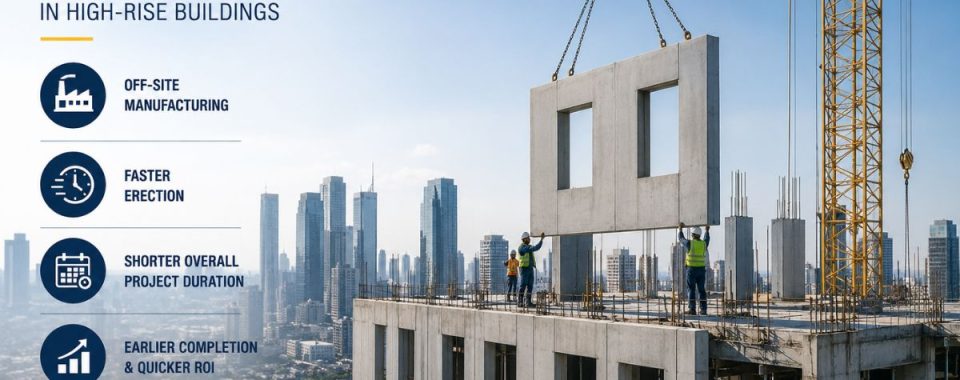
Precast erection is different from traditional site construction. Many of the walls, slabs, and columns are not constructed on-site but manufactured in the factory beforehand. They are then quickly transported and assembled on-site at the project site.
This process involves a decrease in several slow construction projects, such as:
- On-site concrete pouring
- Long curing periods
- Repeated formwork setup
- Relying heavily on manual labor.
- Material handling delays
“12 Meter Engineering” parallel manufacturing and precast detailing services in Australia contribute to minimizing delays, enhancing coordination, and speeding up the installation process.
How factory-made components save site time?
Precast erection is one of the main drivers for the reduction of project timelines, especially when production is in the factory. Quality control is easier with controlled production of components, and production is more consistent.
While factories are not as much impacted as open construction sites, they are impacted by:
- Rain
- Extreme heat
- Dust problems
- Site congestion
- Labor disruptions
Therefore, there is not much disruption in the manufacturing process. The components are then delivered to the site, and all the workers have to do is pick them up and place them correctly.
Here is a simple comparison:
| Construction Activity | Traditional Method | Precast Method |
| Wall construction | Built on-site | Installed directly |
| Concrete curing | Several days | Already completed |
| Formwork setup | Repeated many times | Minimal requirement |
| Labour requirement | High | Controlled |
| Project speed | Slower | Faster |
Furthermore, precise precast panels detailing Australia solutions enable engineers to pinpoint connection points, dimensions, and installation phases at an early stage. This helps to reduce confusion when erecting and helps to keep the work flowing in tall structures.
Factory-prepared systems are a huge advantage in a building that has to be up and running for each hour that counts.
Why does planning improve high-rise projects?
Precast erection is not all about lifting with cranes. The reason for completion in a timely manner is the quality of the planning.
All parts need to be delivered on time and in the proper order. This will otherwise result in delays for installation teams. With experienced engineering companies, detailed erection schedules are developed to ensure there is no such thing.
Typically this planning will involve:
- Transport coordination
- Crane movement planning
- Structural connection sequencing
- Safety checks
- Floor-wise installation schedules
Additionally, the detailed engineering support minimizes rework during construction. Early errors in a high-rise can cause big delays on several levels. However , good planning is imperative.
Precast erection services Australia are increasingly being used by many developers for improved execution control. These services are designed to assist teams to handle large structural elements without compromising project timelines or raising safety hazards.
At “12 Meter Engineering,” the processes of design coordination and erection planning are used in a systematic manner. This will minimize misunderstandings between engineers, contractors, and site personnel.
Construction is therefore faster, cleaner, and more organized.
How better coordination reduces delays?
A key issue in traditional high-rise buildings is lack of coordination between the teams. Often the delays occur due to the involvement of architects, engineers, and contractors working individually. Precast systems deal with this better by integrating.
All structural information is thoroughly checked in advance of installation. This will give teams the chance to catch mistakes before construction, rather than after.
Coordinating is helpful in several ways:
- Faster decision-making
- Reduced material wastage
- Lower rework costs
- Smooth installation sequence
- Better labor productivity
Moreover, contemporary precast panel detailing in Australia can aid in exact communication among fabricators and erectors. Correct detailing means that the installation of each panel is done properly.
In many projects, the realignment of even a small alignment can cause the work to stop. Precast systems reduce such interruptions, however, since the whole process is planned beforehand.
When several activities are taking place simultaneously on various floors of a multi-level building, this organized workflow is of critical value.
Does precast erection improve safety too?
Yes, a faster build time doesn’t equate to compromising on safety. Indeed, the use of precast erection generally makes the works safer than conventional work.
Most structural work takes place in factories, reducing the amount of time workers spend dealing with risky work at height. In addition, a cleaner construction site means fewer accidents due to cluttered materials and wet concrete areas.
These are some of the key safety benefits:
- Minimized on-the-job exposure to labor.
- Less scaffolding work
- Controlled lifting operations
- Cleaner working areas
- Reduce the risk of manual handling.
With the advanced safety regime requirement of high-rise projects, many precast erection companies in Australia now adhere to the advanced safety regime. Increased safety and speed go hand in hand with the proper choice of lifting systems, installation methods, and trained operators.
Additionally, controlled installation minimizes unnecessary movement of labor around various areas of the site. This makes the project more structured for all those involved in the project.
Speed and safety combine for improved project performance for builders.
Why do builders prefer precast for tall buildings?
High-rise projects are strict about deadlines, investments, and schedules. Thus, the methods used for development are preferred that minimize risk and increase efficiency.
Precast erection supports these goals by providing:
- Faster floor completion
- Better quality control
- Reduced labor dependency
- Lower construction waste
- Improved project management
Furthermore, in urban construction sites, there may be limited available space. Precast systems can minimize site congestion due to less raw material storage on-site.
Successful companies such as “12 Meter Engineering” know that time is the most crucial factor in today’s construction industry and that precision is essential. Precast erection can achieve both without compromising the quality of construction.
Precast construction will be increasingly used in commercial towers, residential apartment buildings, hospitals, and infrastructure projects as cities keep going upscale.
Wrapping up
The factory-made components, improved planning, and speed of installation in the construction phase can contribute to the increased speed of erecting precasts for high-rise construction. Precast panel detailing services in Australia are still becoming more and more popular, and efficient building methods are supported by “12 Meter Engineering.”
Frequently asked questions
Factory-made parts are available and installed on site, minimizing delays caused by curing.
Yes, precast systems work well for tall structures that need to be constructed quickly.
Yes, it is consistent, and accurate structure dimensions are achieved in factory production.