Table of Contents
- Key Takeaways
- What is BIM in precast construction?
- Why is BIM important for precast detailing?
- How does BIM improve precast coordination?
- How does BIM handle precast connection details?
- What problems does BIM solve in precast projects?
- How does 12 Meter Engineering use BIM smartly?
- How does BIM support fabrication and installation?
- Conclusion
- Frequently asked questions
Key Takeaways
- BIM enhances accuracy in precast detailing and coordination.
- 3D modeling minimizes site errors and rework.
- Connection detailing is more visible and safe.
- Correct BIM workflow saves time and project cost.
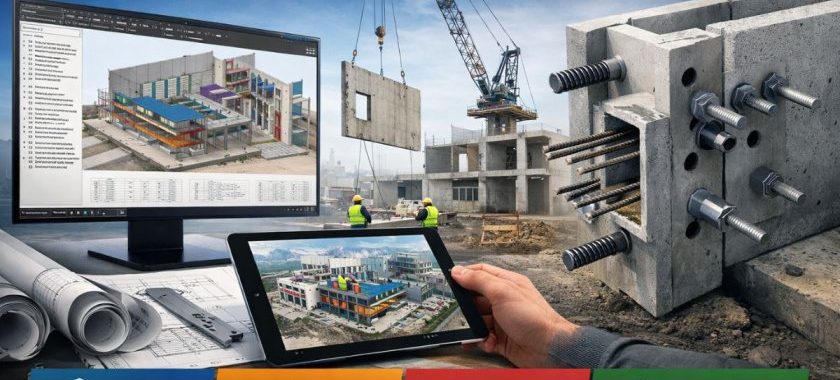
BIM enhances precast detailing and coordination through minimization of errors, time-saving, and team communication. A reputable BIM services provider in the USA develops precise 3D models for smooth fabrication and installation. Because precast construction requires the use of components that fit perfectly, BIM assists in avoiding delays and expensive site errors.
What is BIM in precast construction?
BIM is known as Building Information Modeling. It is not just a 3D drawing. It is an intelligent electronic model that holds complete project data.
In precast construction, BIM assists the teams to:
- Design correct 3D precast part models.
- Include reinforcement information.
- Plan lifting points and locations of embeddings.
- Check clashes at the pre-manufacturing stage.
- Exchange information between designers and fabricators.
BIM also enables all people to view the entire construction prior to its construction as opposed to the traditional 2D drawings. Consequently, confusion is minimized and coordination enhanced.
At 12 Meter Engineering, BIM is applied in modeling as well as in enhanced planning and communication among the design and site teams.
Why is BIM important for precast detailing?
Precast detailing must be very accurate. Every millimeter matters. When detailing is incorrect, fabrication is incorrect. In addition, site correction is expensive and time-consuming.
BIM enhances precast detailing in the following way:
- Accurate 3D Modeling
Instead of flat drawings, BIM creates full 3D models of:
- Precast walls
- Beams
- Columns
- Slabs
- Stairs
This assists engineers to have a clear picture of the connection between components.
- Better Reinforcement Detailing
BIM enables rebar to be modeled in detail. Therefore:
- Bar lengths are exact.
- Flexible time schedules are precise.
- The issues of congestion are detected early.
- Clear Precast Wall Connection Details
In precast systems, connection accuracy is important. Under BIM, the engineers are able to plan and verify precast wall connection details before manufacturing.
This ensures:
- Structural strength
- Proper load transfer
- Easy installation on site
Additionally, site teams know how to fix panels, and this minimizes errors in installation.
- Faster Approval Process
Due to the clarity and visuality of BIM models:
- Clients perceive drawings with ease.
- Consultants approve faster.
- Revisions become easier.
Consequently, project schedules are enhanced.
How does BIM improve precast coordination?
One of the largest problems of precast construction is coordination. MEP systems, structural systems, and architectural systems should be perfectly aligned.
BIM enhances coordination by:
- Clash Detection
Before fabrication, BIM software checks:
- Beam vs. duct clashes
- Wall vs. pipe conflicts
- Slab openings mismatch
Moreover, issues are addressed online rather than on the ground.
- Real-Time Collaboration
The same model can be worked on by different teams. For example:
- Reinforcement is added by structural engineers.
- Panel finish is reviewed by architects.
- MEP teams check openings.
This minimizes communication differences.
- Data Sharing
BIM models store:
- Component weight
- Dimensions
- Material type
- Connection details
This data can be directly used by fabrication teams. Additionally, transportation planning is facilitated.
Companies that provide precast detailing services in Australia are increasingly depending on BIM to enhance coordination between the design offices and the manufacturing plants.
How does BIM handle precast connection details?
The precast structures are based on connections. Failure to connect leads to the failure of the structure. Therefore, the description should be flawless.
1. Modeling of Precast Connection Details
BIM enables engineers to design correct precast connection details such as
- Weld plates
- Anchor bolts
- Grout pockets
- Shear keys
- Dowels
Since all of it is 3D modeled, engineers can:
- Check alignment.
- Verify tolerances
- Ensure load path continuity.
2. Visual Simulation Before Construction
Simulation is another major benefit. Teams can:
- Simulate installation order.
- Check crane access.
- Review the connection assembly.
This eliminates confusion in the erection.
3. Standardization and Repetition
Similar connections are usually repeated in precast projects. BIM assists in the establishment of standard libraries. Therefore:
- Repetitive detailing becomes faster
- Quality remains consistent.
- Mistakes are minimized.
At 12 Meter Engineering, the standardized BIM processes guarantee that all the connection details are checked prior to being released to be produced.
What problems does BIM solve in precast projects?
There are a number of problems that are common in many precast projects. Nevertheless, they are resolved with the help of BIM.
1. Drawing Conflicts
Conventional 2D drawings tend to clash. BIM develops one source of truth.
2. Rework at Site
In cases of mismatch of dimensions, panels require alteration. Most of the errors are identified early with BIM.
3. Delays in Fabrication
Detailed description accelerates the manufacturing process. Direct drawings on the model are given to fabricators.
4. Cost Overruns
Since mistakes are minimized, additional work and material wastage are minimized as well. Thus, general cost is kept within check.
5. Poor Communication
BIM improves transparency. All people are using the same updated model.
How does 12 Meter Engineering use BIM smartly?
Precast detailing is experience-based. Tools alone are not enough. They should be used by talented engineers.
12 Meter Engineering specializes in the following:
- 3D precast modeling of high accuracy.
- Elaborate reinforcement drawings.
- Manufacturing clear shop drawings.
- Smooth coordination between teams
- Quality checks before model release
Moreover, all projects have a systematic BIM workflow:
- Model creation
- Clash detection
- Connection detailing
- Client review
- Final shop drawing issue
This will create confidence among contractors and developers.
Due to a high level of technical skills and practical knowledge, 12 Meter Engineering will make sure that BIM models are not only aesthetically pleasing but also construction-wise.
How does BIM support fabrication and installation?
BIM does not end with detailing. It facilitates the entire project process.
1. During Fabrication
- Proper extraction of quantity.
- Automated bar bending schedules.
- Clear panel numbering
- Weight calculation for lifting
Fabricators operate with confidence since information is valid.
2. During Transportation
BIM helps in:
- Planning loading sequence
- Checking truck capacity
- Avoiding damage risks
3. During Installation
Site teams can:
- Use 3D views for guidance.
- Know the sequence of connections.
- Reduce alignment errors
However, BIM guarantees the seamless passage between design and construction.
Conclusion
BIM enhances precast detailing and coordination through minimizing errors and enhancing team communication. An experienced BIM services company in the USA assists in the smooth running of complex projects. Accurate Precast Connection Details to improve installation planning 12 Meter Engineering utilizes BIM to provide safe, quick, and quality precast construction outcomes.
Frequently asked questions
It enhances accuracy and coordination and minimizes expensive site errors.
Yes, early detection of clashes stop the occurrence of unanticipated construction issues.
Yes, 3D modeling provides high accuracy and safety in connection design