Table of Contents
- Key takeaways
- What are the main challenges in precast erection?
- Why do planning issues delay precast projects?
- How do design errors affect erection work?
- What safety risks appear during erection?
- How does weather impact precast erection?
- Why do coordination gaps create problems?
- How connection issues affect stability?
- Final thoughts
- Frequently asked questions
Key Takeaways
- Delays and expensive errors are prevented through proper planning.
- Proper design minimizes mistakes in construction.
- The first thing should be safety.
- Good coordination enhances the efficiency of the project.
In case of poor planning and coordination, precast erection is prone to delays, safety risks, and misalignment. Therefore, learning about such challenges at the beginning allows teams to prevent expensive mistakes and deliver projects without any issues in a more efficient and safe way.
What are the main challenges in precast erection?
Precast erection may appear easy, but in the real sense, it entails various processes that have to fit well. Nonetheless, any minor error can cause severe issues on-site. To prevent such problems, companies such as 12 Meter Engineering tend to plan and execute simultaneously.
Common challenges include:
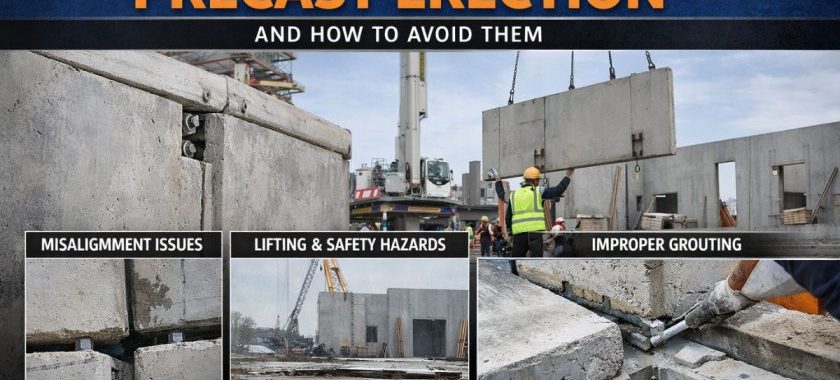
- Poor alignment of panels.
- Past delivery of precast elements.
- Lack of skilled workers
- Lack of interteam communication.
- Breaking of equipment during lifting.
Additionally, these problems not only reduce the pace of work but also make the work more expensive. Therefore, it is highly essential to detect risks prior to the commencement of the erection process.
Furthermore, appropriate technical drawings and planning tools can keep the teams on track and prevent confusion in the implementation process.
Why do planning issues delay precast projects?
Any precast erection is based on planning. With poor planning, delays are nearly assured. Most projects fail as the site teams and design teams do not start on the same page.
Moreover, a significant problem is the inappropriate application of precast erection services Australia, where the planning is not always done properly without analyzing the site. This leads to unforeseen issues in teams during installation.
Key planning challenges:
- Ineffective delivery scheduling.
- Lack of room to store precast elements.
- Poorly planned crane positioning.
- Lack of backup plans
Nevertheless, it is possible to avoid these problems by
- Developing an elaborate erection timetable.
- Site inspection prior to commencement.
- Provision of adequate equipment.
Moreover, planning early will minimize confusion and enhance the general workflow. It is also a way of making sure that every team knows what it is supposed to do.
How do design errors affect erection work?
In precast erection, design is very significant. Even minor design errors could cause huge problems in installation. Therefore, proper detailing should be done prior to the commencement of work.
However, most precast erection companies in Australia have a problem of incomplete or vague designs. This causes a lack of alignment, rework, and wastage of time.
Typical issues of design:
- Wrong sizes of panels.
- Missing connection details
- Lack of coordination between structural and architectural drawings.
To avoid these issues:
- Draw clear and elaborate drawings.
- Check review designs prior to approval.
- Make sure that there is coordination among the teams.
However, the services of erection drawings services in Australia are useful in enhancing the accuracy and minimizing the error in the installation process. These drawings show the workers how to do it step by step, which makes the process easier and safer.
What safety risks appear during erection?
One of the largest concerns in precast erection is safety. The heavy panels are lifted and installed, so any slight error may lead to severe accidents.
The following are some of the typical safety risks:
- Falling of precast panels
- Crane accidents
- Employees sustaining injuries in the process of alignment.
- Mishandling of lifting equipment.
These risks, however, can be minimized through proper planning and training. Such companies as 12 Meter Engineering pay much attention to safety practices to safeguard workers.
Important safety measures:
- Frequent safety training of workers.
- Proper lifting equipment.
- Pre-lifting check of load capacity.
- Following general safety rules.
Additionally, one should not compromise safety in order to save time. A successful project is always a safe project.
How does weather impact precast erection?
The weather conditions are also a significant factor in precast erection. Poor weather may slow down work as well as cause safety hazards.
Typical weather-related issues:
- Powerful winds affect crane activities.
- Slippy floors due to rain.
- High temperatures affect the performance of workers.
Nonetheless, such problems can be addressed through effective planning.
How to manage weather problems:
- Keep track of weather predictions.
- Never lift during heavy winds.
- Offer adequate safety equipment to workers.
Moreover, scheduling the work based on the weather enhances productivity and minimizes risks. Therefore, weather must never be neglected when scheduling a project.
Why do coordination gaps create problems?
In precast erection, coordination among the various teams is highly valued. Without communicating appropriately, then errors are bound to occur in teams.
The lack of coordination between the design and site teams is one of the problems. This is usually confusing during installation.
For example, in case precast panel detailing services in Australia are not shared with the site teams properly, workers can experience challenges in comprehending the design.
Common coordination issues:
- Lack of team communication.
- Delay in sharing updated drawings
- Lack of proper supervision
To avoid these issues:
- Hold frequent team meetings.
- Communicate through effective channels.
- Provide new drawings on schedule.
Moreover, good coordination guarantees a smooth flow of work and minimizes mistakes at the workplace.
How connection issues affect stability?
Connections play a very essential role in precast erection. In case connections are not properly designed or installed, the whole structure may be unsafe.
Incorrect precast connection details may cause:
- Weak structural stability
- Misalignment of panels
- Long-term durability issues
Nevertheless, these issues may be prevented by:
- Applying proper connection designs.
- Checking connections in the course of installation.
- Following proper installation methods
Moreover, the connection planning should be done properly so that the structure is strong and stable in the long run.
Final thoughts
Precast erection is associated with numerous difficulties, yet the majority of them could be prevented with the right planning, design, and effective collaboration. Companies such as 12 Meter Engineering also know that safety, coordination, and accuracy are essential in all projects.
However, with proper processes and trusted precast erection services in Australia, the teams can finish the projects in a shorter time, more safely, and of higher quality.
Frequently asked questions
It is the act of constructing ready-made concrete parts on site in a safe manner.
Delays are caused by ineffective planning and mistakes in design and coordination.
Guidelines, equipment, and safety training can help to minimize risks.
They provide structural stability and correct positioning of all precast components