Table of Contents
- Key Takeaways
- How AI is reshaping shop drawings?
- What construction teams get out of it?
- The problems nobody talks about
- AI vs traditional detailing methods
- What to look for in a partner?
- Final thoughts
- Frequently asked questions
Key Takeaways
- AI is making precast panel shop drawings faster, though accuracy still depends on the person reviewing them.
- Automation cuts down manual mistakes, but you still need trained engineers checking the work.
- Faster turnaround, better coordination, less rework. That’s the real payoff.
- The software matters less than who’s running it.
There’s no room for guesswork when it comes to precast work. If any one drawing is incorrect in a shop drawing, the result is delays, loss of concrete, potential safety on-site, and more. This used to involve hours of manual drafting and numerous rounds of team reviews.
That’s shifting now. AI and automation are beginning to appear in concrete and precast detailing, and construction firms nationwide in the USA are noticing it- the faster projects complete, no more trade showdowns, and design-to-fabrication handoffs are smoother. Yet what does all of this really mean for you, particularly when it comes to the management of contractors and keeping a project on track while you’re on it?
How AI is reshaping shop drawings?
Shop drawings provide fabricators with all the information they need to construct what they are looking to build including the placement of bolts. Previously, it took days to get there- hand-checking dimensions, comparing structural drawings, and finding one mistake at a time.
Software now automatically takes care of a lot of the routine work.
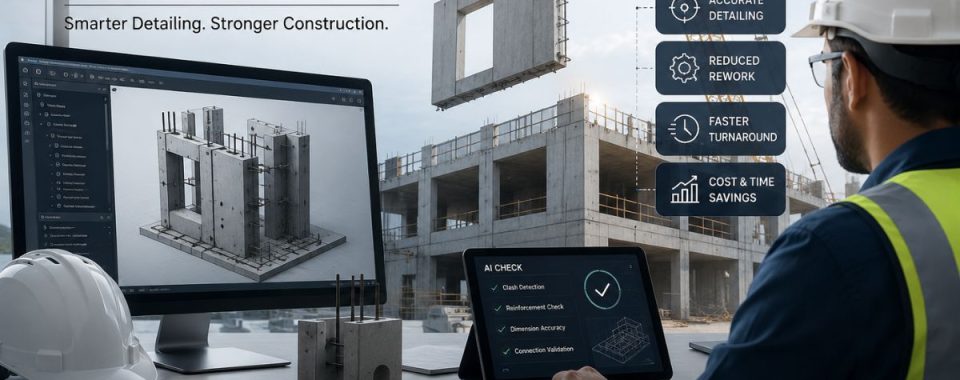
- The process of clash detection is quicker. Minutes are used to highlight the conflicts that arise between structural and MEP drawings, as well as architectural drawings- rather than leaving them unnoticed for days.
- Dimensioning is automated. Measurements are not measured by hand but instead are pulled from the model.
- Detail libraries save time. Common connections and panel types are pulled out of a digital library and are not redrawn from scratch.
- Version control actually does work! Changes to one drawing also propagate to other related drawings, so no slip-ups!
Moreover, none of that replaces the engineer. A detailer still checks every drawing prior to release. What automation does is remove the repetitive elements of a person’s job so that they can spend their time on the calls that really need judgement.
What construction teams get out of it?
If you are hiring a firm for precast detailing services in the USA projects, here how the practical side of automation will change.
1. Faster, not sloppier
The detailing, which was previously three or four weeks, can now be wrapped up in about 30 to 40% less time. That’s important when you’re already busy.
2. Fewer expensive mistakes
It is easy to correct a miscounted rebar or incorrect panel dimension on paper, but difficult to correct once the fabrication starts. Early identification by AI-supported checks can help save on costs in the future.
3. Real collaboration
Architects, engineers, and fabricators can view the same model simultaneously, using cloud-based tools. No need to search for the latest version of the PDF.
4. More consistent output
Each time it is the same logic, so no quality change based on who draws what.
5. Lower costs, eventually
If they can detail faster, they can fabricate faster, they can install faster, and the project can be completed faster. This costs you in labor and on your holding.
The problems nobody talks about
This doesn’t happen automatically.. However, there are a few issues that come up for companies when they introduce these tools.
- There is a learning curve. Before teams can save time, they must first save money by training.
- Bad data in, bad drawings out. If the architectural model feeding the AI is messy or incomplete, the output will be too.
- Some teams rely too heavily on it. If you’re not checking it yourself, you’re likely to make mistakes by skipping it because “the software checked it.
- Not all software is compatible. Certain tools don’t integrate seamlessly with the project management systems already in place, increasing manual labor.
Furthermore, all this isn’t a dealbreaker. A detailing partner who has actually performed these tasks on actual jobs, not just a sales pitch, will help you avoid most of it.
AI vs traditional detailing methods
Let’s make a simple comparison.
| Factor | Traditional Detailing | AI-Assisted Detailing |
| Turnaround time | 3-4 weeks average | 1.5-2.5 weeks average |
| Error detection | Manual review only | Automated clash checks plus manual review |
| Collaboration | Email and file sharing | Real-time cloud collaboration |
| Consistency | Varies by drafter | Standardized across projects |
| Cost efficiency | Higher due to rework | Lower due to fewer revisions |
| Scalability | Limited by staff hours | Higher, handles more projects at once |
Therefore, this is the reason more companies are going for Precast Concrete Detailing Services in USA that combine smart tools and an individual with experience in double-checking the work.
What to look for in a partner?
Not all businesses using “AI” are doing a good job of it. Some simply stick the label on an old process. So, what are the things you should look at when selecting Precast Panel Detailing Services in USA?
- Ask how they use automation
A good partner should break down the software and where it stops and human review starts.
- Watch how they communicate
The vast majority of delays are due to poor communication, not poor drawing.
- Request sample
Seeing their real work about Precast Panel Shop Drawings in USA, this is a way to know what you’re in for.
- Check software compatibility
Their tools should be compatible with any kind of project management system that you are already using.
- Ask about local codes
Detailing must be specific and meet building codes in your area and not industry standards.
Smart tools and on-the-job experience are what make each project happen at 12 Meter Engineering. Software works quickly. The final say goes with the engineers.
Final thoughts
You’re not seeing the end of good detailing just yet. It’s speeding their work up and helping to get it right. That means faster timelines and fewer time delays between construction team members for companies in the building industry. However, the tools are as effective as the hands that operate them.
When you have a project to get done and need detailing that is quick but not rushed, you want a team that is not relying on automation as a crutch but instead should know how to do it properly and quickly. 12 Meter Engineering’s precast detailing services in USA combine cutting-edge technology and experienced engineers who have worked in the field.
Looking to put that into your next project? Connect and communicate with a team that is first in construction and second in software.
Frequently asked questions
They create precise shop drawings for precast concrete parts, directing production and installation and ensuring that everything aligns with code and is installed across teams.
It accelerates dimensioning, automatically detects clashes, reduces manual mistakes, and saves engineers time from repetitive drafting tasks to review.
Yes, provided a qualified human performs a final quality control check. Computer technology performs well in repetitive processes, however seasoned engineers are still necessary to correct the mistakes done by computers.
Due to automation, a project may take between 1-2 weeks as compared to 3-4 weeks needed when manual detailing is used.
No. While the computer works out repetitive computations and clash check outcomes, the final judgment must be made by a professional engineer.
The most important issue to be considered is the quality of their previous projects. It is of utmost importance to find out how forthcoming they are about their own work processes, to get samples of the projects they did and to monitor their communication levels.
In most cases it is not. The less time is spent on a task, the fewer mistakes are made, and this minimizes the expenses associated with redoing mistakes or misunderstanding between teams.
Each state has its own legislation, and the design has to comply with it to avoid problems with compliance and the obligatory corrections