Table of Contents
- Key takeaways
- What is BIM clash detection, and why does it matter?
- How does the clash detection process actually work?
- The three types of clashes BIM catches
- What clash detection prevents on-site?
- Where does structural steel fit into the clash detection picture?
- Common mistakes teams make with clash detection
- Expert insights: choosing the right coordination partner
- Final thoughts
- Frequently asked questions
Clash detection means checking architectural, structural, and services models against each other before anything gets fabricated. When done properly, it catches three types of issues: hard clashes, soft clashes, and sequencing clashes. In case of wrong coordination, the associated reworking costs are generally within a range of 5 to 15% of the total project budget, and many of these expenses originate from conflicts that could have been detected with the help of a well-coordinated model many weeks earlier.
If you order BIM services in Australia, clash detection is not just a complementary service to the design phase; this is the thing that ensures the integrity of fabrication drawings.
Key takeaways
- Before construction commences, clash detection identifies 3D models across organizations, allowing problems on site to be avoided.
- The cost of coordination failure can account for an additional 4% to 12% of project expenditures as a result of unnecessary work.
- Clashes can be classified into hard, clearance, and temporal, which demand different solutions.
- In Australia, steel detailing has adopted BIM models that are integrated and shared across the stakeholders to avoid coordination failures.
What is BIM clash detection, and why does it matter?
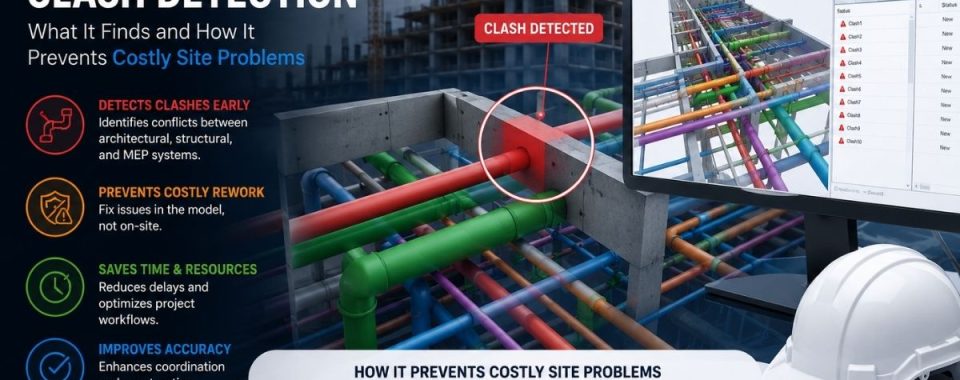
Clash detection involves the process of overlaying 3D models of different disciplines, including architectural, structural, mechanical, electrical, hydraulic, and firefighting disciplines, and determining places where elements are colliding or do not have enough clearance. While the drawings of different disciplines may be fine by themselves, the problem becomes visible only when the 3D models are combined.
However, construction has largely been separated into various segments of activity, where each segment completes its drawing separately, and it is hoped that the whole drawing can be used successfully on the construction site. In reality, it often does not happen that way. When a structural engineer moves a beam six inches for the sake of a column, they update their model. Meanwhile, the mechanical contractor is still using coordinates from last week. Hence, the ductwork is produced according to an old model and would not fit in reality.
Sourcing BIM services in Australia doesn’t just mean keeping out of embarrassing situations on site. It means identifying the clash when the solution is a five-minute fix on screen rather than a two-week delay that entails demolition, re-fabrication, and a slew of subcontractors involved in fixing the problem.
How does the clash detection process actually work?
The mechanics are simple. Keeping up with them across a live project is the hard part.
- Model federation – individual discipline models get combined into one shared, coordinated model.
- Rule-based checking – the combined model runs through interference checks, comparing every element against every other element for overlap or clearance breaches.
- Clash review – results get sorted by severity. A duct clipping a beam matters more than a light fitting sitting a bit close to a ceiling grid.
- Assignment and resolution – each clash goes to the discipline responsible, with a deadline, and gets tracked until it’s actually closed.
- Re-check – once fixes are in, the model runs again to confirm the clash is gone and hasn’t opened up a new one somewhere else.
Furthermore, this isn’t a one-off event before construction starts. On an active project, coordination teams usually run this cycle weekly, sometimes more often during design development, so conflicts get caught as the design changes rather than only at the very end.
The three types of clashes BIM catches
Most people picture clash detection as “finding pipes that run through walls.” That’s part of it, but only part.
- Hard clashes- are the obvious ones: two solid elements physically occupying the same space. A duct through a structural beam. A sprinkler main crosses a steel column. Easy to spot, expensive to leave sitting there, because fixing one after fabrication usually means cutting, re-welding, or replacing whole sections.
- Soft clashes- are subtler. Nothing overlaps, but there isn’t enough room to reach, maintain, or insulate something properly. A valve installed exactly to plan with no room for a technician’s tools. A fire-rated wall built to spec but sitting too close to a duct for the required clearance. These won’t necessarily stop construction. They tend to resurface later, as a maintenance complaint or a compliance failure nobody wants to deal with at handover.
- Workflow clashes– sometimes called 4D clashes- are about sequence rather than geometry. A crane parked where the concrete pour needs access. A wall scheduled to close in before the services behind it are signed off. These get talked about less, but the fix often means undoing finished work just to reach something that should have gone in first.
What clash detection prevents on-site?
This is where the numbers get real. Rework and coordination failures cost the US construction industry tens of billions of dollars a year, and Australian projects run on the same tight margins, compressed programs, and trades working off drawings that go stale the moment one discipline makes a change.
A few things good clash detection actually prevents:
- Scrapped and re-fabricated materials- Steel cut to the wrong dimension, ductwork built to superseded drawings. None of it’s cheap to remake, and custom fabrication lead times can blow out a schedule far worse than the original mistake did.
- Delays that ripple through the whole program- One unresolved clash on a critical path item holds up everything scheduled after it. A short delay there can cost more in extended overheads and financing than the entire coordination effort would have cost up front.
- Arguments over who pays- When a clash shows up on site, the back-and-forth between trades over whose drawing was wrong can eat as much time and goodwill as the physical fix.
- Safety and compliance headaches- Services routed too close to structural elements, or clearances that don’t meet code, aren’t just costly to fix. They can hold up occupancy certification entirely.
Moreover, the data backs this up: coordinated BIM projects typically resolve 80 to 90% of major conflicts before anything gets built. The rest still needs catching on site, which is why supervision and RFI processes don’t disappear entirely, but the volume of genuine surprises drops sharply.
Where does structural steel fit into the clash detection picture?
Structural steel is one of the least forgiving trades when a clash gets through. It’s fabricated off-site, on long lead times, and once a member’s cut and welded to length, there’s almost no room to adjust on site. A clash that would be a quick fix in timber framing can mean scrapping an entire beam in steel.
That’s why structural steel detailing services in Australia are usually run through the same federated model as architecture and services, rather than detailed separately and checked later. Steel detailers work off connection details, bolt patterns, and camber allowances, all of which need to sit correctly against everything else in the building: penetrations for services, clearances for cladding, tolerances for erection. Running steel through clash detection before shop drawings go out for fabrication catches conflicts while they’re still cheap to fix.
This is actually where steel detailing services in Australia pay for themselves most clearly. A missed clash between a beam and a duct riser, caught after fabrication, can mean weeks waiting on a replacement member. Caught in the model, it’s a five-minute change to a connection detail.
Common mistakes teams make with clash detection
A few patterns come up again and again on projects where clash detection didn’t deliver what it should have:
- Running it too late is the big one. Clash detection done only at 90% design development finds problems that are already expensive to change, because the design’s locked in everywhere else. It works best when it runs continuously from early design development on.
- Teams also tend to ignore soft clashes, chasing hard ones and waving clearance issues through as “close enough.” Those clearance issues have a habit of coming back as maintenance complaints or compliance failures well after handover.
- Some teams treat the clash report itself as the finish line. A long list of flagged clashes is worthless if nobody’s assigned to actually resolve them. The report is where the work starts, not where it ends.
- Models built at the wrong level of detail miss clashes simply because the geometry isn’t there, no bolt heads, no insulation thickness, no access panels represented. And skipping the re-check after a fix is applied is how teams end up chasing the same clash twice, because fixing one problem sometimes creates another right next to it.
Expert insights: choosing the right coordination partner
Not every provider runs clash detection the same way, and it shows on site. A team that understands what’s actually buildable will flag clashes differently than one that’s purely checking geometry against geometry.
Worth asking any BIM services provider in Australia directly: how early do they start running interference checks? Do they treat clash severity as a real distinction, or flag everything with the same urgency? Do steel detailers and services engineers sit in the same coordination meetings, or do they just get handed a report afterward?
The best coordination comes from people who’ve spent real time close to construction, not just people who are good with the software.
At 12 Meter Engineering, clash detection runs alongside structural steel detailing and services design from early development, not as a check done once at the end. Conflicts get caught and resolved while changes are still cheap to make.
Final thoughts
Clash detection catches the small things before they become expensive ones: an unsynced beam elevation, a duct routed through a column, a clearance that’s five centimetres short. Leave any of those unnoticed and they turn into rework, delay, and arguments about who’s paying for it. The projects that get real value from clash detection run it early, take soft and sequencing clashes as seriously as hard ones, and treat the report as a task list rather than a box ticked off.
If you’re planning a project and want coordination done properly from the start, working with an experienced BIM services in Australia provider that understands both the modelling and the construction side makes the difference between catching a problem on screen and finding it on site.
Frequently asked questions
- What’s the difference between clash detection and clash coordination?
Clash detection is the technical process of finding conflicts in a combined model. Coordination is the broader work of assigning, discussing, and actually resolving them. Detection finds the problem; coordination fixes it. - How early should clash detection start on a project?
From design development onward, ideally, not just before construction documentation. Starting early means catching conflicts while changes are cheap and the design is still flexible enough to absorb them. - Does clash detection eliminate all site issues?
No. It cuts them down significantly but can’t catch problems tied to workmanship, site conditions, or scope changes made after the models are locked. It’s a major risk reducer, not a guarantee. - How does clash detection affect structural steel specifically?
Steel is fabricated off-site on long lead times, so a missed clash can mean scrapping a beam entirely. Running steel detailing through the same coordinated model as services and architecture catches these conflicts before fabrication ever starts. - What’s a soft clash, and why does it matter if nothing’s physically overlapping?
It’s a clearance breach, not enough room to access, maintain, or insulate something properly. It won’t stop construction outright, but it can cause compliance or maintenance problems well after handover. - How much does poor coordination actually cost a project?
Industry figures put rework at roughly 5 to 15% of total project cost, much of it traceable to conflicts that weren’t caught before construction. The exact number depends on project complexity and how many trades are involved. - Who’s responsible for resolving a clash once it’s found?
Whichever discipline’s element is causing it, though the fix often needs input from other trades too, especially when it affects someone else’s clearance or access. - Can small projects benefit from clash detection, or is it only worth it for large builds?
Even a modest fit-out with mechanical, electrical, and hydraulic services benefits. The effort scales with complexity, but the underlying problem, trades working off drawings that don’t match, exists at any project size. - What should I look for in a BIM services provider in Australia?
A provider that starts interference checks early and keeps running them, treats clash severity as meaningful rather than flagging everything the same, and gets steel detailers and services engineers into the actual resolution conversation instead of just sending a report. - Is clash detection only relevant to new builds, or does it apply to renovations too?
Both. Renovation and retrofit work often has patchier existing documentation, which makes clash detection between new work and undocumented existing conditions even more useful, not less.