Table of Contents
- Key Takeaways
- What do pre-engineered buildings actually need from detailing?
- Where is AI actually showing up in PEB workflows?
- AI’s impact on structural steel detailing services
- How are BIM services evolving with automation?
- Shop drawings and fabrication drawings: what’s changing?
- Common mistakes firms make when adopting AI tools
- What to look for in a detailing partner in 2026?
- Expert recommendations for getting the most from automation
- Final thoughts
- Frequently asked questions
Key Takeaways
- AI increases the efficiency of structural steel detailing services in the USA through quicker and more accurate execution of projects.
- AI is capable of identifying any discrepancies in drawings before fabrication and therefore minimizes expensive mistakes and delays.
- BIM services in the USA help in spotting design inconsistencies in advance to ensure a seamless construction process.
- AI complements the work of engineers, but human expertise is still important for the development of secure and dependable PEB designs.
Anyone who has worked around a PEB project knows the drawings are where things either come together or fall apart. A bolt hole that’s off by a fraction. A beam that doesn’t quite land on the column beneath it. A connection detail that looked fine on screen and then didn’t work on site. These are the problems that used to cost weeks of back-and-forth between engineers and fabricators, and a lot of that time was just paperwork.
AI is not rewriting the rules of structural engineering. But it is changing how the detailing work actually gets done, day to day. At 12 Meter Engineering, we’ve watched automation go from a curiosity to something built into the daily routine: faster clash checks, drawings that build themselves from the model, fewer surprises once steel actually reaches the shop floor.
This blog covers what’s genuinely changing, what isn’t, and what that means if you’re sourcing structural steel detailing services in the USA for your next project.
What do pre-engineered buildings actually need from detailing?
Before getting into the AI side of it, it’s worth remembering why detailing matters so much on PEB work in the first place. A pre-engineered building runs on precision. Every purlin, girt, and base plate has to match the steel fabrication drawings services in USA that get sent to the shop, and those drawings need to match the structural design intent exactly, not roughly.
However, PEB systems don’t have the redundancy conventional steel structures do. Members are sized tightly to the load they carry, so there’s less room to absorb a mistake. A detailing error that would be a minor annoyance on a conventional frame can become a genuine problem here.
That’s why detailing has always demanded a mix of technical knowledge and patience. It’s repetitive in places and unforgiving of shortcuts everywhere else.
Where is AI actually showing up in PEB workflows?
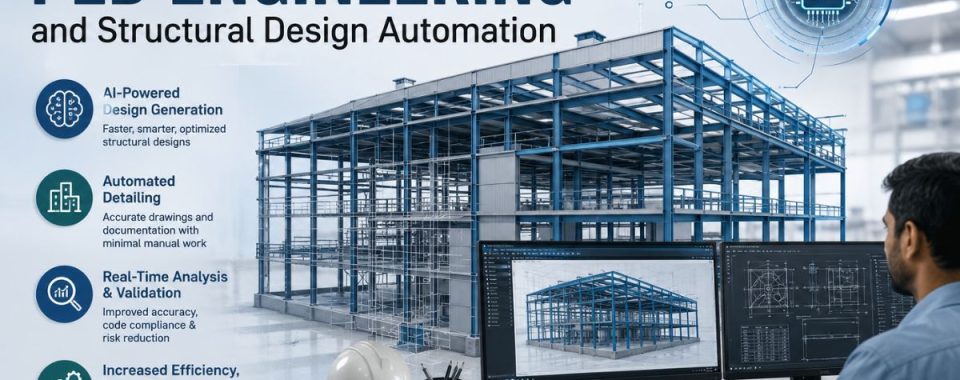
“AI in construction” gets thrown around loosely, so it’s worth being specific. In PEB and structural detailing, the real applications fall into a handful of categories.
- Automated Clash Detection
Software can scan a 3D model and flag geometric conflicts- a duct cutting through a beam, a connection plate overlapping another member- much faster than someone manually checking every intersection by hand. It doesn’t replace the reviewer. It just narrows down what actually needs a second look.
- Drawing Generation From Models
Once a structural model has enough detail built into it, automation can generate a good share of the shop drawings services in USA clients need, pulling dimensions and annotations straight from the model instead of someone redrawing them sheet by sheet.
- Pattern Recognition for Design Optimization
Some tools compare a current design against thousands of past projects and suggest member sizes or connection types that have historically held up for similar spans and loads. Useful as a starting point. Not something you’d sign off on without checking it.
- Quality Control Checks
Automated checks catch inconsistencies between drawing sets, a dimension on one sheet that doesn’t match another, a note referencing a detail that no longer exists in the current revision. Small things, but the kind that cause real problems in the shop.
AI’s impact on structural steel detailing services
For firms and clients relying on structural steel detailing services in USA, the benefits show up in a couple of concrete ways.
Turnaround time is the obvious one. Work that used to take a detailer several days, modeling repetitive framing, drafting standard connections, now gets roughed out much faster, which leaves the detailer more time for the parts of the job that actually need judgment.
Moreover, error rates matter just as much. Automated clash detection catches a category of mistake that used to go unnoticed until steel was already being cut, which is the most expensive point to find a problem. Catching something on screen costs almost nothing. Catching it after fabrication costs real time and real money.
None of this removes the need for an experienced engineer reviewing the output, though. AI-generated suggestions still need someone who understands load paths, connection behavior, and site conditions before anything gets signed off. We tell clients this a lot: automation speeds up the process; it doesn’t replace the review step. If anything, that review matters more now, since there’s simply more work moving through the pipeline.
How are BIM services evolving with automation?
BIM services in USA have probably changed more than any other piece of this workflow. A few years ago, BIM meant a coordinated 3D model that different disciplines could reference when they needed to. Now that model is increasingly the actual source of truth that automation pulls from directly.
- Model-Based Design Checks
Instead of someone manually cross-referencing a structural model against architectural and MEP models sheet by sheet, automated coordination checks flag conflicts as the model updates. That’s especially useful on fast-moving projects, where design changes come weekly, and manual coordination just can’t keep pace.
- Data-Rich Models
Modern BIM models carry more than geometry. Material specs, connection types, and fabrication notes often live inside the model itself, which feeds both drawing automation and downstream cost estimating.
- Version Control and Change Tracking
Automated tools track what changed between model revisions, which matters a lot when design changes come late, and everyone on the project needs to know exactly what moved.
None of this replaces coordination meetings between disciplines. It just gives those meetings better information to start from.
Shop drawings and fabrication drawings: what’s changing?
On the fabrication side, the shift toward automated shop drawings services in USA and fabrication drawings services in USA has been noticeable in production.
- Faster Turnaround on Standard Details
Repetitive elements, standard base plates, common connection types, and repeated bay framing are generated quickly once the pattern exists in the model, instead of being drawn from scratch every time.
- Fewer Revision Cycles
Because clash detection happens earlier now, fewer problems show up after drawings reach the shop. That means fewer revision rounds between the detailer and the fabricator, and fewer delays waiting on them.
- Consistency Across Large Projects
On projects with hundreds of similar members, automation keeps drawing conventions consistent: the same dimensioning style, the same notation, the same level of detail throughout, which is genuinely hard to maintain when several people are drawing sheets by hand over months.
Furthermore, one example: on a recent multi-building PEB project, roughly 60% of the standard framing drawings came straight out of the coordinated model. That left the detailing team free to focus on the non-standard connections and site-specific conditions that actually needed engineering judgment.
Common mistakes firms make when adopting AI tools
Not every firm handles this transition well. A few patterns keep showing up.
- Trusting automated output without checking it- Automation flags issues and builds drawings, but it doesn’t understand context the way an engineer does. Skip the review step and mistakes come right back.
- Treating AI as a substitute for experienced detailers- The firms getting real value use automation for the repetitive work and put their experienced people on the judgment calls, not the reverse.
- Underestimating the setup time- Getting a model detailed enough for reliable automated drawing generation takes real effort up front. Firms that rush this step end up with drawings that need more correction than if someone had just drawn them by hand.
- Ignoring site-specific conditions- Automated suggestions are built from patterns in past projects. They don’t know about an unusual foundation condition or a client’s fabrication preference unless someone tells them.
What to look for in a detailing partner in 2026?
If you’re evaluating firms for structural steel detailing services in USA, a few questions are worth asking directly.
- How do they balance automated tools with manual engineering review? A firm leaning entirely on one or the other is missing something.
- Can they point to a project where automation caught an issue before fabrication? A firm actually using these tools well should have specific stories, not vague reassurances.
- What does their BIM coordination process look like, and how often does the model actually get updated during a project?
- How do they handle non-standard connections? This is where automation needs the most human input, and it’s a good test of how a firm actually works.
Expert recommendations for getting the most from automation
From running detailing projects at 12 Meter Engineering, a few things consistently make the difference.
Keep the model detailed and current. Automation is only as good as what feeds it, so time spent on accurate modeling early pays off for the rest of the project.
Put experienced reviewers on automated output, not just junior staff. The calls that matter most- connection adequacy, load path continuity, whether something is actually fabricable- still need someone who’s seen enough projects to spot what looks wrong.
Use the time automation frees up for harder problems, not as an excuse to cut review staff. The firms getting the best results spend more time on the fraction of the work that genuinely needs deep expertise, not less.
Stay in coordination meetings even when the model is flagging fewer conflicts. Automated checks are good at geometric clashes. They don’t replace a conversation about sequencing, constructability, or a client’s specific site constraints.
Final thoughts
AI isn’t replacing the engineers and detailers behind PEB projects. It’s changing where they spend their time. Repetitive modeling and basic clash checks are increasingly automated, which frees experienced people up for the judgment calls that actually require experience: connection design, unusual site conditions, the kind of engineering instinct that only comes from years on real projects.
For anyone sourcing structural steel detailing services in the USA, BIM services in or fabrication drawings services in the USA, the takeaway is simple. Find a partner that uses these tools well, but never lets them replace the human review that keeps a project safe and buildable.
Looking for a detailing partner that combines smart automation with hands-on engineering review? Reach out to 12 Meter Engineering to talk through your next PEB project.
Frequently asked questions
Mainly through automated clash detection, faster drawing generation from 3D models, and consistency checks across large drawing sets, with engineers still reviewing and approving the final output.
No. AI handles repetitive modeling and flagging tasks. Engineers still make the calls on connections, load paths, and site-specific conditions that automation can’t fully judge.
Better coordination between disciplines, earlier conflict detection through model-based checks, and data-rich models that speed up both drawing production and cost estimating.
It cross-checks dimensions and details across drawing sets, catching inconsistencies before fabrication starts instead of after steel is already cut.
They’re a strong starting point, but still need review by an experienced detailer or engineer to confirm accuracy and account for project-specific details.
A firm that pairs automated tools with solid manual review, has real experience with non-standard connections, and can show specific examples of catching issues before fabrication.
It varies by project complexity, but standard connections and repetitive framing often get modeled and drawn noticeably faster, leaving more time for the non-standard work.
Yes, through faster turnaround on standard details and fewer revision cycles, though the upfront investment in accurate modeling matters just as much for smaller shops as larger ones.
Skipping human review of automated output. Automation doesn’t fully grasp site-specific conditions or unusual structural configurations the way an experienced engineer does.
Automated tools speed up repetitive modeling and clash detection, while experienced engineers review every drawing set for accuracy and constructability before it reaches.