Table of Contents
- Key Takeaways
- What is structural steel detailing?
- Step-by-step workflow explained
- Benefits of a structured workflow
- Project success example
- Wrapping up
- Frequently asked questions
Key Takeaways
- Structural steel detailing converts your design concepts into fabrication and erection-ready documentation.
- A well-defined workflow can minimize mistakes, delays, and construction expenses.
- A correctly drawn fabrication and erection plan helps to coordinate and execute the project.
- Precision and quality control are essential in advanced detailing work, where service providers like 12 Meter Engineering contribute to the greater success of the projects.
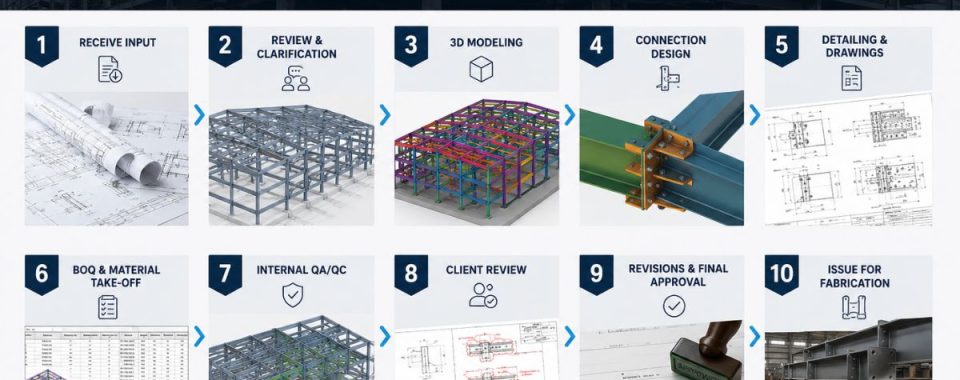
Structural steel detailing projects consist of a series of systematic steps that convert engineering design to detailed fabrication and erection documents. In general, the process consists of the project review, 3D modeling, connection detailing, shop drawing, erection planning, quality control, and delivery. By following a structured approach, errors can be minimized, coordination can be enhanced, and successful project implementation is more likely.
Moreover, structural steel detailing in the USA is an essential service for any construction project, particularly one with complex designs, as it can help prevent delays and costly rework. Whether you are designing a commercial or industrial building, steel detailers work between design engineers, fabricators, and erection teams.
What is structural steel detailing?
Structural steel detailing involves creating detailed drawings and models for the fabrication and installation of steel structures. It turns engineering designs into workable instructions that fabricators and contractors can use.
Typical outcomes of delivering the project are the following:
- Shop drawings
- Fabrication drawings
- Connection details
- Material lists
- CNC data
- Erection drawings
Furthermore, professional steel detailing services in USA help to ensure that all steel members are perfectly represented before the fabrication process starts.
Step-by-step workflow explained
1. Project Review
Every detailing job starts with a comprehensive review of documents available.
These typically include:
- Structural design drawings
- Architectural drawings
- Design specifications
- Project standards
- BIM models (if available)
At this point, detailers note missing information, conflicts, and potential constructability issues prior to modeling.
2. 3D Steel Modeling
Once project documents have been reviewed, the detailer creates a detailed 3D model with industry-standard software.
The model includes:
- Beams
- Columns
- Braces
- Connections
- Miscellaneous steel components
Therefore, a well-developed model is used to identify conflicts at an early stage and enhances stakeholder coordination.
For businesses like 12 Meter Engineering that employ state-of-the-art modeling workflows, the results are increased accuracy and project delivery efficiency.
3. Connection Detailing
One of the most important components of any steel structure is the connections.
Detailers define:
- Bolt locations
- Weld specifications
- Plate dimensions
- Connection assemblies
However, correct detailing of connections guarantees the strength and project specifications.
4. Fabrication Drawing Preparation
After the model has gained approval, shop and fabrication drawings are produced.
These drawings include the following manufacturing data to be used by fabricators:
- Dimensions
- Material specifications
- Hole locations
- Weld symbols
- Assembly details
Additionally, high-quality steel fabrication drawings services in USA can minimize the quantity of production errors and maintain the same quality for the production in the steel fabrication shop.
5. Erection Drawing Development
Once the fabrication drawings have been created, erection drawings are created for the erection crew.
These drawings show:
- Member locations
- Assembly sequences
- Grid references
- Elevations
- Connection references
Accurate steel erection drawings in USA are crucial for contractors to install the structural components efficiently and safely.
6. Quality Control and Checking
Quality checks are carried out in detail before the project submission.
The review process typically verifies:
- Drawing accuracy
- Connection consistency
- Material quantities
- Member numbering
- Ability to meet project specifications
This stage drastically helps to diminish fabrication and construction problems.
Furthermore, multi-level checking procedures at 12 Meter Engineering ensure high standards in detailing work throughout projects.
7. Final Delivery and Coordination
The last phase is to provide the final approved project files to fabricators and contractors.
Deliverables may include:
- PDF drawings
- NC files
- BOM reports
- IFC models
- Erection packages
Continuous coordination through fabrication and construction will continue to be important to consider revisions and site-related changes.
Benefits of a structured workflow
There are a number of benefits to a well-defined detailing workflow:
| Benefit | Impact |
| Improved Accuracy | Reduces fabrication errors |
| Faster Project Delivery | Streamlines coordination |
| Better Cost Control | Minimizes rework |
| Enhanced Safety | Supports proper erection planning |
| Higher Productivity | Improves fabrication efficiency |
Moreover, professional structural steel detailing services in USA help project teams get smoother execution from design to installation.
Project success example
This will help you avoid unnecessary rework in a commercial building project. To avoid unnecessary rework in a commercial building project, this will help you.
During this 3D modeling process, the detailing team found there was some problem in the clashes between the structural steel and the mechanical systems in a large-scale commercial building project.
Because these issues were resolved before fabrication:
- Waste of material was minimized.
- Sites were modified to the least extent possible.
- The work went according to schedule.
- There was a better level of trade coordination.
This is just one example of how proactively detailing directly affects project success.
However, clash detection is becoming more commonplace, with some organizations like 12 Meter Engineering specializing in early clash detection and constructability reviews to help clients prevent costly field issues.
Wrapping up
Structural steel detailing is much more than drawing preparation. A critical process that links engineering design, fabrication, and field construction. Structured workflows, ranging from project review to 3D modeling, fabrication drawings, and erection planning through to quality control, will help project teams to increase accuracy, minimize risk, and quicken project completion.
To get the best steel detailing services in the USA, it is best to choose the services of a professional team such as 12 Meter Engineering, which will help to ensure that the project is completed in the most accurate and efficient manner.
Frequently asked questions
Structural steel detailing ensures project accuracy and efficiency by producing the drawings and structural steel models.
Fabrication drawings are used to communicate exact size, detail, and material specifications to the manufacturer for the accurate production of steel components.
Erection drawings include member locations, assembly sequence, elevations, grid references, and installation details for field crews.
A 3D model can be used to look for clashes, to coordinate the parts, and to minimize build-up errors before any work is done on the machine.
Minimal rework, waste of material, fabrication mistakes, and construction delays cost money. Minimal rework, material waste, fabrication mistakes, and construction delays cost money.
The purpose of structural steel detailing drawings is to ensure that the steel components are manufactured correctly, coordinated with other building components, and erected accurately during the structural construction process, from the fabrication process to the erection process.