Table of Contents
- Key Takeaways
- What is a BIM-based steel detailing model?
- Why do fabricators prefer these models?
- How does BIM improve fabrication accuracy?
- Key benefits for steel fabricators
- Advantages of working with an BIM partner
- BIM-based detailing success example
- Why is BIM becoming the industry standard?
- Final thoughts
- Frequently asked questions
Key Takeaways
- The BIM-based steel detailing boosts the precision of steel fabrication and project coordination.
- Early clash detection means no costly construction problems.
- Automated drawing generation speeds up fabrication workflows.
- Experienced partners like 12 Meter Engineering help fabricators maximize BIM benefits.
BIM-based steel detailing models offer several benefits for fabricators, including increased accuracy, fewer errors, faster production times, and better collaboration among project teams. Unlike 2D drawings, the BIM 3D model is data-rich and can be used to check for clashes, produce accurate fabrication drawings, and streamline construction workflows.
Steel projects in the United States are getting more and more complicated, and businesses are increasingly turning to structural steel detailing services in the USA to provide models that are ready to be fabricated, minimizing rework and delays in the project. Today, BIM technology is playing a crucial role in ensuring efficiency and quality in modern steel construction.
What is a BIM-based steel detailing model?
A BIM (Building Information Modeling) steel detailing model is a digital 3D representation of a steel structure that carries information about each steel component, connection, bolt, plate, and member.
Unlike traditional CAD drawings, the advantages of BIM models are:
- Accurate geometry
- Material specifications
- Fabrication information
- Installation sequencing
- Clash detection capabilities
Moreover, this comprehensive approach enables fabricators to see the big picture prior to putting products into production.
Why do fabricators prefer these models?
- Better Accuracy
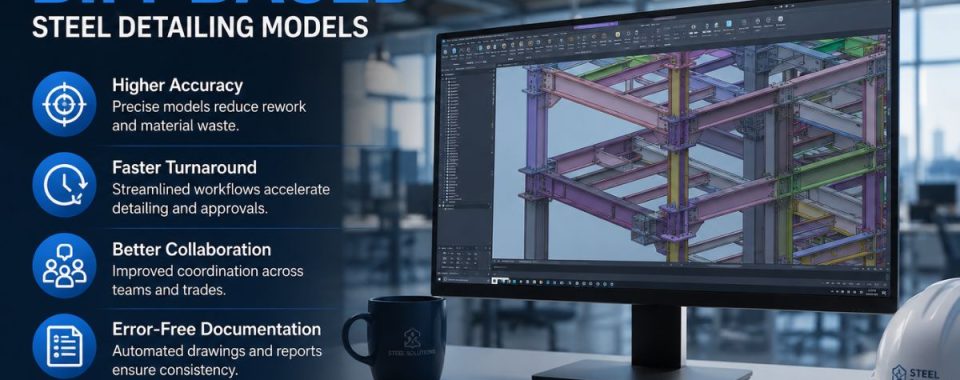
Accuracy is one of the major factors that drive BIM implementation in fabricators. A BIM model will give precise size and connection information and will minimize the risk of fabrication errors. Because each steel piece is digitally coordinated, discrepancies can be detected prior to the beginning of production.
- Faster Fabrication Workflows
The information produced by BIM can be directly utilized by the fabricators in the manufacturing process. This decreases the amount of manual calculations and minimizes the time invested in reviewing drawings, bringing projects from design to fabrication that much quicker.
- Improved Coordination
There are a lot of people who are involved in large construction projects, such as architects, engineers, contractors, and fabricators. BIM establishes a shared model space for all parties to collaborate in. This enhances communication and helps prevent miscommunication.
- Clash Detection Before Construction
BIM software detects clashes of structural steel, mechanical, electrical, and plumbing elements. Early detection of these problems will avoid costly site changes and delays in the project.
How does BIM improve fabrication accuracy?
1. Detailed Component Modeling
All the steel components are modeled using accurate details. This guarantees that manufacturing teams get extremely accurate manufacturing details.
2. Automated Drawing Generation
BIM software will automatically generate:
- Shop drawings
- Assembly drawings
- Erection drawings
- Material lists
As a result, minimizes the chances of human intervention causing mistakes with regard to the manual drafting.
3. Real-Time Updates
When design changes occur, the BIM model updates related drawings automatically. This minimizes the risk of teams in fabrication using outdated information.
4. Material Optimization
Fabricators can precisely determine material needs, minimizing waste and boosting project profitability. This is why numerous companies that can offer steel fabrication drawings services in USA have now started to incorporate the BIM work process into their detailing procedure.
Key benefits for steel fabricators
| Benefit | Impact on Fabricators |
| Reduced Errors | Fewer fabrication mistakes |
| Faster Production | Improved project timelines |
| Better Coordination | Stronger team collaboration |
| Cost Savings | Less rework and material waste |
| Improved Quality | Higher fabrication accuracy |
| Enhanced Visualization | Better project understanding |
Additional Advantages
- Faster approval cycles
- Easier project tracking
- Improved constructability reviews
- Accurate quantity takeoffs.
- Greater client confidence
All these benefits are why BIM is a preferred solution for fabricators and contractors in all parts of the United States.
Advantages of working with an BIM partner
Choosing the right details partner is as crucial as implementing BIM tools.
Fabricators can create highly coordinated BIM models and fabricate with efficiency and project success with the help of an experienced company like 12 Meter Engineering.
Professional BIM teams offer:
- Detailed steel modeling
- Connection detailing
- Shop drawing generation
- Material takeoffs
- Clash detection support
Furthermore, for those seeking a dependable BIM services provider in USA, experience in structural steel projects and fabrication processes is a key consideration.
BIM-based detailing success example
For a large commercial development, there were thousands of structural steel components to coordinate and execute across multiple floors that necessitated the need for structural steel detailing services in USA for accurate coordination and execution.
However, the project team started off with issues of coordination between structural and MEP systems. With the BIM-based steel detailing, potential clashes were detected during the design phase, before construction started.
The detailed model allowed the fabrication teams to create accurate shop drawings and to optimize material procurement. This resulted in fewer changes in the field, decreased fabrication delays, and more efficient installation.
It’s for this reason that many companies such as 12 Meter Engineering continue to provide fabricators with the advanced detailing solutions, structural steel detailing solutions, and structural steel detailing services in USA using BIM.
Why is BIM becoming the industry standard?
The steel construction industry is quickly transitioning to digital workflows.
BIM is becoming a popular option for fabricators because it:
- Improves productivity
- Enhances project visibility
- Reduces project risks
- Supports faster decision-making
- Provides improved project results
In today’s world, many steel detailing firms in the USA have made BIM indispensable to the steel fabrication and construction industry.
Adoption of BIM will further rise in all sectors, commercial, industrial, and infrastructural, as they become more complex.
Final thoughts
The steel detailing BIM models have revolutionized the approach to steel project planning, coordination, and execution in today’s era. BIM brings tangible benefits throughout the construction process, including increased accuracy, decreased rework, clash detection, and streamlined fabrication processes.
With the increasing demand for efficient and technological construction, partnering with seasoned service providers like 12 Meter Engineering can assure organizations of improved project outcomes, quicker delivery timelines, and better results in fabrication.
Seeking precise solutions for steel detailing, based on BIM? Call 12 Meter Engineering today to experience precision-driven modeling and detailing solutions to streamline your next steel fabrication project.
Frequently asked questions
BIM in steel detailing is a 3D digital modeling process that includes fabrication, construction, and coordination information for structural steel components. It enhances accuracy and project team collaboration.
The advantages of BIM to fabricators include the ability to minimize errors in fabrication, to aid in coordination in the construction phase, to speed up fabrication, and to identify construction issues prior to manufacture.
BIM reduces material waste, eliminates rework, aids planning, and helps detect clashes early in the project, which can lead to substantial cost savings during the project life cycle.
Yes, BIM software can automatically create shop drawings, assembly drawings, erection drawings, and material schedules from the model.
Absolutely. BIM is especially beneficial for large and complex projects, as it makes it easier to coordinate multiple people and increases project accuracy