Table of Contents
- Key takeaways
- What do fabrication drawings actually do on a steel project?
- Why do large steel projects depend on detailing accuracy?
- The real cost of getting fabrication drawings wrong
- What separates a reliable detailing partner from the rest?
- Common mistakes in steel fabrication drawings
- Expert recommendations for project managers and contractors
- Conclusion
- Frequently asked questions
Key takeaways
- Fabrication drawings depict the detailed structural designs as precise construction instructions.
- Minor drawing mistakes can grow into serious fabrication problems in big industrial projects.
- Steel fabrication drawings services in Australia lessen the amount of rework done and enhance the efficiency of ongoing work.
- 12 Meter Engineering provides workable drawings that help the fabrication and erection of steel structures go on without a hitch.
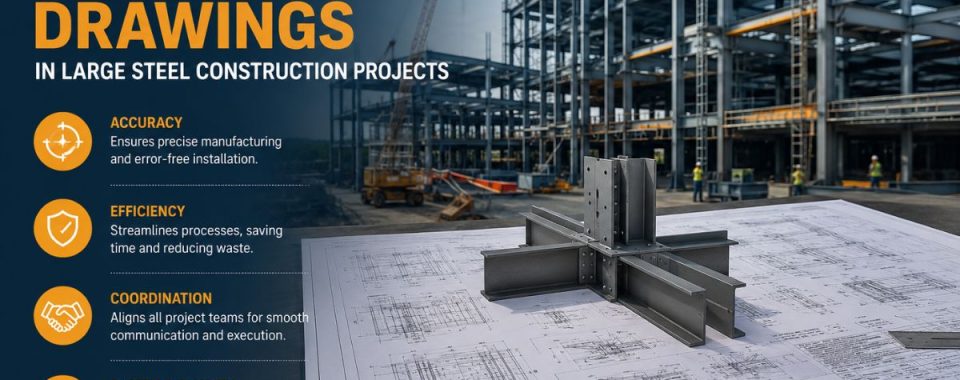
A crucial part of every large steel structure, be it a factory, bridge, or any other steel structure, are fabrication drawings. Fabrication drawings are vital for fabricators to accurately carry out all instructions about how to cut, drill, weld, and ultimately assemble all steel parts, enabling the organization to proceed with installation on site without unexpected complications. Neglecting professional fabrication drawing services in Australia could easily lead to problems such as erroneous design, delayed cranes, and unresponsive contractors. This blog covers why fabrication drawings matter this much on large steel jobs, where projects usually go wrong, and what to look for in a detailing partner.
What do fabrication drawings actually do on a steel project?
Structural engineers design the “what.” Loads, spans, material grades, the things that keep a building standing. Fabrication drawings answer the “how,” converting that engineering intent into shop-floor instructions: precise dimensions, bolt patterns, weld symbols, piece marks a fabricator can actually work from.
From Design Intent to Shop Floor Reality
The structural drawing could represent the beam-to-column connection with a simple line diagram. With the help of the fabrication drawing, every plate, bolt hole, and weld necessary for the construction of this connection is clearly illustrated and designed. Tolerances and specifications of the connection might be even in millimeters. When there are thousands of such connections on the site, the drawings are what keep the construction process going.
Where Erection Drawings Fit In?
Once steel leaves the shop, someone still has to put it together on site in the right order. That’s the job of a steel structure erection drawing service in Australia. These drawings guide crane crews and riggers on lift sequencing, temporary bracing, and assembly order, which matters a lot on tight or multi-storey sites where steel arrives in stages rather than all at once.
Why do large steel projects depend on detailing accuracy?
Small residential steel jobs can usually absorb a bit of on-site adjustment. Large commercial and industrial projects can’t. When a job involves hundreds of tonnes of steel across multiple fabrication runs, one wrong dimension doesn’t just affect one piece. It can hold up the entire erection sequence behind it.
- Scale Multiplies Small Errors
A missed clash between a beam and a duct run might be a five-minute fix on a small job. On a large multi-level structure, the same clash discovered on site can mean re-cutting steel, waiting on a new fabrication run, and paying for idle crane and crew time while everyone stands around.
- Coordination With Other Trades
Steel is not found on its own. Drawings that are used for fabrication have to incorporate the various other components of the design, such as mechanical components, electrical components, and architectural design. Affordable steel detailing services in Australia can figure out these clashes through modelling before the fabrication of steel, and contractors need not discover them during the course of building.
- Practical Example
On a recent industrial shed project, a detailing review caught a conflict between a roof purlin layout and a planned HVAC duct run before fabrication began. Fixing it on paper took an afternoon. Fixing it after the steel was cut would have meant weeks of delay and a fresh fabrication order.
The real cost of getting fabrication drawings wrong
Poor drawings rarely show up as one dramatic failure. More often it’s a string of smaller problems that add up: rework here, wasted material there, a schedule that keeps slipping, and a fabricator relationship that gets tenser with every revision.
Here’s how the impact typically breaks down on a mid-to-large steel project:
| Issue | Cause | Typical Impact |
| Bolt hole misalignment | Inaccurate connection detailing | On-site drilling delays, weakened connections |
| Member clashes | Poor coordination with other trades | Re-fabrication, schedule slippage |
| Wrong material specification | Drawing-spec mismatch | Wasted steel, procurement delays |
| Erection sequence errors | Missing or unclear erection drawings | Crane idle time, safety risks |
| Dimension errors | Manual detailing mistakes | Rework at fabrication shop |
Actionable Tip
Before fabrication starts, ask for a clash detection report alongside your drawings. It’s a small task, and it catches most of the expensive problems above before they ever reach the shop floor.
What separates a reliable detailing partner from the rest?
Not every detailing provider works the same way, and on large projects that difference shows up fast. A good partner does more than produce drawings that look correct on screen. They understand fabrication constraints, local Australian standards, and how erection actually happens once steel hits the ground.
- Experience With Australian Standards
Structural steel work in Australia follows AS 4100 and related codes, and drawings need to reflect these standards precisely, not just generic international practice. Providers offering structural steel detailing services in Australia should treat this as a baseline, not a selling point.
- Software and Modeling Capability
Modern detailing relies on 3D modeling tools which allow clash detection before a single piece of steel is cut. Ask any prospective partner which software they use, and whether clash checks are standard practice or something that only happens when someone remembers to ask.
- Communication During the Project
Large jobs change. Design revisions happen, site conditions shift, and drawings have to keep pace without derailing the schedule. A detailing partner who’s slow to respond to revision requests can quietly become the bottleneck on an otherwise well-run job.
This is one area 12 Meter Engineering has focused on: staying engaged with contractors through revisions rather than treating drawings as a one-off handoff. For contractors looking for steel fabrication drawings services in Australia that don’t disappear after the first delivery, responsiveness during changes matters just as much as getting it right the first time.
Common mistakes in steel fabrication drawings
Even experienced teams fall into predictable traps. Knowing what to watch for helps contractors ask better questions before problems reach the shop floor.
- Relying on outdated architectural drawings instead of the latest revision
- Skipping clash detection to save time on a tight schedule
- Under-detailing complex connections and leaving fabricators to guess intent
- Failing to coordinate erection sequence with crane capacity and site access
- Treating drawing review as a formality instead of an actual quality check
Beneficial tips
Build in a dedicated drawing review stage with your structural engineer and fabricator in the room together, not just an email sign-off. A short meeting at this point catches issues that get missed when reviews happen separately.
Expert recommendations for project managers and contractors
Project managers don’t need to become detailers themselves. A few habits still make a measurable difference on large steel jobs.
- Ask for Revision History
Request a clear revision log with every drawing package. It shows exactly what changed, when, and why, which matters later if there’s ever a dispute about what was actually approved.
- Confirm Erection Sequencing Early
Don’t wait until steel arrives on site to think about lift sequence. Review your steel structure erection drawing service in Australia output during the planning phase, with your crane and rigging contractor at the table, and you’ll avoid a lot of costly on-site improvisation.
- Involve Detailers Early, Not Late
Bringing a detailing team in after design is finalised often means missing chances to simplify connections or cut fabrication complexity. Early involvement tends to produce drawings that are both accurate and easier to actually build from.
Conclusion
Fabrication drawings aren’t paperwork. They’re the document set that decides whether a large steel project runs smoothly or ends up stuck in expensive rework. Getting them right takes local code knowledge and careful modeling, plus a genuine understanding of how fabrication and erection happen on the ground, not just in a model. Whether you need steel detailing services for one warehouse or ongoing structural steel detailing services in Australia across several sites, the drawing stage deserves as much attention as the structural design itself.
Planning a large steel project and want detailing that holds up from shop floor to final erection? 12 Meter Engineering offers steel fabrication drawing services in Australia built around real fabrication and site conditions. Get in touch to talk through your project scope and timeline.
Frequently asked questions
Shop drawings, connection details, bolt and weld specifications, material lists, and piece marks- all the detail a fabricator needs to cut and assemble every steel member accurately.
Structural drawings are to illustrate the engineering design and load paths. Fabrication drawings convert that design into instructions that fabricators use to actually build it.
With thousands of connections for large projects, over multiple fabrication runs, there is more than a small chance that things will get out of hand. Detailed, clash-checked drawings keep delays and rework from piling up.
Yes. If there is a mistake in a dimension or a clash is not detected on site, there may be a need to re-cut the steel and wait on a new fabrication run, delaying everything scheduled after that re-cut.
It provides guidance to the site crew for lift sequencing, temporary bracing and assembly order for the safe and efficient installation of steel upon arrival from the fabrication shop.
Yes. Drawings for structural steel work in Australia must be compliant with AS 4100 and other relevant codes, and should not follow International practice.
Ideally, the design phase should be done before, not after, the build. Earlier in, connections are easier, and it helps to identify any coordination issues before they become fabrication issues.
Typically Clash of old reference drawings, lack of clash detection, under-detailed connections, and lack of coordination between structural, architectural, and services drawings.
Search for local code experience, 3D modeling with clash detection, a clearly defined revision process, and a proven history of actually answering when changes are needed within the design.