Table of Contents
- Key takeaways
- What does structural steel detailing involve?
- How do in-house and outsourced detailing compare?
- What are the hidden costs of an in-house detailing team?
- What are the hidden costs of outsourcing?
- When does in-house detailing make sense?
- When is outsourcing the better option?
- Australian project factors to consider
- How to choose the right detailing partner?
- Wrapping up
- Frequently asked questions
Outsourced structural steel detailing may be more cost-effective and time-saving when working with variable workloads, tight deadlines, or not enough detailing capacity, while in-house detailing is better for companies that do a lot of work and have a competent workforce. The choice of method depends on the project sizes, the consistency of workloads, available technical skills, and resources.
Most Contractors and fabricators in Australia face this dilemma from time to time, mostly when another job lands that the drawing office could not handle. Here is a comparison of the two options.
Key takeaways
- Outsourcing turns fixed overhead into a variable cost.
- Doing detailing in-house gives you more control, but it only makes sense if there’s enough steady work to keep your team occupied.
- Hidden costs can be found on both sides, like idle capacity and turnover in-house, and communication breakdowns and quality differences when outsourcing.
- A hybrid approach of a small core team supported with an outside partner for peaks works well for many Australian fabricators.
What does structural steel detailing involve?
Structural steel detailing takes the engineer’s design drawings and converts them into the fabrication and erection drawings from which the fabricator and erector will work. This can include general arrangements, member and assembly drawings, connection details, anchor bolt plans, cut lists, and material lists. Sometimes fabrication information for CNC equipment is also provided.
Details matter because mistakes travel. A wrong hole or wrong member mark is discovered when hanging, so the job has to be reversed and rejoined and paid for. Structural steel detailing services in Australia also involve complying with the appropriate standards such as AS 4100 steel structures and AS/NZS 5131 fabrication and erection, as well as the project specification and surface treatment specifications.
However, detailing is a coordination task as much as a drafting task. The detailer has to cross-reference buildings, structural and, occasionally, services information, and highlight clashes and outstanding info before steel is cut.
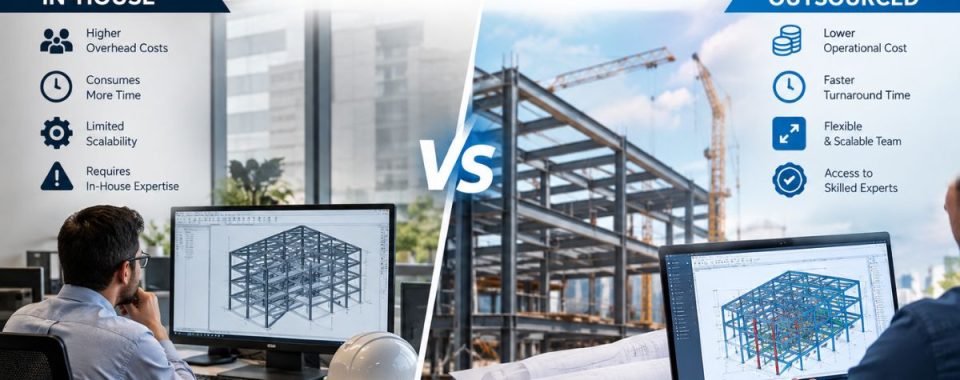
How do in-house and outsourced detailing compare?
The table below summarises the main differences. Individual results vary with the firm and the project.
| Factor | In-House Detailing | Outsourced Detailing |
| Cost | Fixed overhead: salaries, super, leave, equipment, training | Typically charged per project or per tonne; cost follows workload |
| Turnaround time | Fast for small, urgent changes; limited by team size on large jobs | Capacity can be added for large or overlapping jobs; depends on partner’s schedule |
| Staffing | Recruitment, retention, and succession are your responsibility | Partner manages recruitment and workload |
| Expertise | Deep knowledge of your own shop practices | Broader exposure to different project types and structures |
| Scalability | Limited by headcount | Flexible, up or down with demand |
| Quality control | Direct oversight and quick checks | Depends on the partner’s checking process and your review |
| Coordination | Easy day-to-day communication with estimators and workshop | Needs clear processes for RFIs, revisions and approvals |
| Software and resources | You fund licences, hardware, upgrades and training | Covered by the partner |
| Project workload | Best when volume is steady and predictable | Best when volume fluctuates |
What are the hidden costs of an in-house detailing team?
The cost of a detailer is only part of the equation. The rest is often underestimated by the firms.
- On cost: superannuation, leave, workers’ compensation, payroll tax (where applicable), and public holidays.
- Between jobs: Even a salary detailer will cost the same when doing the job between projects. This is the highest cost not visible to fabricators who may have an uneven order book.
- Software and Hardware: Licences, Maintenance, Upgrades and workstations to support large models.
- Training: Updating staff about standards, connection techniques, fabrication techniques, etc. is time-consuming, and it takes time away from billable work.
- Recruitment and turnover: experienced detailers are hard to find. A single loss of a project in the middle of the project can slow down a project, and a replacement must come up to your standards in the middle of the project.
- Management time: someone needs to assign work, read drawings, and follow up on revisions.
None of that is a reason that in-house detailing is a bad option. It indicates that the cost per drawing or tonne is often not as low as the salary figure indicates, especially during quiet periods.
What are the hidden costs of outsourcing?
There are risks to outsourcing, and there’s a list of them.
- Communication overhead: Poor briefs cause rework. Outsourcing is best suited for situations where you can provide thorough design details and answer questions promptly.
- Not all checks are equal: Not all providers have the same checking discipline. Bad drawings are so much more expensive downstream than the savings on the detailing fee.
- Handling revisions: Frequent design changes may lead to variation charges unless scope is agreed and the process for handling revisions is laid out.
- Time zone and availability: Offshore partners may have a delay in answering questions when they are urgent. This can be beneficial if the drawings improve overnight – but only if there is a good handover routine.
- Confidentiality: You’re exchanging project information, so data handling issues are important.
When does in-house detailing make sense?
In-house detailing tends to suit firms that:
- Maintain a steady stream of work, keeping detailers busy all year round.
- Make repetitive or standardised products, like portal frames or modules, in which the know-how for detailing is well related to the workshop.
- Often requires same-day answers or quick changes to drawings created.
- Want tight control over proprietary methods and sensitive projects
- Have an experienced detailer as a leader to train and review
However, a small staff of individuals can be developed in a regional centre where the fabricator is creating consistent light industrial sheds, for instance, to work on common information and processes. The team is kept active, and all fabrication enquiries are minimised through close contact with the shop floor.
When is outsourcing the better option?
Outsourcing is typically the better option when:
- The work demands vary from one month to the next, and a full-time crew would be waiting for work during lean periods.
- The team of installed projects is too small to take in a large project without delaying other projects. The in-house team is too small to take in a large project without things getting delayed.
- The firm is beginning or growing but doesn’t have enough funds to support a drawing office.
- A project requires specialised detailing, such as providing complex connections, curved members, and heavy sections.
- Tender deadlines are tight, and drawings are needed quickly to confirm quantities and programme
Think of a medium-sized fabricator getting a commercial warehouse and a mezzanine fit-out in the same month. Using additional detailers for a few months is costly and time-consuming.
Therefore, a trusted external partner offers steel detailing services in Australia, providing services on demand and allowing the in-house team to focus on workshop coordination and approvals.
Australian project factors to consider
Local conditions have more influence on the decision than is implied by generic comparisons.
- Standards and compliance: Drawings should comply with the Australian Standards and the construction category of the project as per AS/NZS 5131. If someone has described the task, make sure the provider is aware of local specifications for welding, bolting and tolerances.
- Corrosion protection and climate: Correct sizing of drain and vent holes, access for coatings, and size limitations of galvanising baths are required for coastal and industrial environments and for hot-dip galvanised members. Without local experience, these details can easily be overlooked.
- Remote and regional projects: Materials and transport for mining, infrastructure, and builds in the region can have long lead times. Late-found errors are costly, and consequently, the importance of thorough pre-release checking of errors is paramount.
- Programme pressure: There are a number of projects in Australia that have short programmes, and for many, steel is on the critical path. Steel fabrication drawings services in Australia are extremely useful to steel fabricators when it comes to ordering material early and minimizing delays on the site.
- Approval cycles: Engineers and Builders require time to look at drawings. A detailing partner that coordinates in a sensible method rather than releasing all at once makes review quicker.
How to choose the right detailing partner?
It doesn’t matter if you hire or outsource; the questions are the same.
- Request samples of similar projects and check them out for clarity and completeness.
- Look at their reviews. Who checks the drawings before they are issued, and how?
- Confirm standard knowledge. They need to be familiar with the Australian standards and typical specification requirements.
- In writing, agree scope and process of revision; what constitutes a ‘variation’.
- Test communication. How quickly they respond to the quoting stage is a good indicator of their working during the project itself.\
- If the relationship is new, then begin with a smaller package.
Furthermore, companies like 12 Meter Engineering operate on this principle with Australian fabricators and contractors, detailing in a manner more than simply random, but rather established and very much considered.
Wrapping up
There is no universal winner. In-house detailing can work well for firms with predictable workloads, repeatable products and a lean drawing office. Outsourcing can work well where workloads are intermittent, with a critical programme or limited capacity. Many Australian firms settle somewhere in between.
To determine, look at the order book for the next 12 months, try to calculate the real cost of a detailer, taking downtime into account, and be brutally honest about how often you are forced to turn work away or rush it to meet deadlines. Your bottleneck is capacity if outsourcing is the faster, cheaper solution. It’s control and integration if it’s not.
When considering your next project, we are happy to go through your drawings and scope of work and show where the outsourced support can aid.
Frequently asked questions
In many cases, but not always. Typically, outsourcing is more affordable when workload fluctuates as you only pay for the output, not the infrastructure. An in-house team will be cheaper per drawing if the work is steady and has high volumes.
It is based on the design information size, complexity, and completeness. It can take days for a small frame, and weeks for a multi-storey building. Incomplete or changing design information is the most common cause of delay.
General arrangement drawings, shop drawings of members and assemblies, connection details, anchor bolt plans, and material lists. Based on scope, fabrication data for CNC equipment will also be provided.
Yes, if they are used to them. Make sure they are familiar with AS 4100, AS/NZS 5131, and your project specification.
Responsibility depends on the contract and scope. Detailers are generally responsible for accurately representing the design information provided, although arrangements for checking, approval, and design responsibility should be agreed in writing.
Details of how the structure is put together- structural design drawings, architectural drawings, specifications, connection details, finishing details, and any other fabrication details or specifications. Well-defined details reduce questions and rework.