Table of Contents
- Key Takeaways
- What is structural steel detailing and why does it matter?
- What are the warning signs your project needs help?
- How do detailing services save time and money?
- What should a detailing partner deliver?
- How do you choose the right detailing provider?
- Wrapping up
- Frequently asked questions
If your drawings are behind schedule, there are fabrication mistakes that seem to keep occurring, or your designs for connections are beyond your own team’s capabilities, then your project is probably in need of professional steel detailing support. These warning signs typically show themselves weeks in advance of a delay or cost overrun becoming obvious. This guide will tell you what to look out for, what a detailing partner offers, and how to pick one. Structural steel detailing services in the USA are designed to fill just these gaps, ensuring that steel fabrication and erection are on track.
Key takeaways
- The obvious indicators that you need some assistance are late drawings, repeated fit-up mistakes, and complicated connections.
- Professional detailing provides increased capacity, expertise, and improved control of errors.
- Shop drawings, erection drawings, material lists, and revision logs are all a part of the complete package.
- Ensure that providers are compared for experience, sample quality, coding knowledge, and written schedules.
What is structural steel detailing and why does it matter?
Structural steel detailing services in USA are the work of converting engineering design into accurate fabrication and erection drawings. Every member size, connection, bolt, weld, and dimension that a fabricator requires is shown on these drawings. Detailing is vital to every steel project since it avoids any clash on site, material waste, and rework.
Why detailing is a separate discipline
Engineers create the design, but detailers convert intent to shop-ready information. Both positions call for various capabilities. The detailer needs to know how to make the fabrications, bolt tolerances, coating, and erection sequences. If this translation is not implemented, drawings created by a sound design can be impossible to construct at the fabrication site.
How does detailing affect the whole project?
Detailing has an impact on more than the fabrication shop. Drawings are of critical value to the procurement team in order to order the correct material, to the erection crew to help in the building of the works, and to inspectors to provide them with a clear guide. If the detail is light, the repercussions spread to all the trades. So, detailed treatment as an action rather than a management function is in the interest of the whole budget.
What are the warning signs your project needs help?
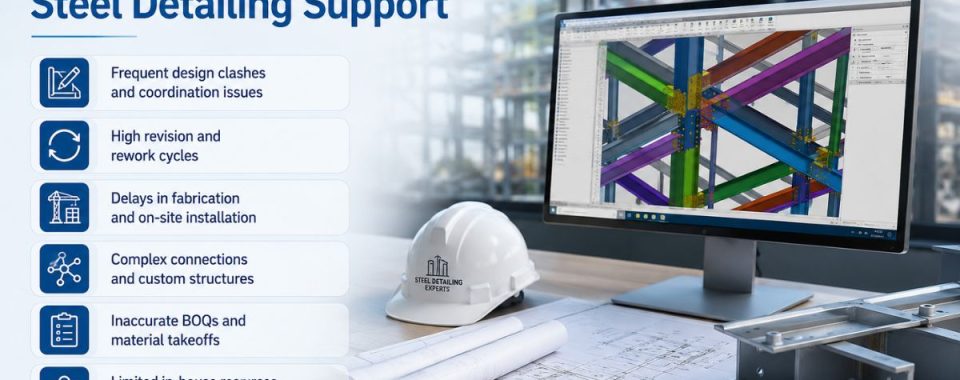
When the internal capacity, timeframe, or level of technical complexity of your work becomes a barrier to your project’s advancement, you require detailing support. There are a number of clues that tend to occur in combination, and early detection will allow you more choices.
- Drawing backlogs are slowing fabrication
- Fit-up errors occur in the shop or installation site.
- Designs for connections are exceeded by in-house experience.
- You have strict deadlines and few employees on staff.
- As designs change, there are frequent revisions.
- The cooperation between the trades continues to be fractured.
Drawing delays are slowing down the fabrication process
Moreover, the delay in fabrication will multiply if there is any delay with drawings. The labour and machine time are booked weeks ahead at the shop. When approved drawings are late, the shop is either idle or has to move on to another job, adding to everyone’s cost. One of the best indicators that external assistance is necessary is the presence of a steady backlog.
Various fabrication shops schedule their labor and machine time weeks ahead; however, lead times vary by shop. If approved drawings are not received in time, the booked capacity is wasted.
Fit-up errors keep appearing
When fit-up is an ongoing problem (holes not lining up, members not fitting properly, etc.), it is a sign of detailing accuracy problems. With any project, mistakes are sometimes made. A few of them, however, indicate that drawings are not as coordinated as they would be if they had been done by a special team.
The manufacturing and installation tolerances are defined in AISC 303, or the Code of Standard Practice for Steel Buildings and Bridges, which states variation limits regarding hole placements and member fittings. In cases of an exceeded limit, the alignment query is mainly related to the drawing.
Complex connections exceed internal skills
Moment connections, heavy transfer girders, and odd geometries require experience that is not found in many general teams. Correct connection design demands understanding of fabrication limitations and erection facts. When these details are present in your project, professional support minimizes chances of costly redesigns later on.
How do detailing services save time and money?
Professional detailing services eliminate the waste of time by providing dedicated capacity, decrease errors, and handle revisions in an orderly fashion. They also help to make the costs more predictable, as you have agreed scope and deliverables prior to work starting. Additionally, many teams choose to outsource peak workloads instead of permanently adding employees to their roster for a short project.
| Factor | In-House Team | Professional Detailing Partner |
| Workload during peaks | Often overloaded | Scalable capacity on demand |
| Access to specialists | Limited to current staff | Experienced connection and erection specialists |
| Error control | Depends on reviewer availability | Built-in checking and revision logs |
| Cost predictability | Variable, with overtime risk | Fixed quotes per package |
| Turnaround during shutdowns | Slower when staff are absent | Continuous coverage |
An outside collaborator also allows your team to concentrate on design decisions and project coordination. This specialization is often shortened in the overall time schedule over time.
The ideal steel detailing services partner should also be able to communicate well. Weekly progress reports and having one point of contact ensure decisions are made and that minor issues don’t become bigger issues.The turnaround is determined by the tonnage, number of connections, and number of revisions. Smaller design packages may take just a couple of weeks, with bigger multi-storey projects taking months to complete. Request for a written schedule before giving your approval.
What should a detailing partner deliver?
Several types of documents are part of a complete detailing package, each with its own function. It is better to know what to expect so you can avoid the delays of a lack of understanding later in the process of comparing proposals.
Several document types are covered in Core Deliverables.
- Shop drawings including member details, connection details, and notes of fabrication.
- Installation and anchor point sequencing drawings of erections.
- Bills of material with quantities, sizes, and grades.
- Revision Logs documenting all revisions and approvals.
Shop drawings and fabrication accuracy
Shop drawings are the main instructions to the fabricator. They are to be complete, uniform, and verified with the engineer’s design. The review cycle is one of the common services provided by strong steel fabrication drawings services in USA, in which the detailer checks the drawing with the engineer and the fabricator before releasing the steel fabrication drawings.
Erection drawings guide site crews
Erection drawings provide information to the crew on what, in what order, and where to install. This enhances crane time and avoids blocking members. Providers that deliver a steel structure erection drawing service in USA can also mark site restrictions early, which include access restrictions or temporary bracing demands, amongst others.
How do you choose the right detailing provider?
Select a provider based on experience, sample quality, communication style, and turnaround time. Proper selection increases the value of your project from weak drawings to missed deadlines. If you have followed a clear sequence, you will be able to compare proposals correctly.
- Verify experience in project sizes and connection complexity.
- Examine sample drawings for clarity, completeness, and consistent notation.
- Check knowledge of AISC standards and relevant building codes in the USA.
- Inquire about how the team manages changes in the design and revisions for approval.
- Have a written action plan that specifies milestones and who to contact.
Questions to ask before you sign
- Inquire about the methods used by the provider to verify their work before release.
- Inquire about the people who look at connection designs and how feedback on fabrications is included.
- Check with them about what file types and how they will be receiving your engineering documents.
These responses show if the team is truly process-disciplined or, in reality, just a “fast” promise.
Wrapping up
Early recognition of signs helps to ensure your project is on budget and on schedule. When drawings aren’t being completed, mistakes are being repeated, or work is outside the expertise of your staff, professional support is not a last resort. By working with an experienced team, you can navigate the process of Steel detailing services in USA without the fear of it becoming a hassle.
At 12 Meter Engineering, we assist project teams to assess their current load and determine the appropriate level of support. Communicate early, and your fabrication & erection team will thank you!
Frequently asked questions
Once final structural drawings have been issued, preferably prior to securing fabrication slots, engage detailers to ensure schedules are protected.
Yes, the majority of detailers will take engineer drawings and models in standard formats and confirm scope/coordinate changes before beginning work.
Timelines will vary according to tonnage and complexity and are typically several weeks and should be requested in writing prior to any work being approved.
Seek knowledge of AISC standards, local building codes, and U.S. fabrication experience, and a track record with similar structures.