Table of Contents
- Key takeaways
- What is BIM in steel detailing?
- Why do fabricators need BIM today?
- Key benefits for contractors
- BIM vs traditional detailing methods
- Common challenges without BIM
- Choosing the right detailing partner
- Final thoughts
- Frequently asked questions
Key takeaways
- BIM services in USA cut down fabrication errors and shorten project timelines
- Clash detection catches problems before steel ever reaches the shop floor
- 3D modeling keeps architects, engineers, and builders working off the same information
- Steel fabrication drawings services in USA get approved faster when they’re modeled accurately
Steel detailing projects were drawing on manual calculations and 2D designs ten years ago. Nowadays, Building Information Modeling (BIM) dominates the construction process. It permits project teams to better manage the process of designing, assembling, and installing steel structures.
If you need structural steel detailing services in the USA, be sure to realize how BIM is changing steel detailing. The technology enhances accuracy, eliminates a lot of mistakes, and reduces rework during a project. Along with this, it facilitates the working process for all specialists involved: architects, engineers, manufacturers, and contractors. The article will explain how BIM works in steel detailing and its advantages.
What is BIM in steel detailing?
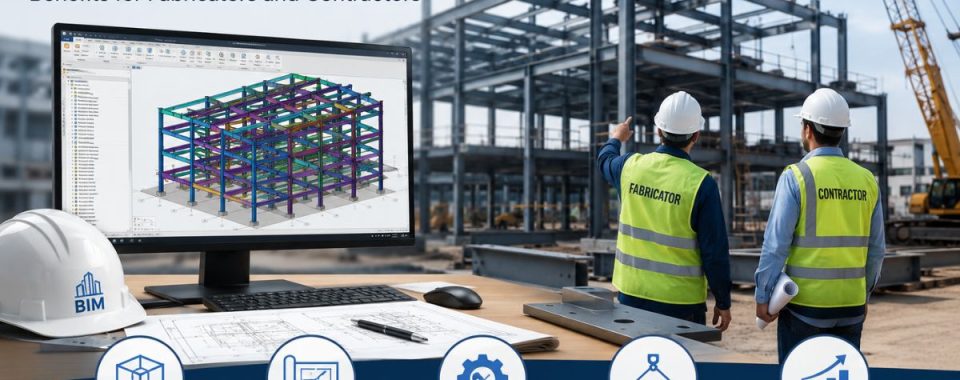
BIM is a digital model of a structure that captures both its physical dimensions and how its parts function together. Instead of a stack of disconnected drawings, everyone on the project works off one shared 3D model.
For steel detailing, that translates to a few concrete things:
- Every beam, column, and connection carries exact, modeled dimensions.
- A change made by one person updates automatically for everyone else.
- Fabricators pull measurements straight from the model instead of re-checking drawings by hand.
Pair this with experienced steel detailing services in USA, and problems that used to surface mid-fabrication get caught weeks earlier, before any steel is cut.
Why do fabricators need BIM today?
Shop drawings used to go stale fast. A revision would come in, someone would miss the update, and material got cut to the wrong spec. BIM doesn’t eliminate every mistake, but it closes most of that gap.
What fabricators actually gain:
- Shop drawings arrive faster because the data pulls straight from the model.
- Fewer measurement errors, since dimensions come from the model rather than manual re-checks
- Material quantities are calculated automatically instead of relying on manual takeoffs.
- Engineers and fabricators can look at the same 3D visual instead of describing changes over email.
At 12 Meter Engineering, model-based detailing isn’t an add-on service anymore; it’s how projects move from design to shop floor with fewer stalled conversations along the way.
Key benefits for contractors
Contractors are the ones holding schedules, budgets, and safety compliance together at once. BIM doesn’t remove that workload, but it makes it a lot more manageable.
A few things contractors notice right away:
- Clash detection flags conflicts before construction starts, not after.
- Architects, engineers, and fabricators can collaborate on a live, shared model.
- Sequencing gets simulated ahead of time, which tightens up scheduling accuracy.
- Change orders drop because there’s less material waste from design conflicts.
Moreover, contractors who work with solid BIM services in USA tend to report smoother timelines for one simple reason: everyone’s looking at the same accurate model instead of outdated printouts.
BIM vs traditional detailing methods
| Factor | Traditional Detailing | BIM-Based Detailing |
| Drawing format | 2D, manual | 3D, model-driven |
| Error detection | After fabrication | Before fabrication |
| Collaboration | Siloed teams | Shared live model |
| Revisions | Slow, manual | Automatic updates |
| Material estimation | Manual takeoffs | Auto-generated quantities |
| Project delays | Common | Rare |
Laid out this way, it’s easy to see why manual-only detailing has fallen out of favor on most commercial steel projects.
Common challenges without BIM
Plenty of teams still haven’t made the switch, and the gaps show up quickly once a project gets underway. Without a shared digital model, you’ll usually see:
- Design and fabrication teams working from slightly different information
- Architectural and structural dimensions that don’t quite line up
- Approvals dragging out over multiple rounds of revisions
- Scrap steel from avoidable measurement errors
- Confusion over which drawing version is actually current
Each problem may appear insignificant, but they add up and drive up costs and cause project delays.. That’s the real reason more fabricators and contractors are leaning on steel fabrication drawings services in the USA built on BIM rather than sticking with older manual processes.
Choosing the right detailing partner
Not every detailing provider has the same depth of BIM experience, so it’s worth asking a few pointed questions before signing on:
- Do they work on an advanced industry-standard platform?
- Will they provide a clash detection report before fabrication begins?
- Have they detailed your specific type of steel structure before?
- How do they typically handle mid-project revisions?
- What’s a realistic turnaround time for shop drawings on your project?
A partner like 12 Meter Engineering, with real hands-on experience across commercial and industrial steel work, tends to make the difference between a build that stays on schedule and one that doesn’t.
Final thoughts
BIM has changed how steel structures actually get built, not just how they’re drawn. Fabricators deal with fewer errors and faster shop drawings. Contractors get better coordination and fewer surprises once construction is underway.
If you’re planning a steel project and want the detailing handled right the first time, it’s worth working with a team of Structural steel detailing services in the USA team that knows both the software and the shop floor side of BIM.
Reach out to 12 Meter Engineering to see how BIM-driven detailing can keep your next steel project on schedule and on budget.
Frequently asked questions
BIM is short for Building Information Modeling, which is a digital process that creates a detailed 3D model used for accurate detailing and construction planning.
It identifies conflicts and inconsistencies before any actual cutting takes place and catches them on the computer, not on the shop floor.
Not really. Smaller structures are benefited too, primarily because of the increased accuracy, faster drawings, and more effective team coordination.
It is a function of the complexity of the project, but BIM is typically faster than manual detailing, as drawings are automatically generated as the model evolves.
Yes. Stock quantities are automatically calculated from the model, providing a more accurate cost estimate early in the planning phase for contractors.
While some detail steel providers in the USA offer these types of services, most steel modeling providers perform all the modeling themselves and just provide the finished drawings.
These result in fewer mistakes, tighter schedules, and improved collaboration- saving contractors real time and real money.