Table of Contents
- Key takeaways
- What is structural steel detailing and why does it matters?
- The real cost of poor steel detailing
- Key elements of accurate structural steel detailing
- Why do Australian projects need specialised detailing services?
- Choosing the best structural steel detailing
- Technology trends shaping steel detailing in 2026
- Final verdict
- Frequently asked questions
Key Takeaways
- Accurate structural steel detailing prevents costly on-site errors, rework, and project delays.
- Reliable steel detailing services in Australia bridge the gap between design intent and buildable reality.
- Sydney’s booming construction sector demands detailing partners who understand local codes and fabrication standards.
- Technology like BIM and AI-assisted modelling is redefining detailing accuracy heading into 2026.
Every skyscraper, warehouse, and steel-framed home you see standing tall started as lines on a drawing. The gap between that drawing and the completed structure is a crucial one that requires a lot of work—but most of the time, it’s invisible: structural steel detailing. It’s the process that transforms an engineer’s vision into accurate fabrication drawings, which can be used by steelworkers, welders, and erectors to build from.
Do it wrong and you’ll find yourself with misaligned bolts, lost steel, overspent budgets, and project delays that affect the entire arc of a construction timeline. Do it right, and everything from fabricating to on-site assembly works smoothly, safely, and on schedule.
From the bustling construction scene in Sydney to the various industrial sectors in regional hubs, the demand for reliable structural steel detailing services in Australia has never been greater as the industry continues to thrive and expand. This blog goes into detail why accuracy is a must and the difference between good and great detailing, as well as how to find a partner that doesn’t let you down during your project.
What is structural steel detailing and why does it matters?
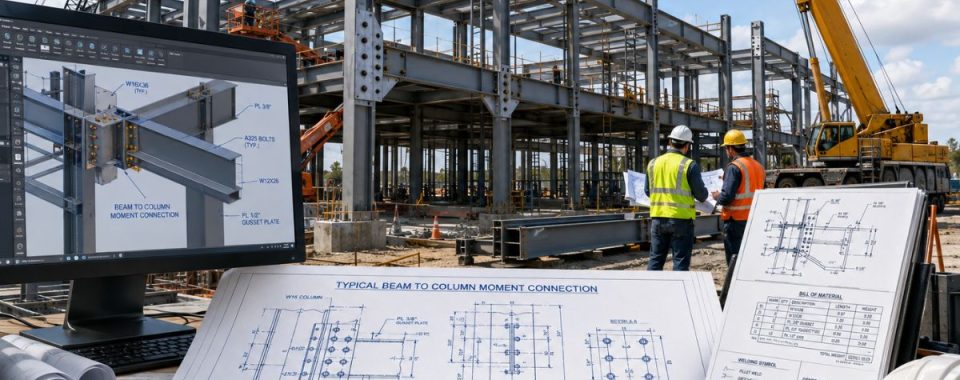
Structural steel detailing is the task of creating detailed shop drawings and erection drawings from structural engineering designs. These drawings provide precise dimensions, connections, bolt patterns, welds, materials, etc. to be used to fabricate and assemble steel parts.
It’s kind of like the translator between the architect’s high-level vision and the fabricator’s workshop floor. Without accurate detailing:
- On-site, steel pieces might not fit together.
- Workers waste their time on rework when they make mistakes in cuts.
- The integrity of the structure may be altered.
- Waste of materials and delays with labor create a growth in project expenses.
Furthermore, detailing isn’t just a technical formality; it’s a lifeline to building accuracy. One mistake in a connection detail can result in weeks of delay and thousands of dollars of rework.
The real cost of poor steel detailing
People don’t realize how many dollars they can lose due to detailing errors until they start looking at a stalled site or until they are in the middle of a project. Here are some immediate consequences:
| Issue | Immediate Impact | Long-Term Consequence |
| Incorrect bolt hole placement | On-site drilling delays | Weakened connections, safety risks |
| Missing connection details | Fabrication rework | Increased labour costs |
| Clash with other trades (MEP, architectural) | Redesign mid-construction | Schedule blowouts |
| Inaccurate material take-offs | Over/under-ordering steel | Budget overruns, waste |
| Poor coordination with fabricators | Communication breakdowns | Damaged client relationships |
Moreover, these aren’t hypothetical examples, but what often happens on projects where detailing has not been a professional field but rather the “afterthought.”
Key elements of accurate structural steel detailing
Great detailing isn’t simply about drawing lines properly; it’s about comprehending how steel will behave, how trades will work together, and how the realities of fabrication differ from your design assumptions. The essentials include:
- Accurate connection design, whether bolted, welded, or moment, with detailed designs to tight tolerances.
- Accurate material takeoffs (ordering the right quantity & grade of steel)
- Clash detection refers to the process of finding any collisions or overlaps that are taking place between mechanical, electrical, and plumbing systems before they’re put together in the shop.
- To determine the sequence of erection of steel members in the construction of the structure on site.
- Meeting the Australian Standards including AS 4100 and AS/NZS 5131, relating to steel structures
- Provide clear shop drawings (detailed enough that the fabricators do not need to be given too much direction)
Therefore, when these factors combine, the process is smooth and straightforward from design to fabrication to erection and with little surprise.
Why do Australian projects need specialised detailing services?
There are regulatory, climatic, and logistic peculiarities in Australia’s construction scene. There are a number of regions in the north that are cyclone rated, bushfire areas, and highly populated urban areas, such as Sydney and Melbourne, which require detailing to take into account local requirements and compliance codes.
That is where steel detailing services in Australia come in handy. Local detailing teams understand:
- Australian Standards (AS 4100, AS/NZS 1554, AS/NZS 5131) inside and out
- Regional fabrication capabilities and typical shop tolerances.
- Limited capacity in transportation of large steel members for freight and logistics.
- Documentation expectations for council and certifier relating to structure.
Furthermore, working with a detailer who understands these nuances reduces back-and-forth revisions and keeps projects moving without compliance hiccups.
Choosing the best structural steel detailing
The construction industry is thriving in Sydney, spanning residential projects such as tower construction to commercial fit-outs and infrastructure improvements. With so much steel-framed development happening simultaneously, finding the best structural steel detailing in Sydney means looking beyond just software proficiency..
It’s time to pay attention to these details:
- Portfolio depth- Do they have experience with similar projects to yours that are not much larger or smaller?
- Software proficiency– Do they have experience in modern software that integrates with BIM?
- Turnaround times– Can they meet your fabrication and construction schedule?
- Communication style- Do they bring issues to your attention, or do you raise them?
- Local knowledge– Do they know the special needs of Sydney’s council and fabrication shop practices?
Companies such as 12 Meter Engineering have developed a reputation for mastering technical precision while also being able to respond with project communication which is as important as the accuracy of the draft when deadlines are short.
Technology trends shaping steel detailing in 2026
Steel detailing has come a long way from manual drafting to complete, fully integrated building information modeling (BIM) workflows. As we look forward to the future, there are a number of trends that are changing the landscape of the industry in the lead up to 2026:
- AI-assisted clash detection– Automated tools to identify clash(es) quicker than manual—
- Cloud-based collaboration- Real-time drawing access by engineers, fabricators, and site teams all at once.
- Digital twins- Virtual models that replicate the physical structure for continuous quality assurance are known as “digital twins.”
- Prefabrication first detailing- Design connections optimized for offsite fabrication and faster assembly.
- Sustainability tracking– Which refers to the detailing that considers material efficiency and minimizes the amount of steel waste
However, detailing firms that adopt these tools aren’t just keeping pace, they are getting jobs completed more quickly and with fewer mistakes, and that’s what today’s construction schedules require.
Final verdict
Structural steel detailing might not be the flashiest part of a construction project, but it’s arguably one of the most decisive. Accurate detailing minimizes rework costs, ensures the production and erection of the structure on time, and allows the structure to perform exactly as designed. The increasing complexity of Australian projects, whether they are constrained on the urban edge of Sydney or on a regional scale and working in partnership with experienced structural steel detailing services in Australia, is no longer a luxury, it’s a necessity.
When you are considering a steel-framed project and want the detailing work to be done right the first time, it’s smart to talk to a team who knows both the detailing requirements and the local construction environment. 12 Meter Engineering collaborates with engineers, architects, and fabricators to provide detailing that ensures projects stay on schedule, on budget, and accurate from design to erection.
Reach out today to discuss your next project and see how professional detailing can save you time, money, and headaches down the line.
Frequently asked questions
Structural steel detailing helps to turn engineering designs into accurate fabrication and erection drawings, showing steelwork contractors and builders with all the necessary measurements and connections, as well as the order of assembly.
A proper steel detailing service can avoid a variety of errors during fabrication and provide a perfect fit on-site and during assembly of the steel structure, thus eliminating the need for any reworking and keeping the time and costs down.
Local detailers understand Australian Standards, local requirements, peculiarities of the climate, and fabrication methods that help them meet all the demands of Australian customers.
Check for proven portfolios, competent software skills, quick processing times, effective communication, and knowledge of Sydney’s council codes and construction regulations.
Incorrect steel detailing leads to inconsistent connections, need for rework, project delays, rise in costs, and threat of safety during construction and assembly.
Time taken for conducting steel detailing work will depend upon the complexity of the work. In general, projects take several weeks to months based on size and modifications of the details.
Yes, when structural steel detailing is done successfully, it brings down the material wastage, prevents need for expensive rework, and fastens the process of construction work.