Table of Contents
- Key takeaways
- What is beam-to-column connection detailing?
- Why does accurate connection detailing matter?
- Common types of beam-to-column connections
- Key factors engineers should consider
- The role of modern steel detailing technology
- Choosing the right structural steel detailing partner
- Conclusion
- Frequently asked questions
Key takeaways
- Precise connection detailing enhances the safety of structures and their long-term performance.
- Fabrication-ready drawings minimize any errors, delays, and expensive rework.
- BIM technologies help coordinate engineers, fabricators, and contractors.
- Steel detailing guarantees code-conformant project implementation.
For a structure to be safe, accurate in fabrication and efficient in construction, beam-to-column connections play a critical role. Structural steel detailing services in the USA deliver precise drawings, which minimize mistakes, simplify fabrication and erection, and guarantee code compliance. This guide provides a basic explanation of the principles of reliable, fabrication-ready steel connections for modern construction projects.
What is beam-to-column connection detailing?
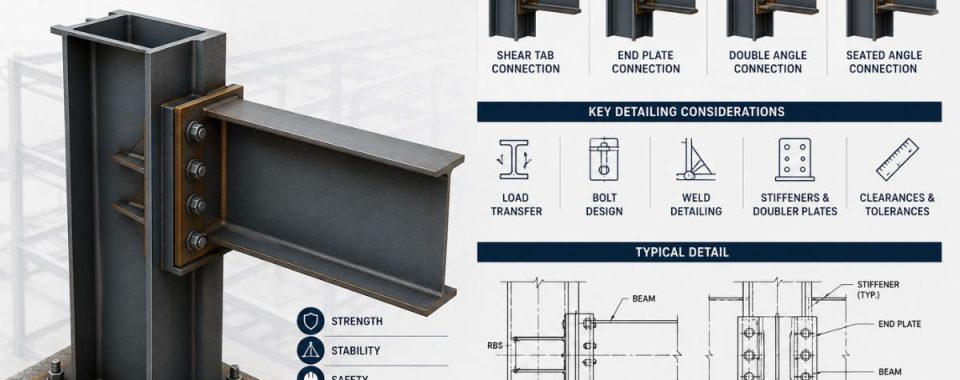
Beam-to-column connection detailing involves developing accurate drawings and specifications that specify the connection between steel beams and steel columns.
These detailed drawings include:
- Bolt locations
- Weld specifications
- Plate dimensions
- Connection angles
- Stiffeners
- End plates
- Material grades
- Hole sizes
- Fabrication notes
These details are incorporated into the comprehensive steel fabrication drawing services in the USA, guaranteeing that all steel components are installed properly during the fabrication and site assembly process.
However, the process of detailing fills the gap between structural design calculations and construction.
Why does accurate connection detailing matter?
The details of connection are much more than just joining two steel members together. It has a direct impact on the quality, safety, and efficiency of the project.
Some major benefits include:
- Improved Structural Performance
A properly designed connection will transfer loads safely between structural components and will remain stable during use.
- Faster Fabrication
Shop drawings ensure there is no confusion in fabrication processes, and there will be no need for revisions.
- Smooth Site Installation
Thank you for your help and patience; the connection information is correct, and the steel erection team does not encounter delays and alignment problems during the installation.
- Lower Construction Costs
Accurate detailing reduces the following:
- Material waste
- Fabrication errors
- Field modifications
- Rework expenses
- Better Coordination
In the modern world, structural steel detailing services in USA provide perfect coordination between architects, structural engineers, MEP engineers, fabricators, and contractors.
Common types of beam-to-column connections
For various projects, the type of connection could vary based on the structural needs, loading conditions, and specifications of the project.
1. Simple Shear Connections
These are some of the connections that are most likely to be used.
Features include:
- Shear tabs
- Clip angles
- Single-plate connections
- Cost-effective fabrication
- Quick installation
They are mainly shear load transfer with free rotation of the beam.
2. Moment Connections
Moment connections transfer both shear and bending moments.
They are found in:
- High-rise buildings
- Seismic structures
- Industrial facilities
- Heavy commercial projects
Additionally, these involve more detailed welds, bolts, and reinforcement.
3. End Plate Connections
End plate connections are made by making a weld on the end of the beam prior to bolting it to the column.
Advantages include:
- Easy field installation
- High strength
- Reduced site welding
- Improved quality control
4. Seated Connections
A seat angle will support the beam, and top angles will stabilize the connection.
They generally are used to provide extra support during installation of beams.
5. Fully Welded Connections
All of these connections are made with only welds, no bolts.
These are often chosen for:
- Heavy industrial facilities
- Complex architectural structures
- High-load applications
Moreover, they do need to be detailed and quality checked very carefully, though.
Key factors engineers should consider
Many more factors go into beam-to-column detailing than simply conforming to common connection types.
Considerations that engineers always have to keep in mind.
- Load Requirements
- Connections should be able to withstand:
- Dead loads
- Live loads
- Wind loads
- Seismic forces
- Dynamic loading
Correct calculations are needed to size the correct bolt size, weld length, and plate thickness.
- Building Codes and Standards
Detailing of connection must be done according to appropriate industry standards.
Typical standards include the following:
- Construction Manual for AISC Steel.
- OSHA requirements
- AWS welding standards
- Local building regulations
Professional structural steel detailing in the USA guarantees all drawings are in accordance with these requirements.
- Fabrication Feasibility
Paper-based great connections may be challenging or costly to fabricate.
Good detailing considers:
- Welding accessibility
- Bolt tightening clearance
- Plate cutting efficiency
- Shop fabrication capabilities
Furthermore, this will not compromise structural integrity and lower fabrication costs.
- Erection Sequence
Information about connections should facilitate efficient installation.
Well-prepared steel erection drawings in USA have clearly defined the following:
- Member identification
- Installation sequence
- Temporary bracing
- Bolt installation
- Field welding locations
Effective planning of erection leads to a substantial reduction in project delays.
- Clash Detection
With the use of modern detailing software, conflicts can be identified before the start of fabrication.
Potential clashes include the following:
- Beam intersections
- Bolt interference
- MEP conflicts
- Connection accessibility
- Structural overlaps
These are all solved online, and that saves huge time and money when building.
The role of modern steel detailing technology
The steel detailing industry has progressed a great deal with building information modeling (BIM) and 3D software today.
The engineer can create fabrication models with great accuracy using modern tools like Tekla Structures and AutoCAD.
Benefits include:
- 3D visualization
- Automatic material lists
- Clash detection
- CNC-ready fabrication files
- Faster drawing revisions
- Improved collaboration
These technologies have revolutionized steel detailing in the USA, enabling projects to go from conception to fabrication with greater accuracy and speed.
Furthermore, a seamless BIM approach facilitates better collaboration between engineers, fabricators, architects, and contractors all the way through the project.
Choosing the right structural steel detailing partner
All detailing companies are not created equal. Choosing the appropriate partner can have a great impact on the success of the project.
Look for a detailing company that provides:
- Experienced structural detailers
- Understanding of AISC standards
- BIM expertise
- Fast turnaround times
- Quality assurance processes
- Fabrication-friendly drawings
- Responsive technical support
Steel fabrication drawings services in USA service providers are aware of the engineering demands and the actual constraints of fabrication, enabling projects to be completed within budget and on time.
12 Meter Engineering provides detailed, accurate, and fabrication-ready steel drawings that enable a seamless flow of design and construction work. They have a highly experienced team that specializes in precision, compliance, and timely delivery of projects in various industries in the field of structural construction.
Conclusion
Beam-to-column connections detailing guarantees of structural safety, fabrication correctness, and efficient construction. Professional structural steel detailing services in USA can help reduce errors and ensure adherence to codes. For flawless project execution, 12 Meter Engineering offers USA steel detailing services, steel fabrication drawings, and steel erection drawings.
Frequently asked questions
Beam-to-column connection detailing generates accurate drawings that include bolts, welds, plates, and dimensions for safe structural assembly.
They help increase accuracy in fabrication, minimize construction errors, aid in coordination, and ensure adherence to engineering standards and codes.
Steel erection drawings provide guidance for installation teams, including member location, sequencing, connection details, and field assembly requirements.
Fabrication drawings contain all the information required during the manufacturing process, thus minimizing the wastage of materials, any possible errors, delays, and expensive field adjustments.
12 Meter Engineering offers accurate, code-conformant, and fabrication-ready steel detailing services that facilitate the successful implementation of your projects.