Table of Contents
- Key Takeaways
- What are structural steel shop drawings?
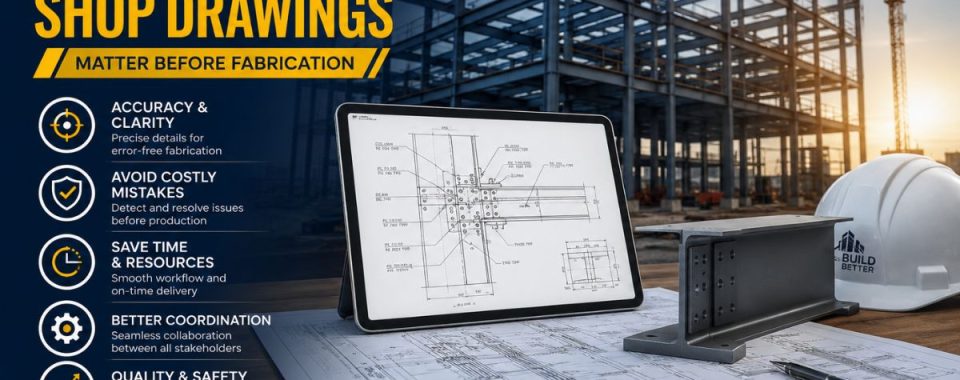
- Why shop drawings matter before fabrication?
- Key benefits of accurate shop drawings
- How shop drawings improve project coordination?
- Real project example
- Bottom line
- Frequently asked questions
Key Takeaways
- Structural steel shop drawings are the detailed instructions that transform design concepts into instructions for fabrication.
- Proper detailing minimises rework, delays, errors and material waste.
- Shop drawings improve coordination between engineers, fabricators, and contractors.
- Professional detailing services can improve the smoothness of the fabrication process and achieve the successful completion of the project.
Structural steel shop drawings are among the most critical documents generated prior to the start of fabrication. They offer in-depth guidance for fabricators, ensuring that each steel part is precisely created based on design requirements. Projects can get stuck, waste materials, be forced to rework, and experience installation problems if there are no clear shop drawings.
Professional shop drawing services in Australia are a valuable investment that minimises risk and enhances project efficiency for construction companies, engineers and fabricators throughout Australia. Steel detailing firms like 12 Meter Engineering play a vital role in guaranteeing the success of steel construction initiatives by providing precise and detailed information that helps connect design and manufacturing.
What are structural steel shop drawings?
Structural steel shop drawings are technical documents that are detailed and created using engineering and architectural plans. They give steel fabricators precise details to make steel components.
These drawings are usually presented as follows:
- Dimensions and measurements
- Material specifications
- Welding requirements
- The bolts and connections are visible
- Assembly instructions
- Fabrication notes
Moreover, shop drawings are different from design drawings, as they concentrate on the way the steel members will be constructed and assembled.
Why shop drawings matter before fabrication?
1. Prevent Fabrication Errors
Steel fabrication is a process with a lot of inherent risks, and even the smallest of errors can cause major delays in any project. Shop drawings aid in pointing out discrepancies prior to production.
Detailing information can be reviewed in advance, preventing fabricators from making the following mistakes:
- Incorrect member sizes
- Misaligned connections
- Missing components
- Assembly conflicts
Additionally, this greatly minimises rework expenses and delays.
2. Improve Accuracy
In today’s modern world, structural steel detailing services in australia
have access to various state-of-the-art detailing software to prepare highly accurate fabrication drawings.
Business drawings are all essential so that the following occurs:
- All components go together properly.
- The structure remains intact.
- Fabrication is based on engineering intent.
- Installation runs smoothly on-site
3. Save Time During Construction
If fabrication teams have complete and accurate drawings, they have more efficient production.
Benefits include:
- Faster fabrication workflows
- Reduced clarification requests
- Better scheduling
- Fewer site modifications
However, this means that construction projects are kept on schedule and within budget.
Key benefits of accurate shop drawings
1. Better Communication
Shop drawings are used to communicate between:
- Engineers
- Architects
- Fabricators
- Contractors
- Project managers
All on the same set of detailed instructions, minimising misunderstandings.
2. Material Optimisation
Optimisation of steel usage is achieved by accurate detailing.
This leads to:
- Less material waste
- Better cutting plans
- Lower fabrication costs
- Improved sustainability
3. Enhanced Quality Control
Fabrication is a source of quality problems. Detailed drawings provide clear production and inspection standards. Therefore, professional steel fabrication drawings services in Australia make sure that every fabricated component is suitable for the job’s requirements before it arrives on location.
4. Improved Site Safety
Detailed drawings minimise any changes that may occur during the installation process.
This helps:
- Minimise on-site risks.
- Reduce manual adjustments
- Improve assembly planning
- Be ready to assist in creating safer construction methods.
How shop drawings improve project coordination?
1. Clash Detection
Modern steel detailing processes recognise steel and other building system conflicts.
There can be potential conflict between the following:
- Mechanical services
- Electrical systems
- Plumbing layouts
- Architectural elements
Furthermore, addressing these issues prior to fabrication will save on changes to those components which will be costly after fabrication.
2. Streamlined Approvals
Simple and clear drawings ease in the approval process.
Project stakeholders can easily view:
- Connection details
- Member layouts
- Fabrication methods
- Structural requirements
It helps fast-track project and administrative delays.
3. Better Fabrication Planning
In Australia, professional steel detailing services deliver information to the fabrication teams that enable them to plan for efficient production.
This improves:
- Workshop productivity
- Resource allocation
- Delivery scheduling
- Installation sequencing
Firms like 12 metre engineering specialise in producing drawings that facilitate seamless project execution throughout, ensuring they are fabrication-ready.
Real project example
The project involved a series of large frames of structural steel with intricate connections in a commercial warehouse in Australia.
The detailing team found a number of steel beam and mechanical service route conflicts during the shop drawing review. Several fabricated members would have needed to be modified onsite if the fabrication had begun without these issues being detected.
Moreover, the drawings were corrected, then fabricated successfully the first time. The project saved on rework costs, ensured installation timelines and kept the construction project on schedule.
This is one of the reasons why it’s crucial to have professional shop drawings services in Australia before fabrication.
12 Meter Engineering has a history of offering support to similar projects and supplying precise detailing to contractors to prevent expensive mistakes and make sure projects run smoothly.
Bottom line
Structural steel shop drawings are an important part of a successful project. They also give the information that fabricators must have to accurately and precisely produce the components and help the project teams prevent errors, delays and unnecessary costs.
Professional detailing becomes even more crucial with the increasing complexity of construction projects. Fabrication is sure to start with confidence and precision when working with experienced providers of structural steel detailing services in Australia.
Additionally, for any steel construction project, 12 Meter Engineering can assist you in creating precise and fabrication-ready drawings that promote better coordination, reduce risks and help ensure successful project delivery.
Frequently asked questions
Structural steel shop drawings are drawings that give detailed information about the fabrication and installation of steel, ensuring that the steel components are fabricated accurately.
Shop drawings are used by the various parties involved in a project, including the fabricator, engineer, contractor, project manager, and installation team.
They detect problems early, enhance accuracy, minimise error, and prevent rework while fabricating and installing the product.
These contain dimensions, material specifications, connection information, weld information, bolt information, and assembly information.
The accurate drawings help eliminate fabrication errors, waste, construction delays and changes on the job site, and cost savings are substantial.
Yes, shop drawings can be changed after review if there are changes to the design, coordination or fabrication concerns prior to production.